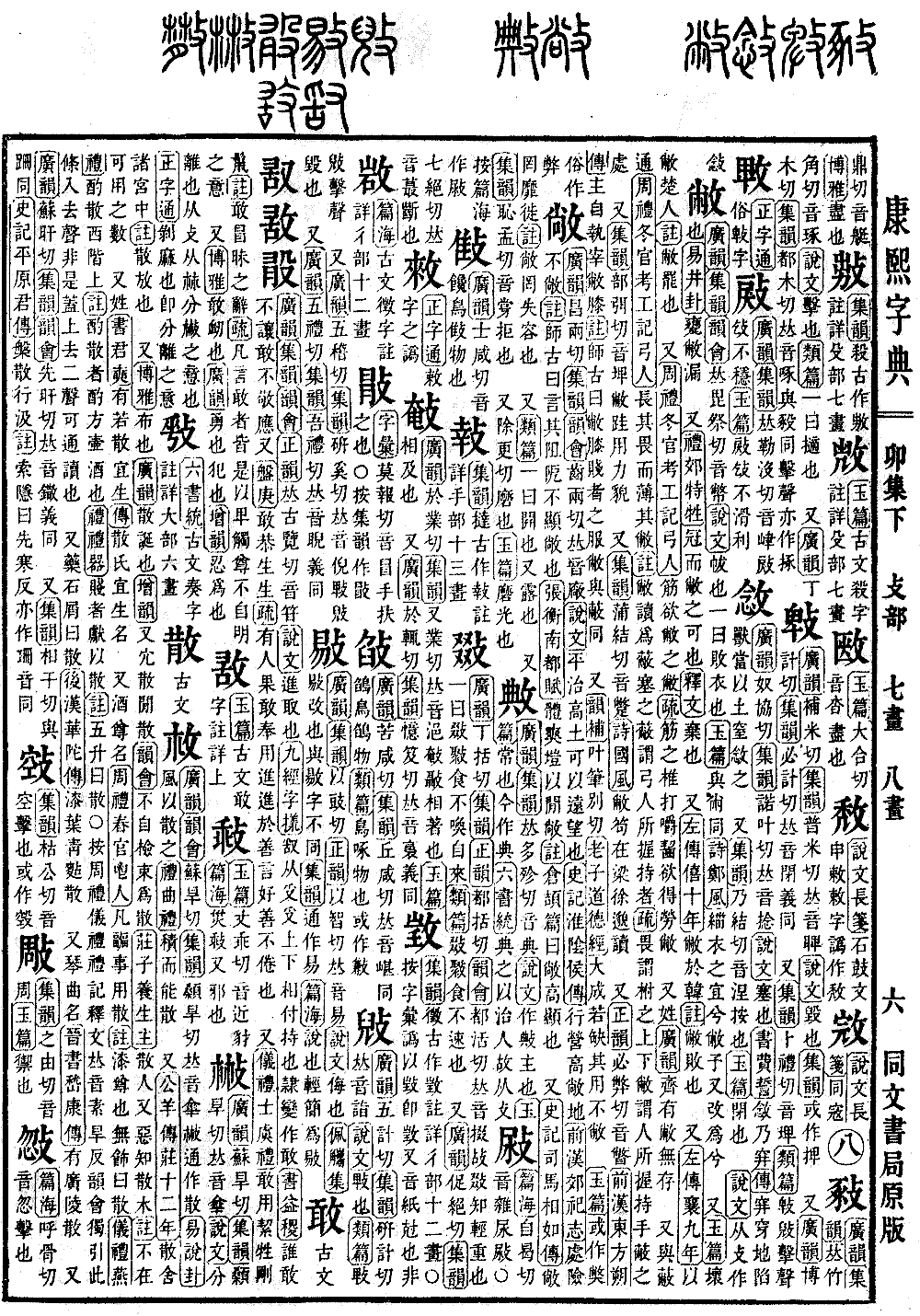
Mao Collection, Lower Volume
Radical: Tapping (pū)
Kangxi Strokes: 12
Page 472, Entry 12
According to the Rhyme Dictionary (Guangyun), pronounced chang (rising tone). According to the Collection of Rhymes (Jiyun) and the Compendium of Rhymes (Yunhui), pronounced chang (rising tone).
According to the Explaining Graphs and Analyzing Characters (Shuowen), it means to level high ground, allowing for a distant view.
In the Records of the Grand Historian (Shiji), Biography of the Marquis of Huaiyin, it says to set up camp on high and spacious ground.
In the History of the Former Han (Qianhan), Treatise on Suburban Sacrifices, it mentions a location that is dangerous and not open. The commentary by Shigu says this refers to being hindered and not clear or open.
In Zhang Heng’s Rhapsody on the Southern Capital (Nandu fu), it says the structures are refreshing, dry, and spacious. The commentary by the Cangsong chapter says that chang means high and conspicuous.
Also, in the Records of the Grand Historian, Biography of Sima Xiangru, it appears in the phrase chang-wang, meaning to lose one's composure.
Additionally, according to the Classified Chapters (Leipian), one meaning is to open. Another meaning is to expose.
According to the Collection of Rhymes (Jiyun), pronounced cheng (rising tone), meaning to resist.
Also pronounced chu (falling tone), meaning to grind. According to the Jade Chapters (Yupian), it means to polish until bright.