Wu Collection, Upper Volume
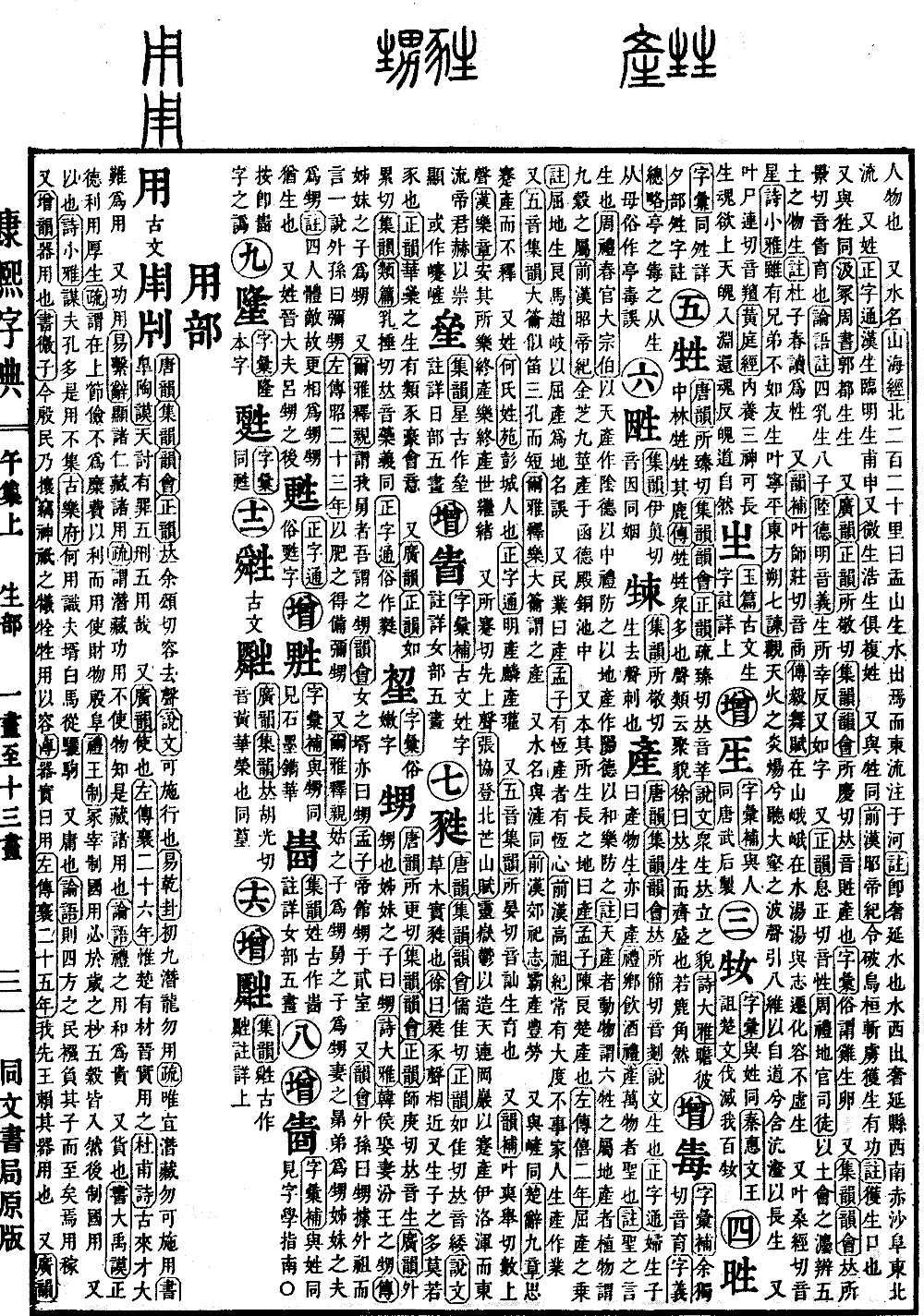
Radical: Life (shēng)
Page 755, Entry 09
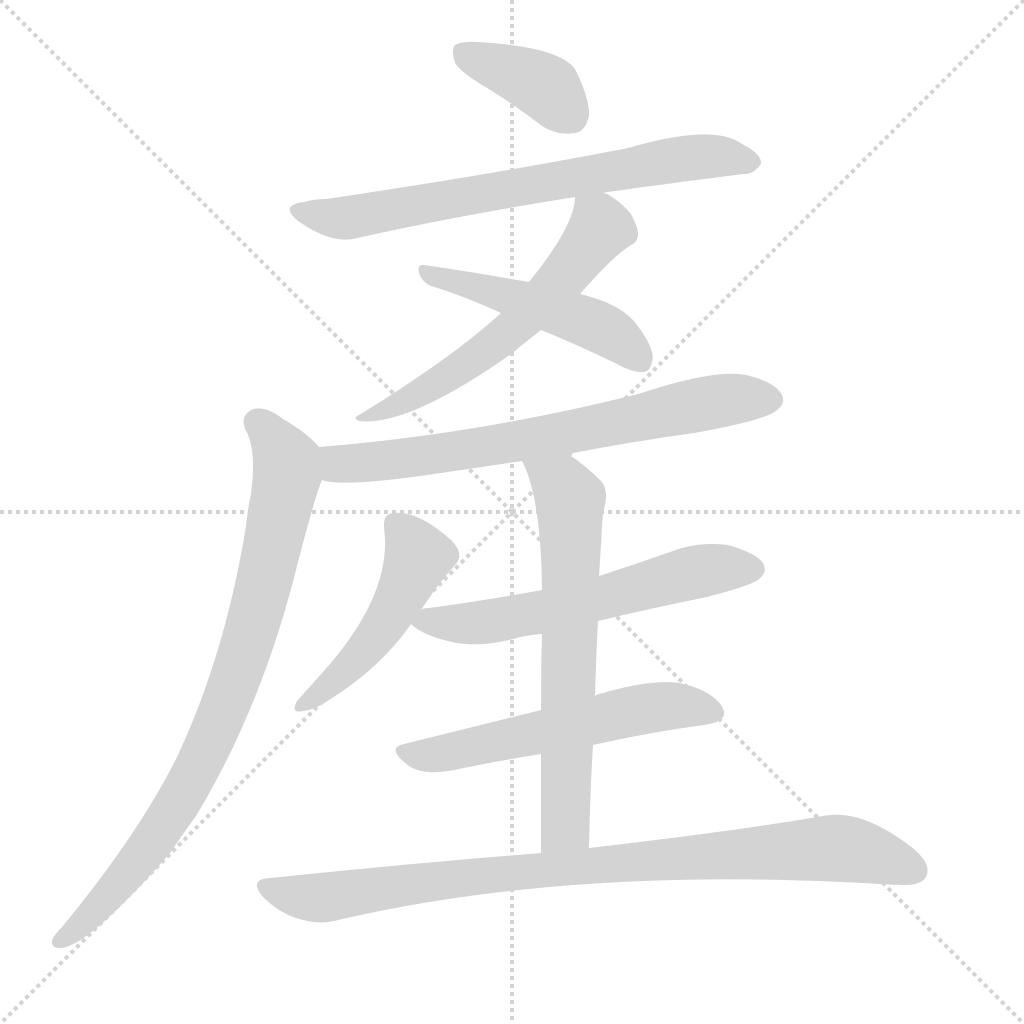
Pronounced chan.
According to the Explaining Graphs and Analyzing Characters (Shuowen Jiezi), it means to give birth.
The Rectification of Character Meanings (Zhengzitong) states that when a woman gives birth to a child, it is called chan; when things are produced, it is also called chan.
In the Book of Rites (Liji), it is written: That which produces the myriad things is the sage. The commentary says: The word sage relates to the meaning of to give birth.
In the Rites of Zhou (Zhouli), regarding the spring official, the Grand Master of Ceremonies: Use the products of heaven to create yin virtue, and guard against them with central rites. Use the products of earth to create yang virtue, and harmonize them with music. The commentary says: Products of heaven refer to animals, such as the six domestic creatures. Products of earth refer to plants, such as the nine types of grain.
In the History of the Former Han (Hanshu), in the annals of Emperor Zhao: Golden mushrooms with nine stalks grew in the bronze pool of the Hande Hall.
It also refers to the place where one is born or grows, known as chan.
In the Mencius (Mengzi): Liang is a native of the state of Chu.
In the Zuo Tradition (Zuozhuan), in the second year of Duke Xi: The horses of the Qu region. The commentary states: Qu is a place that produces good horses. Zhao Qi considered Quchan to be a place name, which is incorrect.
It also refers to a person's livelihood, known as chan.
In the Mencius (Mengzi): Those who have a constant livelihood have a constant heart.
In the History of the Former Han (Hanshu), in the annals of Emperor Gaozu: He always had great magnanimity and did not attend to the production or labor of his family.
According to the Collection of Five Sounds (Wuyin Jiyun), it refers to a large flute-like instrument with three holes and a short body.
In the Erya, concerning the explanation of music: A large flute is called a chan.
It is also a river name, synonymous with the character chan.
In the History of the Former Han (Hanshu), in the Records of Sacrifices: The Ba and Chan rivers flow abundantly.
It is also synonymous with the character chan.
In the Chu Elegies (Chuci), in the Nine Chapters: Thinking is tangled and not released.
It is also a surname.
According to the Garden of Surnames (Heshi Xingyuan): It refers to people from Pengcheng.
The Rectification of Character Meanings (Zhengzitong) mentions Chan Lin and Chan Guan of the Ming Dynasty.
According to the Collection of Five Sounds (Wuyin Jiyun), pronounced shan. It means to give birth.
According to the Supplement to the Rhymes (Yunbu), pronounced jü (rising tone).
In the Han dynasty music archives: Secure in their places, enjoying the final birth, enjoying the final birth, the generations continue the succession.
Also pronounced xian (rising tone).
In the Poem on Ascending North Mang Mountain by Zhang Xie: The spirit peaks rise to touch the heavens, the continuous ridges are jagged and tangled. The Yi and Luo rivers swirl to the east, the imperial ruler is majestic and exalted.
Sometimes written as the character chan.