You Collection, Middle Volume
Radical: Badger (zhì)
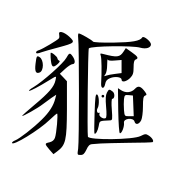
Chu
Kangxi Strokes: 18
Page 1203, Entry 14
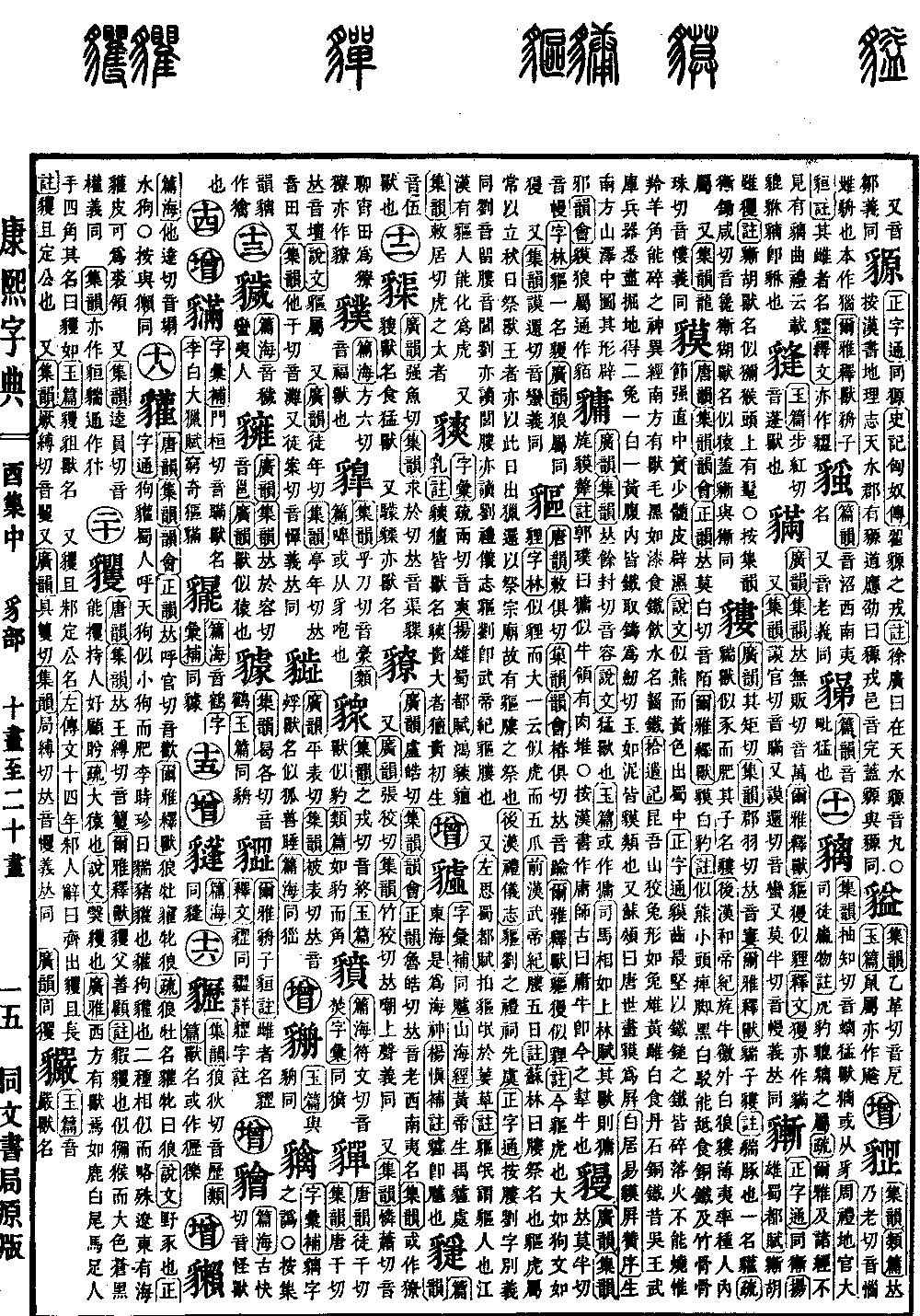
Pronounced chu. According to Tang Rhyme (Tangyun), Collected Rhymes (Jiyun), and Rhyme Compendium (Yunhui), the pronunciation is the same as yu.
Book of Rites (Erya), Chapter on Explaining Beasts: The chu-man is an animal resembling a wildcat. Commentary: It is the modern chu-hu. Its size is like a dog, and its patterns are like a wildcat.
Character Forest (Zilin) records: It resembles a wildcat but is larger. Another source claims it resembles a tiger but has five claws.
History of the Former Han (Qianhan), Annals of Emperor Wu: Records the Lou-wu sacrifice. Commentary: Su Lin explains that lou is a type of sacrifice. Chu belongs to the tiger family. The ancients often sacrificed to the beast deities on the day of the Beginning of Autumn, and the ruler would hunt on this day; upon returning, he would offer the game to the ancestral temple, thus the name chu-lou sacrifice.
Book of the Later Han (Houhan), Records of Rituals: Mentions the chu-liu ritual, which involved sacrificing to the ancient Yu officials.
Correct Character Guide (Zhengtong) notes: The characters lou and liu are different in form but similar in meaning. Liu is pronounced liu, and lou is pronounced lu. Liu can also be pronounced lu, and lou can also be pronounced liu. The chu-liu in the Records of Rituals is the same as the chu-lou in the Annals of Emperor Wu.
Additionally, Zuo Si, Rhapsody on the Capital of Shu (Shudu Fu) writes: Beating the chu-mang in the dense grasses. Commentary: Chu-mang refers to the Chu people. In the regions of the Yangtze and Han rivers, there are Chu people who are able to transform into tigers.
Furthermore, Collected Rhymes (Jiyun) records the pronunciation as chi-ju. It refers to a tiger of exceptionally large size.