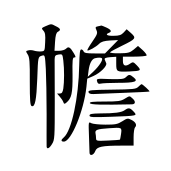
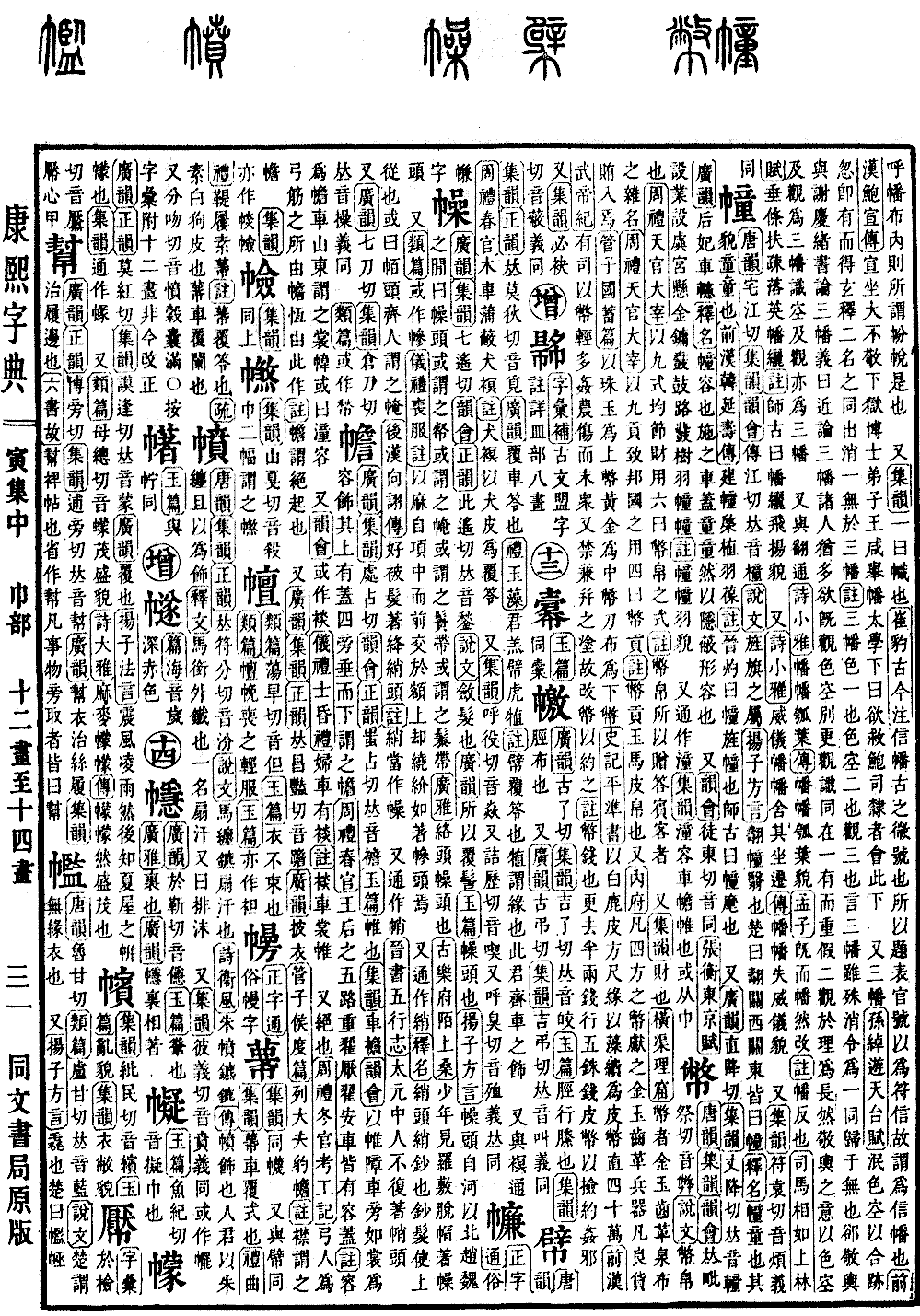
Yin Collection, Middle Volume
Radical: Turban (jīn)
Kangxi Strokes: 16
Page 337, Entry 09
Pronounced chan.
In the Jade Chapters (Yupian), it refers to a curtain or canopy.
In the Collected Rhymes (Jiyun), it refers to a carriage curtain.
In the Rhyme Encyclopedia (Yunhui), it refers to curtains used to shield the sides of a carriage, resembling a skirt or garment, which serves as a decorative accessory. It possesses a carriage canopy on top, with the sides hanging down; this is called a chan.
In the Rites of Zhou (Zhouli), Spring Offices section, it is stated that the five types of carriages for the Queen—the Chongdi, Yandi, and Anche—all possess rong covers. The commentary notes that rong refers to the chan carriage, known in the Shandong region as a shangwei or alternatively as tongrong.
Also, according to the Rhyme Encyclopedia (Yunhui), it is sometimes written in a variant form (chan).
In the Book of Etiquette and Ceremonial (Yili), regarding the marriage rites of scholars, it is noted that a woman's carriage possesses a chan. The commentary explains that chan refers to the curtains on a carriage.
It also carries the meaning of being broken or severed.
In the Rites of Zhou (Zhouli), Winter Offices, Artificers' Record (Kaogongji), it states that for those who make bows, the places where sinew is used are where breakage often occurs. The commentary explains that chan refers to a protrusion caused by such a break.
Also pronounced chang.
In the Expanded Rhymes (Guangyun), it refers to wearing clothing draped over the shoulders.
In the Guanzi, section on Regulation and Measurement (Kuidu pian), it states that high-ranking officials used leopard skin for their garment lapels. The commentary explains that these lapels are called chan.
In the Collected Rhymes (Jiyun), it is also written in a variant form.
Textual verification: In the Rites of Zhou (Zhouli), Spring Offices, the commentary originally read guest; it has been corrected to refer to. In the Guanzi, section on Regulation and Measurement (Kuidu pian), the text originally read leopard chan; it has been corrected to read the standard text.