Xu Collection, Upper Volume
Radical: Metal (jīn)
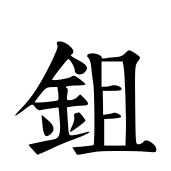
Character: Chu
Kangxi Stroke Count: 13
Page 1301, Entry 05
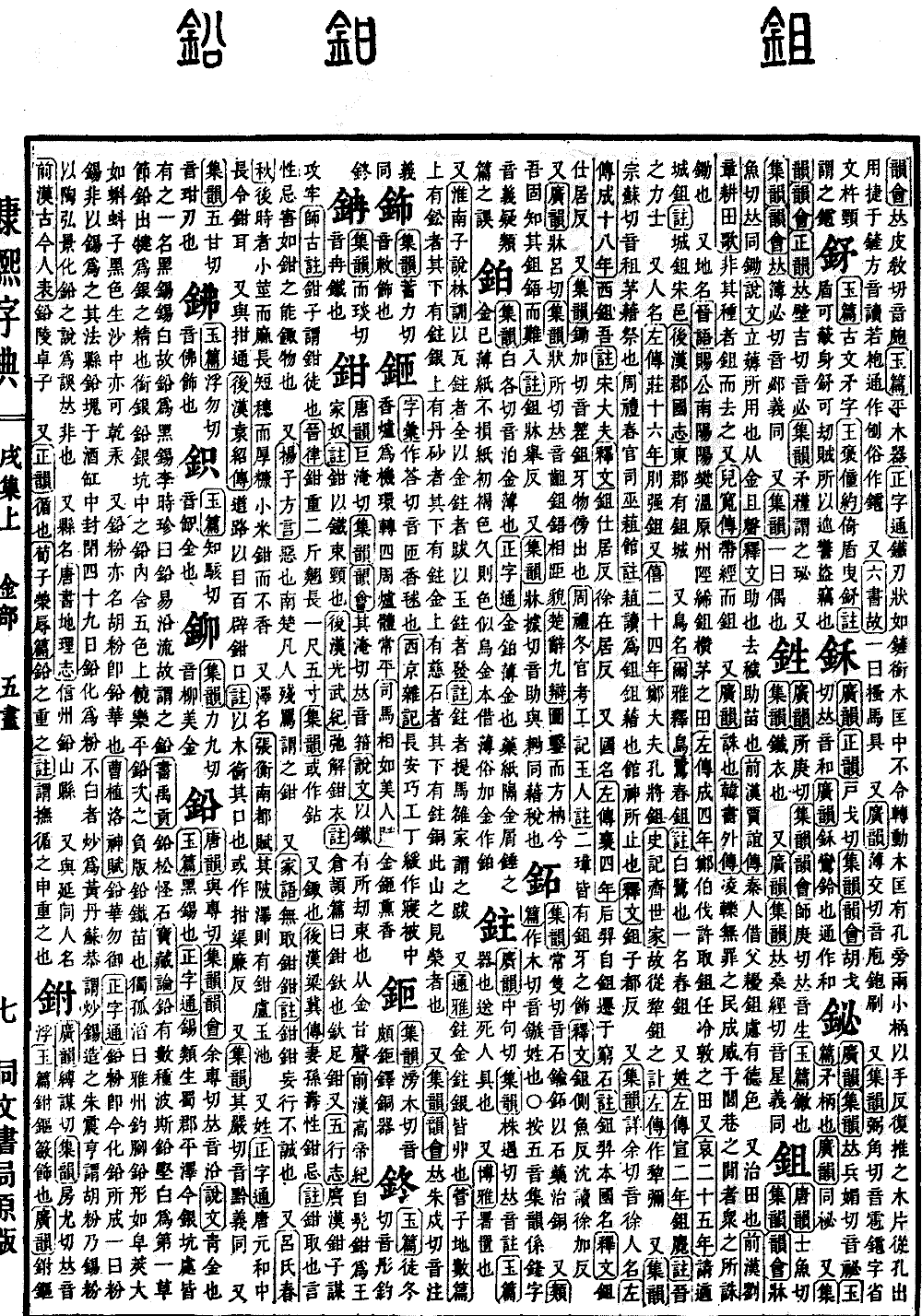
Pronounced yu. In Collected Rhymes (Jiyun) and Rhyme Anthology (Yunhui), pronounced chu. Equivalent to the character meaning hoe.
According to Explanation of Simple and Compound Characters (Shuowen): An implement used for weeding while standing. Composed of the radical for metal and a phonetic component. According to Classical Explanations (Shiwen): To assist. Meaning to remove weeds to assist the crops.
In the Biography of Jia Yi in the History of the Former Han (Qianhan): The people of Qin would lend their hoes and cultivators, and then act as if they had done a great favor.
Also means to till the fields. In the Song of Plowing by Liu Zhang in the History of the Former Han: Those that are not of the correct seed, hoe them and remove them.
Also in the Biography of Er Kuan: Carrying a classic while hoeing.
Also, according to Broad Rhymes (Guangyun): To punish or execute. In the Han Poetry Exegesis (Hanshi Waizhuan): Those who oppress the innocent to build prestige in the village lanes are those whom the masses will execute and eliminate.
Also a place name. In the Discourses of Jin (Jinyu): Bestowed upon the Duke the fields of Nanyang, Yangfan, Wen, Yuan, Zhou, Xing, Chi, Chu, Zan, and Mao.
In the Zuo Commentary to the Spring and Autumn Annals (Zuozhuan), Fourth Year of Duke Cheng: The Earl of Zheng attacked Xu and took the fields of Chu, Ren, Leng, and Dun.
Also in the Twenty-fifth Year of Duke Ai: Requesting to head to the city of Chu. Commentary: Chu City is a town in the state of Song.
In the Treatise on Geography from the History of the Later Han (Houhan): Dong Commandery contains the city of Chu.
Also a name for a bird. In the Literary Expositor (Erya), Interpretation of Birds: The heron is called the chong-chu. Commentary: It is the white heron, also known as the chong-chu.
Also a surname. In the Zuo Commentary, Second Year of Duke Xuan: Chu Ni. Commentary: A strong warrior of Jin.
Also a personal name. In the Zuo Commentary, Sixteenth Year of Duke Zhuang: Yue Qiangchu.
Also in the Twenty-fourth Year of Duke Xi: The Zheng official Kong Jiangchu. In the Records of the Grand Historian (Shiji), Annals of Qi: Hence followed the plan of Li Chu. The Zuo Commentary writes this as Li Mi.
Also, according to Collected Rhymes (Jiyun): Pronounced zu. Refers to a reed mat used in rituals. In the commentary to the Official of Divination in the Spring Offices of the Rites of Zhou (Zhouli): The term zu is read as chu. Chu means a mat, a place where the spirits reside.
Also, according to Collected Rhymes (Jiyun): Pronounced xu. A personal name. In the Zuo Commentary, Eighteenth Year of Duke Cheng: Xi Chuwu. Commentary: An official of the state of Song.
Also a state name. In the Zuo Commentary, Fourth Year of Duke Xiang: Hou Yi moved from Chu to Qiongshi. Commentary: Chu-Yi was the original name of the state.
Also, according to Collected Rhymes (Jiyun): Pronounced cha. Chu-ya refers to things protruding from the side. In the commentary to the Artificers Record in the Rites of Zhou: Two ritual jades, both with chu-ya decorations.
Also, according to Broad Rhymes (Guangyun): Pronounced ju. In the form chu-yu, meaning resisting or clashing. In the Nine Arguments (Jiubian) of the Songs of Chu (Chuci): Round mortises and square tenons, I have always known they would clash and be difficult to join.
Also, according to Collected Rhymes (Jiyun): Pronounced zhu. Equivalent to the character for land tax.
Verification note: In the citation of Han Poetry Exegesis (Hanshi Waizhuan), the original text has been corrected from History of Han (Hanshu) to Han Poetry Exegesis (Hanshi) in accordance with the original source.