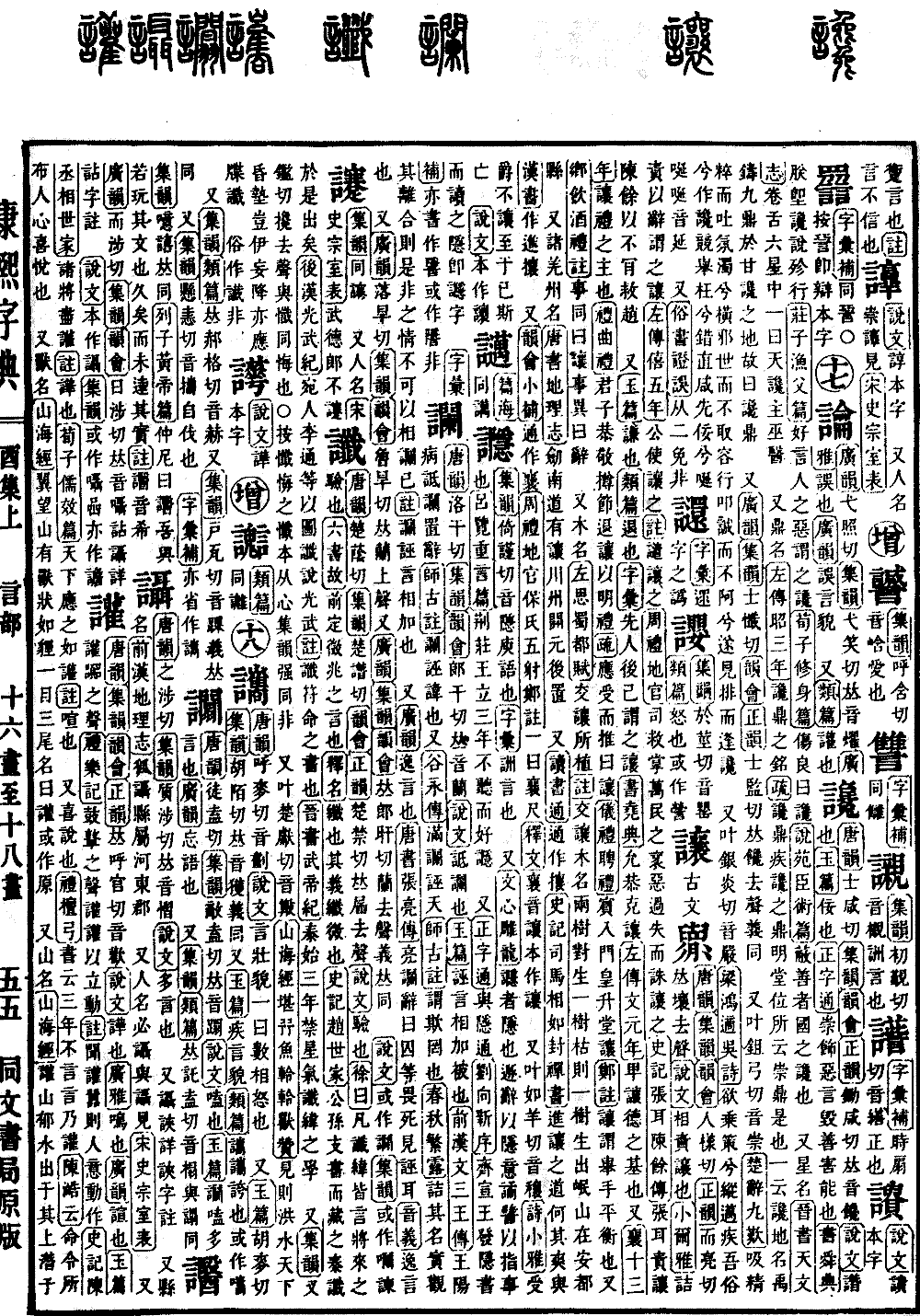
You Collection, Upper Volume
Radical: Speech (yán)
Kangxi Strokes: 24
Page 1187, Entry 18
Pronounced chen (falling tone).
According to the Shuo Wen Jiezi (Shuowen), it means an omen that is fulfilled.
Xu Kai stated that all theories of prophetic omens (chenwei) refer to predictions of future events that will be verified.
According to the Liu Shu Gu, these are words that predict future signs of good or bad fortune.
According to the Shi Ming, it refers to things that are subtle, implying that the meaning is profound and mysterious.
In the Records of the Grand Historian (Shiji), Zhao Family, it is written that Gongsun Zhi recorded and stored them, and thus the prophetic omens of the Qin state were handed down.
In the Book of the Later Han (Hou Hanshu), Biography of Emperor Guangwu, it is noted that Li Tong of Wancheng and others used prophetic diagrams (tuchen) to advise Emperor Guangwu.
The commentary explains that these are books containing predictions of the Mandate of Heaven and auspicious signs.
In the Book of Jin (Jinshu), Biography of Emperor Wu, it is noted that in the third year of Taishi, studies concerning astrology, astronomical phenomena, and prophetic omens were prohibited.
Also, according to the Jiyun, it is pronounced chan (falling tone). It is identical to the character meaning to repent (chan). Note: The character for repentance originally used the heart radical; the claim in the Jiyun that these are identical is incorrect.
Also rhyming as chen (falling tone).
From the Classic of Mountains and Seas (Shanhaijing), Praise of the Kanyu Lingling Beast: When it appears, it causes flooding, and the world falls into chaos and suffering. Is it not that it descends recklessly? This also fulfills the prediction.
Commonly written as a variant form, but this is incorrect.