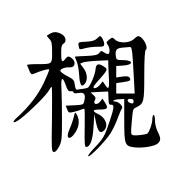
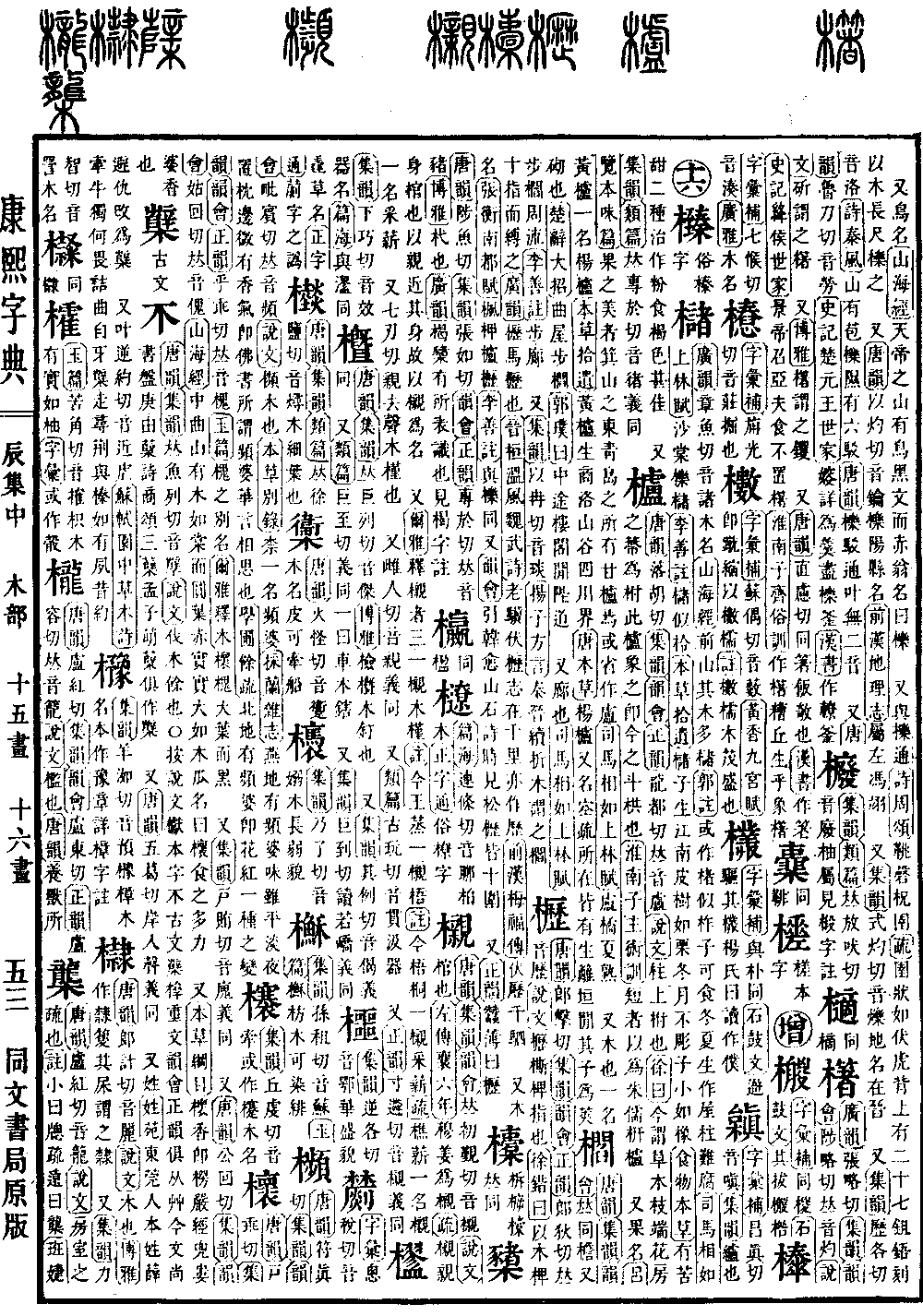
Chen Collection, Middle Volume. Radical: Tree (mù). Character: chen. Kangxi stroke count: 20. Page 561, Entry 21.
According to the Tang Rhyme (Tangyun), Collected Rhymes (Jiyun), and Rhyme Meeting (Yunhui), the pronunciation is chen (falling tone).
According to the Explaining Graphs and Analyzing Characters (Shuowen Jiezi), it refers to a coffin. In the Commentary on the Zuo (Zuo Zhuan), second year of Duke Xiang, it is recorded: "Mu Jiang had a coffin prepared." The sub-commentary explains that the term chen refers to a coffin that is in close proximity to the body; because it is held near the body, it is named chen.
Additionally, in the Literary Expositor (Erya), there are three definitions for chen: First, chen refers to the rose of Sharon (mùjǐn). The commentary notes it is currently known as wangzheng. Second, chen refers to the parasol tree (wútóng). The commentary notes it is currently known as the wutong tree. Third, chen refers to gathered firewood. The sub-commentary explains that firewood used for fuel is called both chen and gathered firewood.
It is also pronounced qin (falling tone), referring to the rose of Sharon. It is also pronounced qin (level tone), with the same meaning.
According to the Classified Chapters (Leipian), it is pronounced guan, referring to a vessel for drawing water.
According to the Correct Rhymes (Zhengyun), it is pronounced chen (falling tone), with the same meaning.
Textual Research: In the Commentary on the Zuo (Zuo Zhuan), sixth year of Duke Xiang, it is recorded: "Mu Jiang had a coffin prepared." In accordance with the original text, the year has been corrected from six to two.