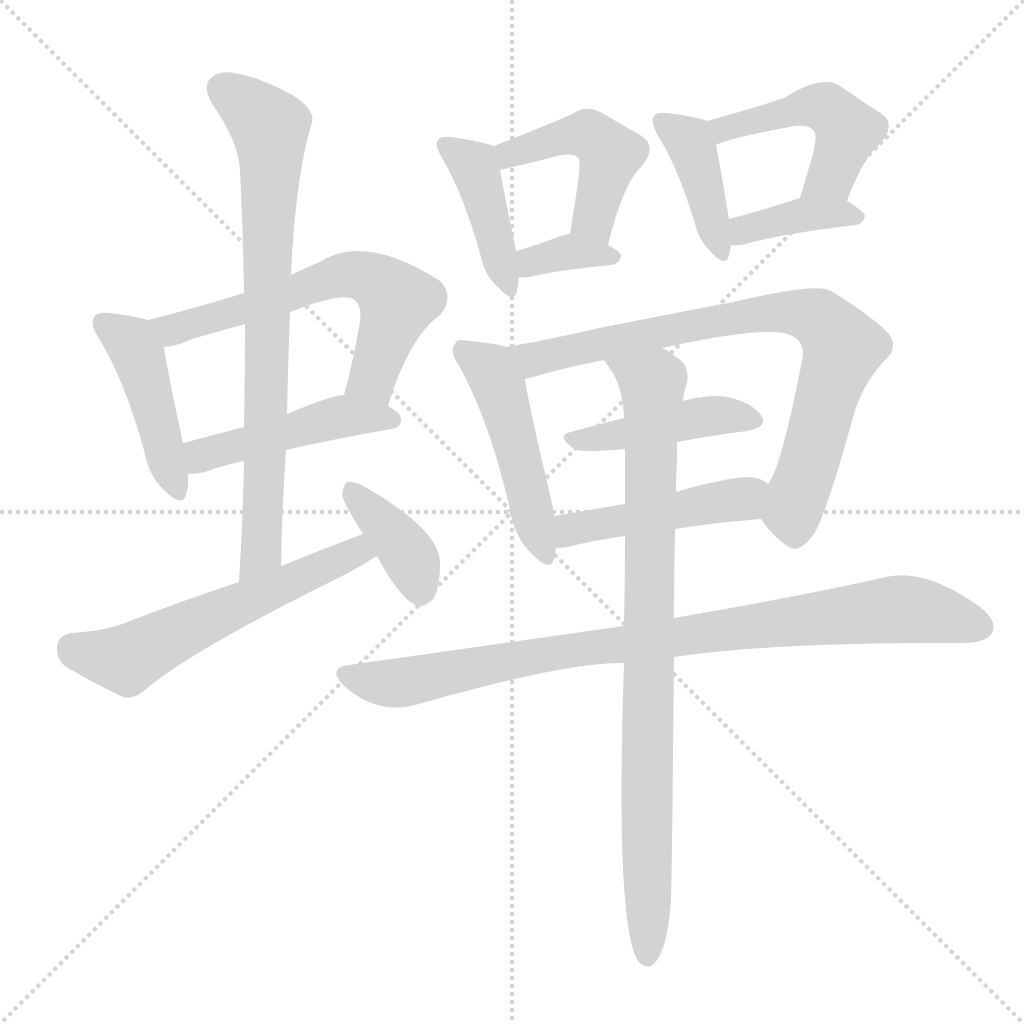
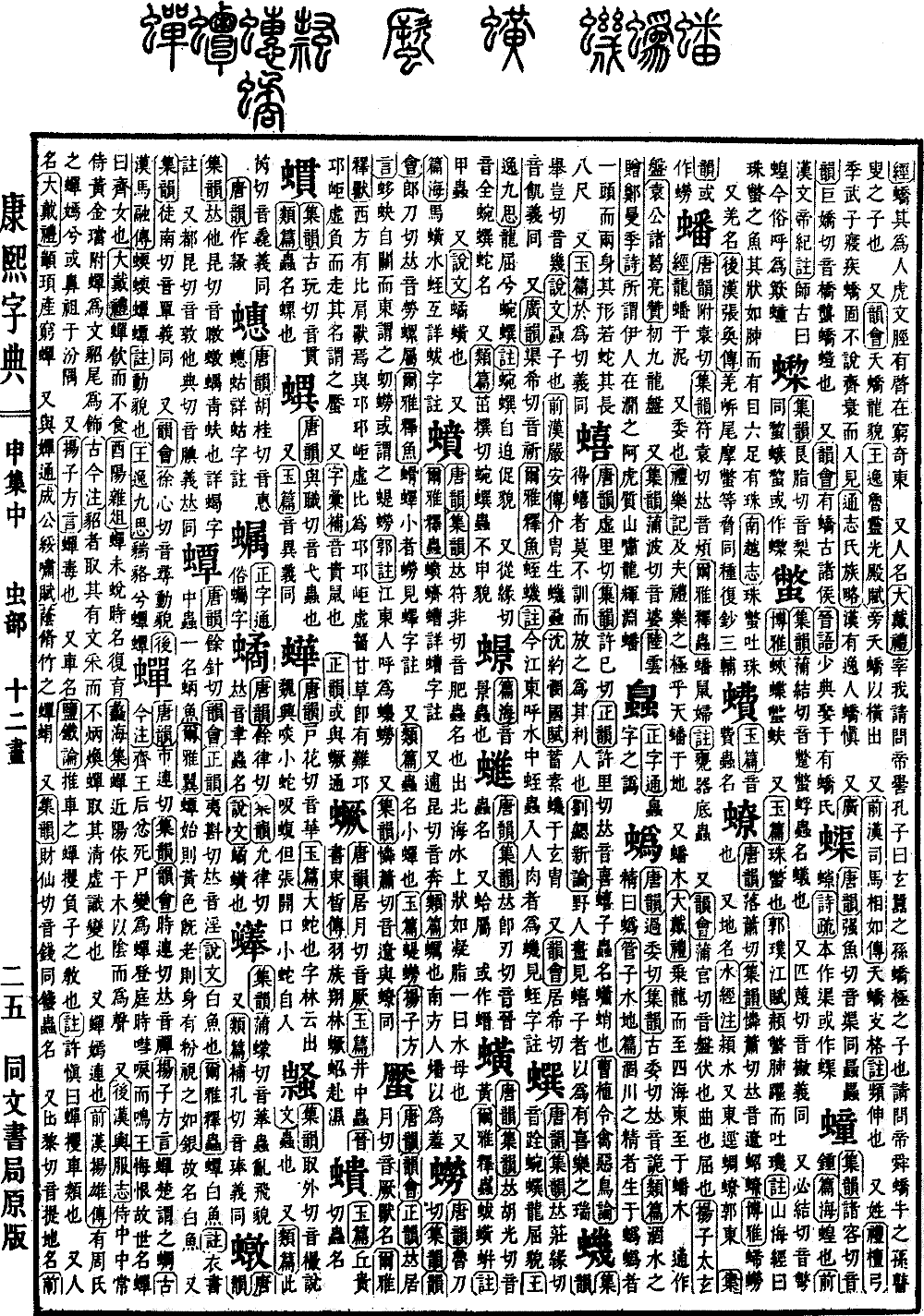
Shen Collection, Middle Volume. Radical: Insect (chóng). 18 strokes. Page 1097, Entry 31.
Tang Rhymes (Tangyun): Pronounced chan (level tone). Collected Rhymes (Jiyun) and Rhyme Collection (Yunhui): Pronounced chan (level tone).
Yangzi Dialect (Fangyan): The cicada is known as tiao in the Chu region.
Notes on Ancient and Modern Times (Gujin Zhu): The Queen of Qi died holding onto her resentment, and her body transformed into a cicada. It flew into the courtyard and sang with a shrill, chirping sound, causing the King of Qi to feel endless regret; therefore, people of the world call the cicada the Qi woman.
Record of Rites by Dai the Elder (Da Dai Liji): The cicada drinks only dew and consumes no food.
Miscellaneous Morsels from Youyang (Youyang Zazu): Before the cicada sheds its skin, it is called a fuyu.
Collection of Lihai (Lihai Ji): The nature of the cicada is close to yang, and it clings to trees, relying on yin energy to produce its sound.
History of the Later Han (Hou Hanshu): Records of Carriages and Clothing (Yufu Zhi): The golden pendants worn by attendants and regular attendants were decorated with cicada motifs and adorned with marten tails.
Notes on Ancient and Modern Times (Gujin Zhu): The selection of the marten is intended to represent possessing refined talent without being ostentatious. The selection of the cicada is intended to represent purity, emptiness, and the ability to foresee change.
Also, chanyan refers to that which is continuous and unbroken.
History of the Former Han (Qian Hanshu): Biography of Yang Xiong: There is the Zhou clan, continuous and unbroken, with some ancestors originating from the banks of the Fen River.
Yangzi Dialect (Fangyan): Cicada also denotes poison.
It also refers to a type of carriage.
Discourses on Salt and Iron (Yantielun): The pushcart known as a chanjue is intended to instruct people in carrying children on their backs. Note: Xu Shen says a chanjue is a type of carriage.
It also serves as a personal name.
Record of Rites by Dai the Elder (Da Dai Liji): Zhuanxu gave birth to Qiongchan.
It is also used interchangeably with chan (graceful).
Cheng Gongsui: Rhapsody on Whistling (Xiao Fu): Shaded and hidden within the graceful and beautiful appearance of tall bamboos.
Collected Rhymes (Jiyun): Pronounced qian (level tone). Same as a variant form, the name of an insect.
Pronounced ti (level tone). A place name.
History of the Former Han (Qian Hanshu): Treatise on Geography (Dili Zhi): In Lelang Commandery there is a Nianchan County.
Corrected Rhymes (Zhengyun): Pronounced shan (level tone). Wanchan, describing something spiraling and winding.
Wang Yi: Nine Longings (Jiusi): Riding six flood dragons as they wind and spiral. Note: Describes the appearance of numerous flood dragons. Sometimes written as a variant form (shan).