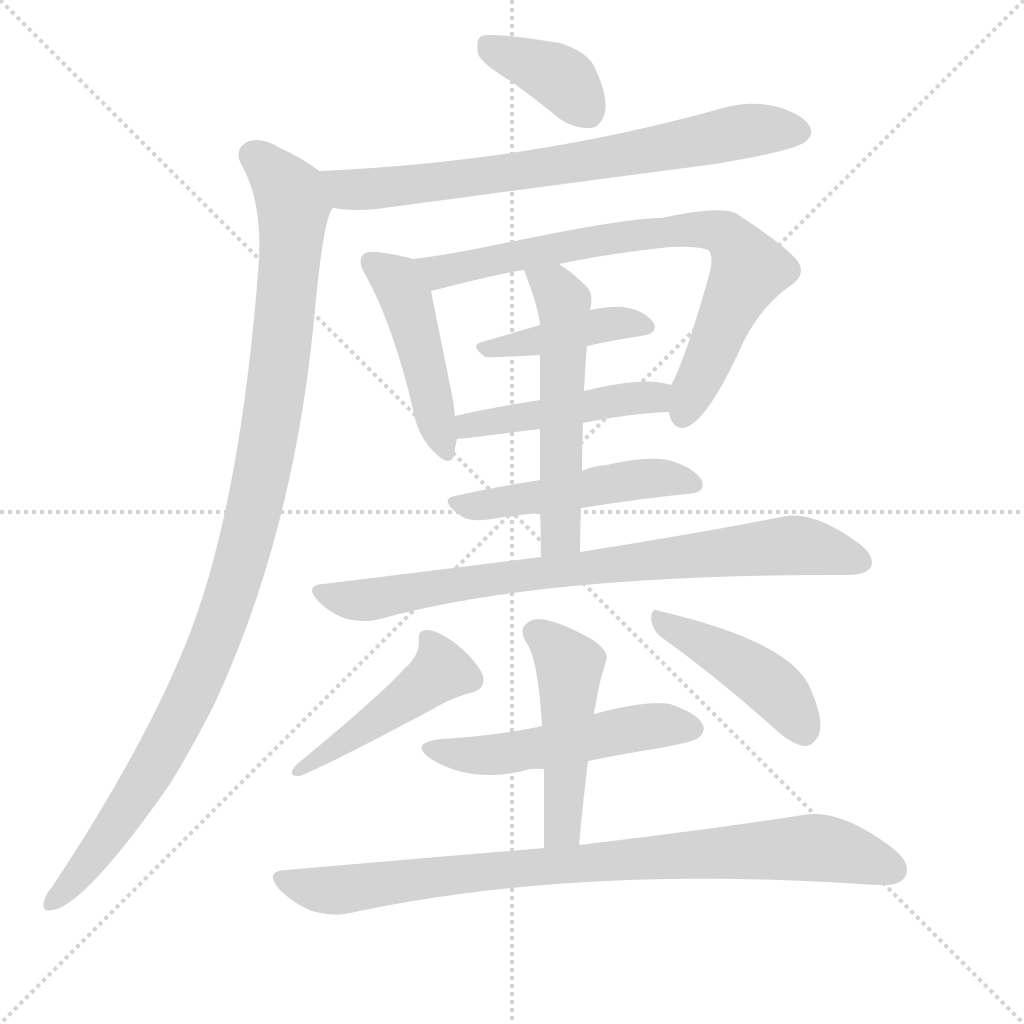
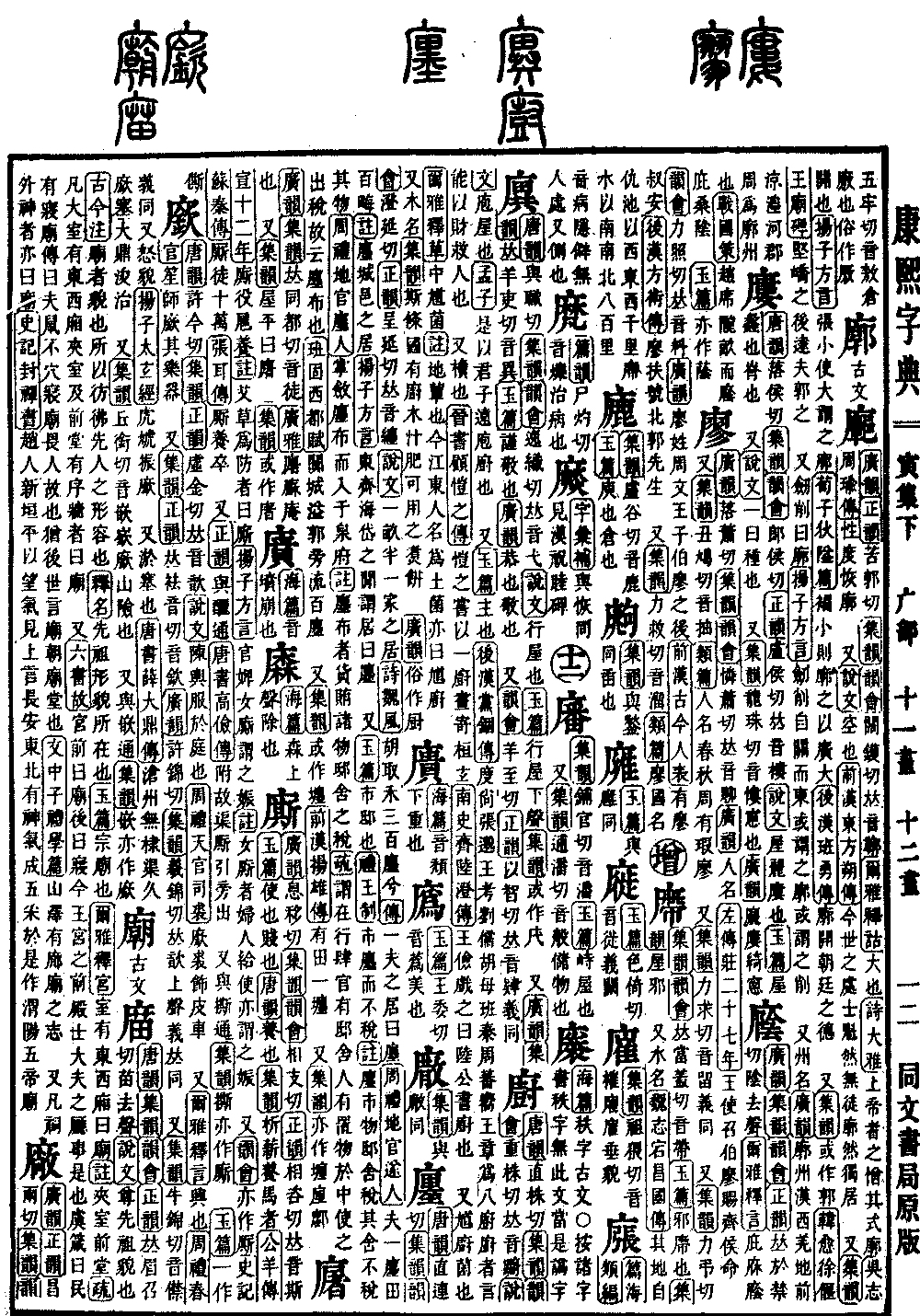
Yin Collection, Lower Volume
Radical: Wide (guǎng)
Kangxi stroke count: 15
Page 350, Entry 22
Pronounced chan.
According to the Explaining Graphs and Analyzing Characters (Shuowen Jiezi), a measurement of one and a half mu, the residence of one household.
In the Book of Odes (Shijing), in the section Wei Wind (Wei Feng), it says: Why take three hundred bundles of grain from the residence? The Commentary (Zhuan) states: The residence of a husbandman is called a chan.
In the Rites of Zhou (Zhouli), Earth Offices, Officer of the Sui (Suiren): A husbandman has one chan and one hundred mu of fields. The Note (Zhu) says: A chan is a residence within a city wall.
In the Book of Dialects (Fangyan) by Yang Xiong: Between the eastern Qi and the Hai-Dai regions, a residence is called a chan.
Also, according to the Jade Chapters (Yupian), it is a market shop.
In the Book of Rites (Liji), Royal Regulations (Wangzhi): Tax the market shop but not the goods. The Note (Zhu) says: The chan is a room in the market for storing goods; only the room tax is levied, not the goods tax.
In the Rites of Zhou (Zhouli), Earth Offices, Market Official (Chanren): Manage the collection of chan cloth taxes and deposit them into the treasury. The Note (Zhu) says: Chan cloth refers to the tax paid for storing goods in government-provided rooms. The Sub-commentary (Shu) explains: This refers to the market where the government provides rooms; merchants store their goods there and pay taxes, thus it is called chan cloth.
In Ban Gu’s Western Capital Rhapsody (Xidu Fu): Filling the city and overflowing the walls, spreading out into hundreds of shops.
Also, according to the Collection of Rhymes (Jiyun), it is sometimes written as a variant form.
In the History of the Former Han (Qian Hanshu), Biography of Yang Xiong: Having one field of chan.
Also, according to the Collection of Rhymes (Jiyun), it is also written as chan.