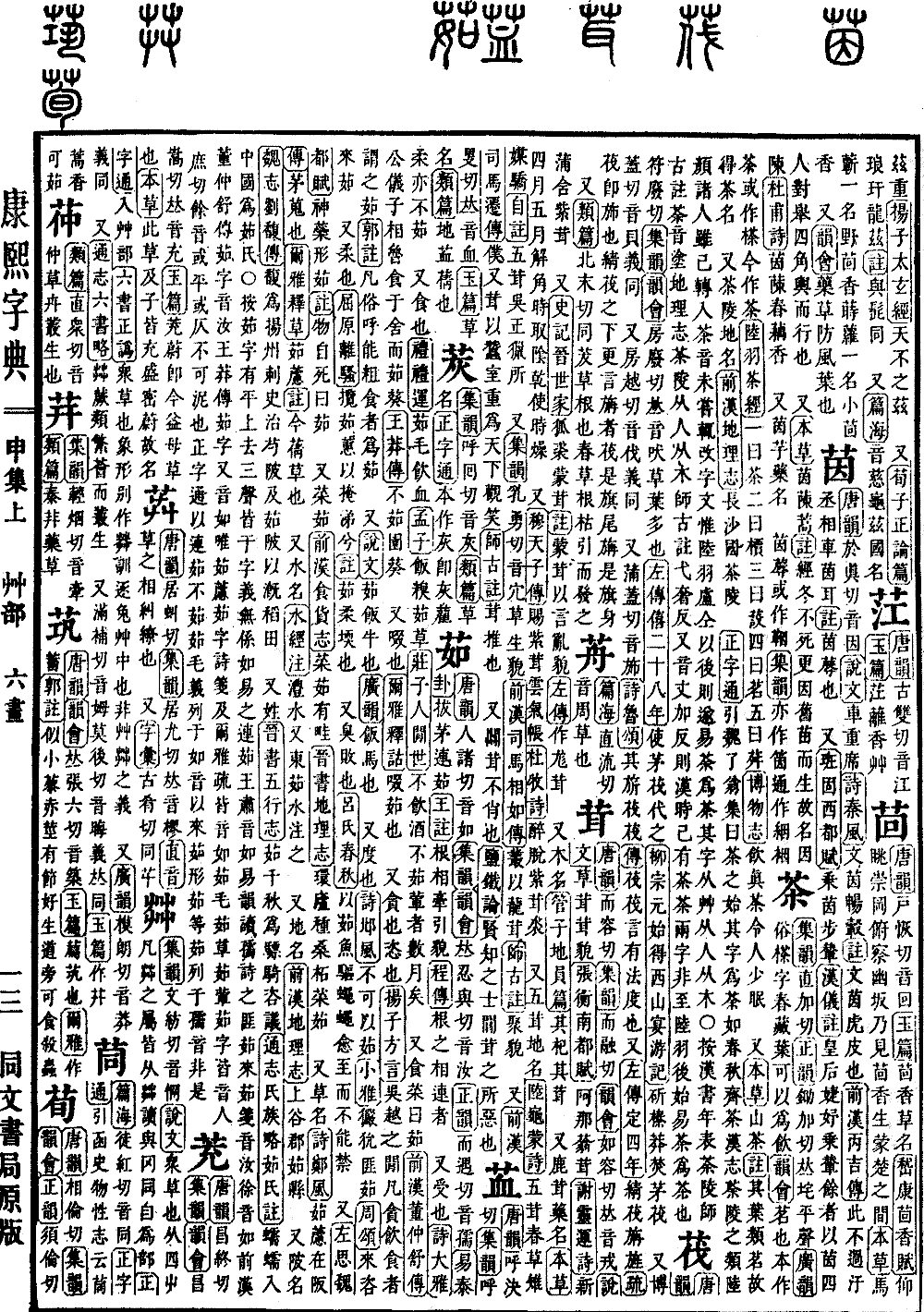
Shen Collection, Upper Volume
Radical: Grass (cǎo)
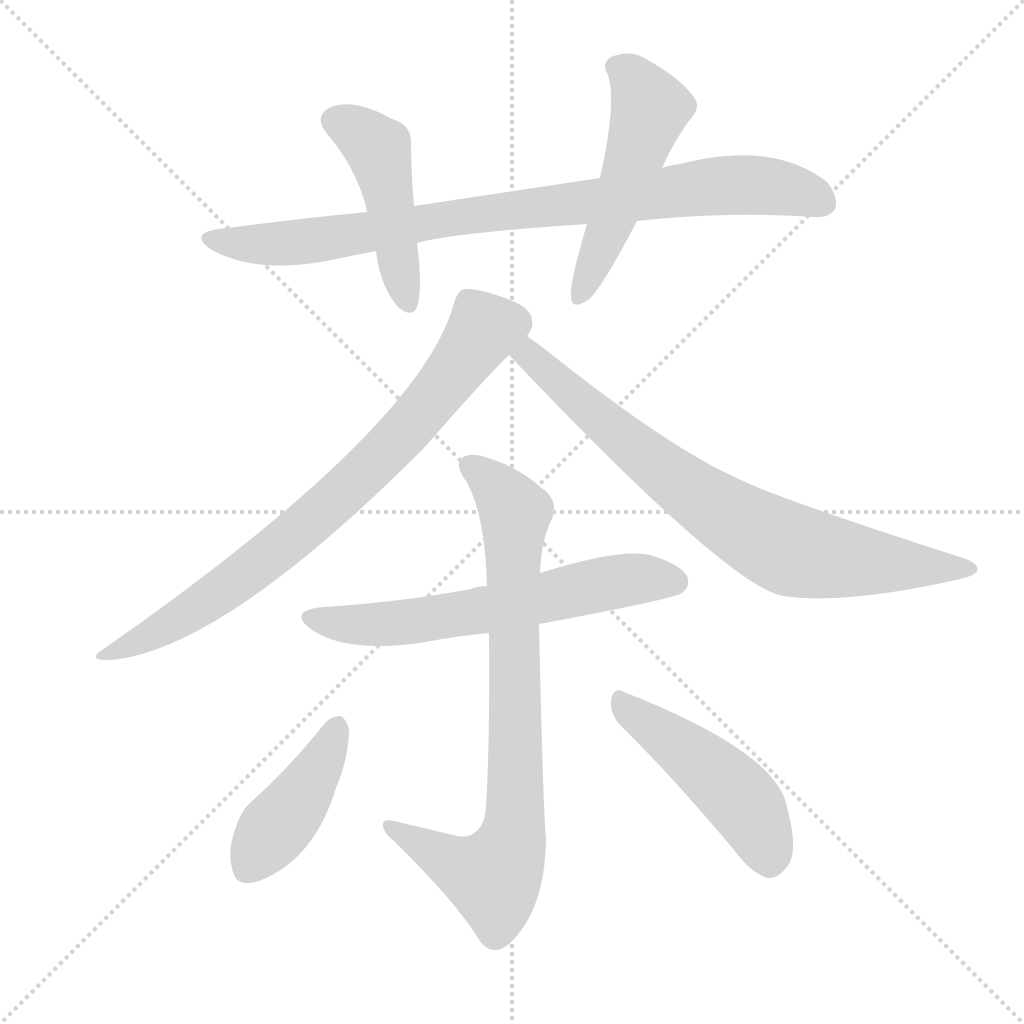
Tea
Kangxi stroke count: 12
Page 1029, Entry 04
Collected Rimes (Jiyun): Pronounced zha.
Correct Rimes (Zhengyun): Pronounced zha, with the same sound as the level tone of cha.
Expanded Rimes (Guangyun): This is a common variant form. Leaves collected in spring can be made into a beverage.
Collection of Rimes (Yunhui): It is the same as ming (tea leaves). Originally written as tu, sometimes written as a variant form, and now written as cha.
Lu Yu, Classic of Tea (Chajing): The first type is called cha, the second type is called jia, the third type is called she, the fourth type is called ming, and the fifth type is called chuan.
Records of General Observations (Bowuzhi): Drinking true tea reduces the need for sleep.
Also, Materia Medica (Bencao): Includes mountain tea.
Annotation: Its leaves are similar to ming, which is how it received the name cha.
There is also Chaling, which is a place name.
History of the Former Han (Qianhan), Treatise on Geography (Dilizhi): Changsha Kingdom contains Chaling.
General Explanation of Characters (Zhengzitong): Citing the Collection of Wei Liaoweng: When the character for tea first appeared, its form was tu, such as in the case of Qi Tu in the Spring and Autumn Annals (Chunqiu) or Tu Ling in the Han Treatise (Hanzhi). Although Lu Deming and Yan Shigu already pronounced it with the sound of cha, they did not arbitrarily alter the character form. It was only after Lu Yu and Lu Tong that tu was changed to cha. This character is composed of grass, person, and wood. According to the Chronological Tables in the History of the Han (Hanshu), it is written as Tu Ling. Shigu’s annotation: Tu is pronounced with the sound of tu. In the Treatise on Geography (Dilizhi), the character cha in Chaling is formed with the components for person and wood. Shigu’s annotation: Pronounced ye, and also pronounced zhang jia. Thus, both the characters tu and cha already existed during the Han dynasty; it is not the case that the change from tu to cha only began after Lu Yu.