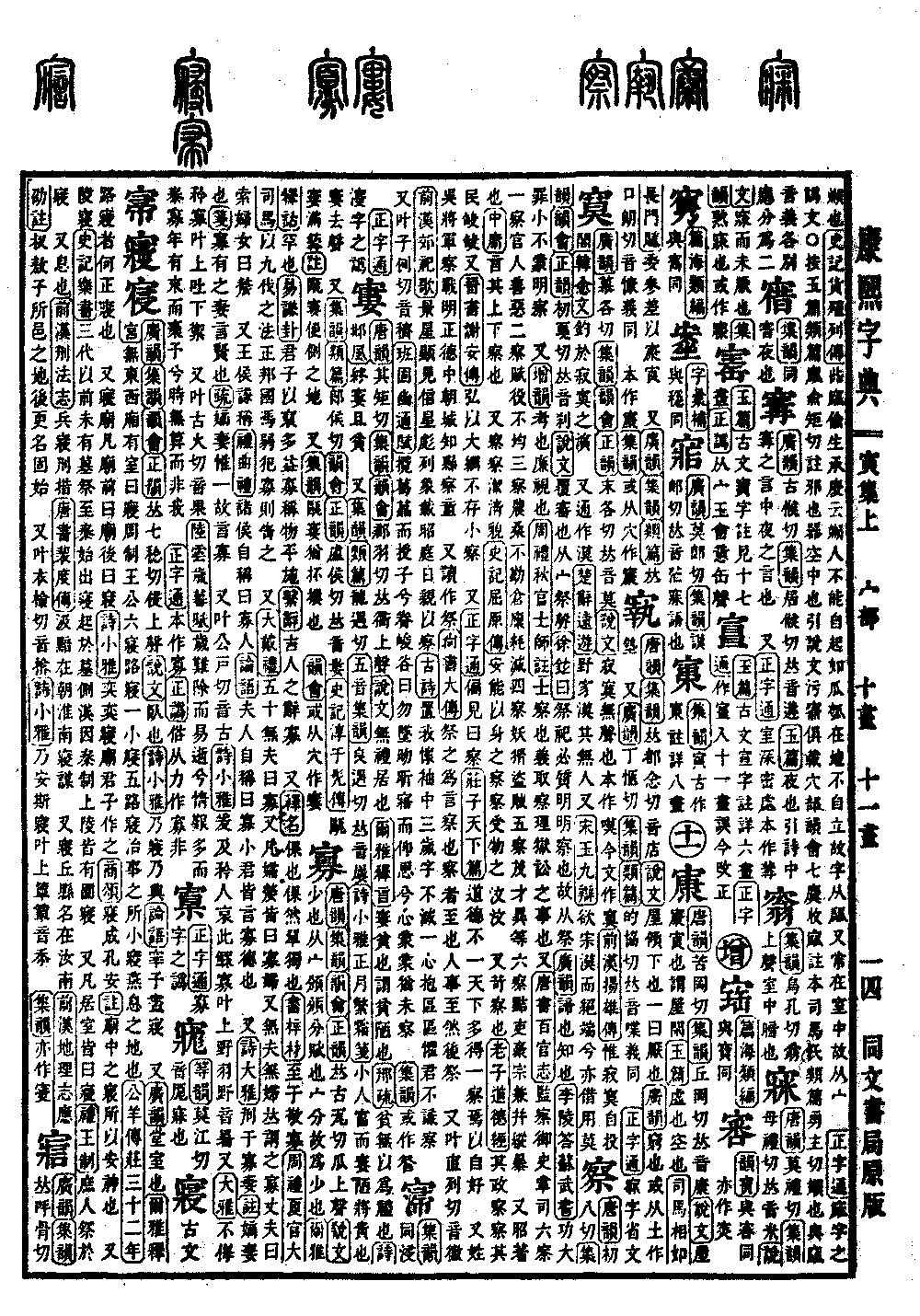
Yin Collection, Upper Volume
Radical: Roof (bù)
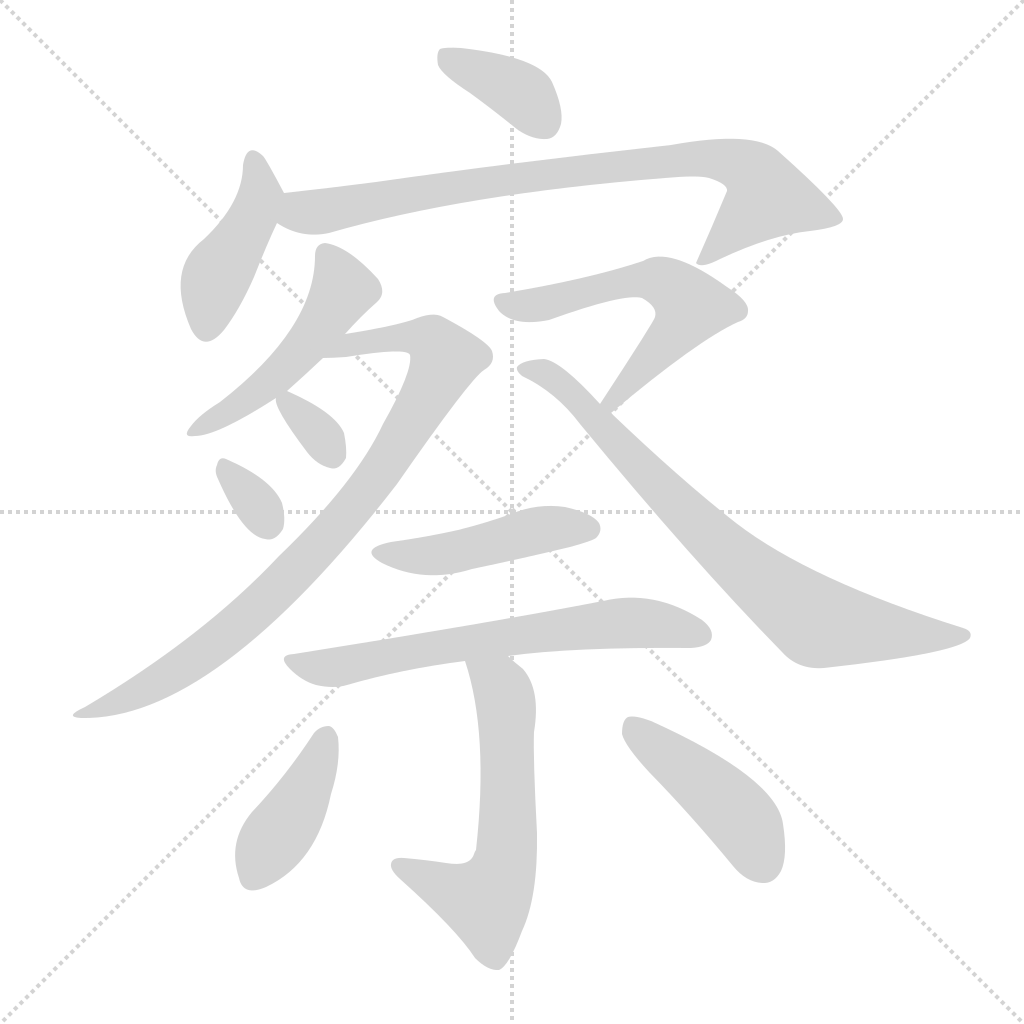
Character: Cha
Kangxi Dictionary strokes: 14
Page 290, Entry 16
Pronounced cha. In the Explaining and Analyzing Characters (Shuowen Jiezi), it means to review or investigate. Derived from Roof (radical) and Ji (phonetic). Xu Xuan says that for ancestral sacrifices, one must verify the brightness; brightness is investigation, hence it is derived from sacrifice.
According to the Guangyun, it means to scrutinize or to know. In the Letter to Su Wu (Da Su Wu Shu) by Li Ling, it is written: Although the merit was great and the crime small, I did not receive a clear investigation. According to the Zengyun, it also means to examine or to look closely. In the Rites of Zhou (Zhouli), Autumn Official, Master of Officials commentary, it states that the title of the official implies investigation, as the meaning is derived from investigating and managing legal cases.
In the History of Tang (Tangshu), Treatise on Officialdom, the Censor-in-chief is described as being in charge of the six investigations: first, investigating the good and evil of officials; second, investigating inequalities in taxes and labor; third, investigating neglect in agriculture and sericulture, and losses in granaries; fourth, investigating bandits and evildoers; fifth, investigating talented individuals; sixth, investigating corrupt officials and powerful clans who engage in annexation and violence.
It also means to manifest or make clear. In the Doctrine of the Mean (Zhongyong), it says: Speak of how it is manifest from top to bottom. It also describes a clean and pure appearance. In the Biography of Qu Yuan in the Records of the Grand Historian (Shiji), it is written: How can I, with my pure body, endure the filth of the world?
It also refers to being overly fastidious. In the Classic of the Way and Virtue (Daodejing), it states: When the government is overly fastidious, the people are impoverished. In the Biography of Xie An in the Book of Jin (Jinshu), it is written: He was magnanimous with general principles and did not dwell on petty investigations.
According to the Zhengzitong, partial views are called cha. In the Zhuangzi, Chapter on All Under Heaven (Tianxia), it is written: The Way and Virtue are not unified; those under heaven often grasp one part and delight in their own narrow investigation.
It is also a surname. There was the Wu General Cha Zhan, and in the Zhengde period of the Ming dynasty, there was Cha Tong, a magistrate of Chaocheng.
It is also pronounced ji. In the Book of Documents Commentary (Shangshu Dazhuan), it is written: To sacrifice is to investigate; investigation means to arrive, as human affairs must arrive before a sacrifice is performed.
It also rhymes with che. In the Han History (Qianhan Shu), Songs of Suburban Sacrifices, it is written: The brilliant stars appear, and the faithful stars are brightly aligned. The images are manifested in the court, and the sun approaches to investigate. In an ancient poem: You placed me in your sleeve, and for three years the writing did not fade. My heart holds only you, fearing that you do not recognize my scrutiny.
It also rhymes with ji. In the You Tong Fu by Ban Gu: I gathered the vines and gave them to me, looking back at the steep valley to say do not fall. Waking in the twilight and pondering, my heart is still covered and has not yet investigated.
According to the Jiyun, it is sometimes written in a variant form (cha).