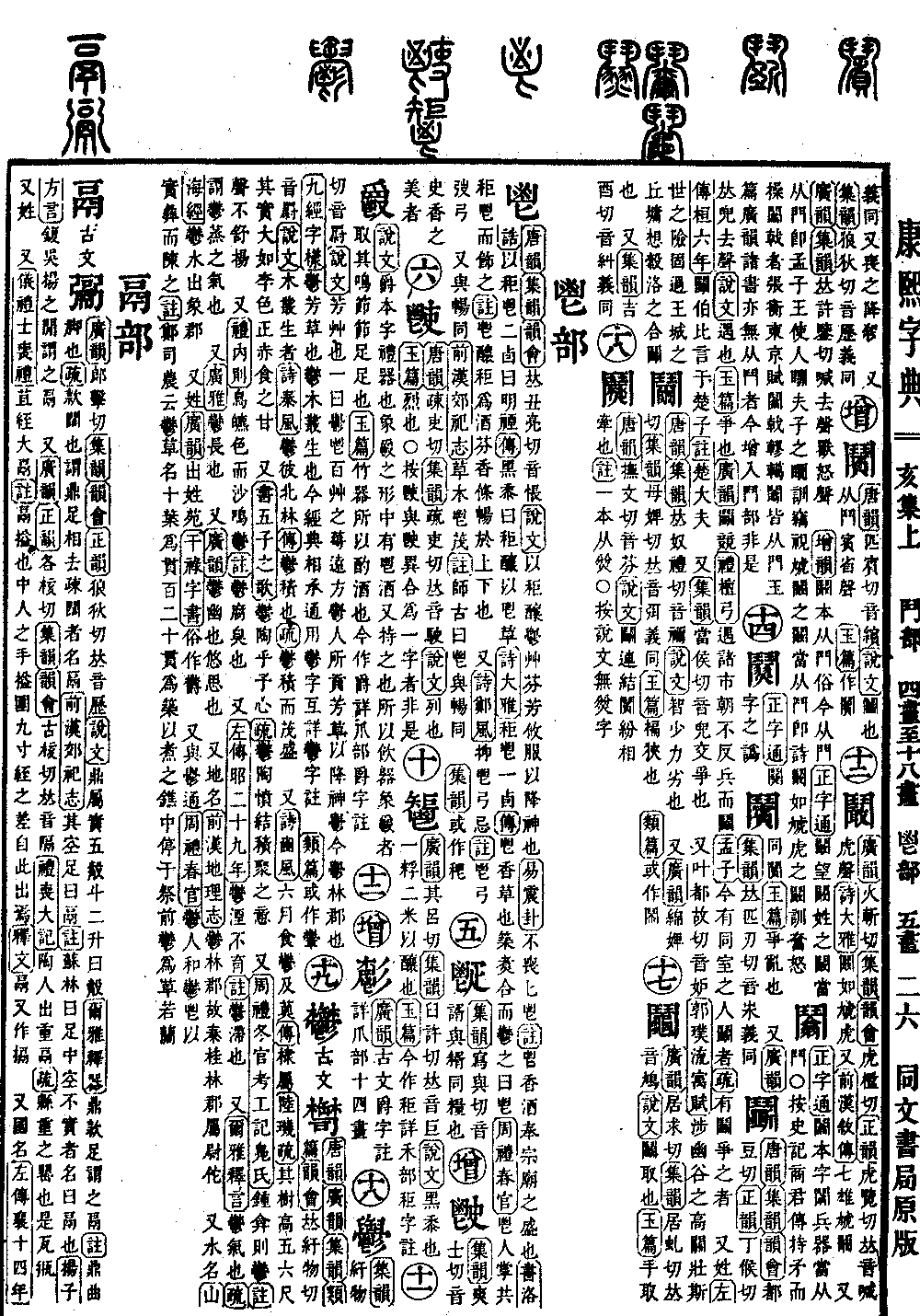
Hai Collection, Upper Volume
Radical: Sacrificial wine (chàng)
Kangxi stroke count: 10
Page 1458, Entry 10
Pronounced chàng.
According to the Shuowen Jiezi (Shuowen): Brewed using black millet and aromatic herbs, its fragrance carries far, and it is used to invoke spirits.
Book of Changes (Yijing), Hexagram Zhen: One does not lose the sacrificial ladle or the fragrant wine.
Commentary: The fragrant wine is a premium offering used for ancestral temple sacrifices.
Book of Documents (Shujing), Announcement of Luo (Luogao): Use two vessels of black millet fragrant wine to perform the bright, pure sacrifice.
Commentary: Black millet is called ju, and it is brewed using the aromatic chang herb.
Book of Odes (Shijing), Greater Odes (Daya): One vessel of black millet fragrant wine.
Commentary: Chang is an aromatic herb. It is pounded, steamed, mixed, and left to mature, which is called chang.
Rites of Zhou (Zhouli), Ministry of Spring: The official in charge of fragrant wine manages the supply of black millet fragrant wine and its ornamentation.
Commentary: This wine is brewed from black millet, and its fragrance penetrates between heaven and earth.
Also, Book of Odes (Shijing), Odes of Zheng (Zhengfeng): Restrain the bow in the bag.
Commentary: To bag the bow means to place it inside a bow case.
Also written as the character for flourishing (chàng).
History of the Former Han (Qian Hanshu), Treatise on Suburban Sacrifices (Jiaosi Zhi): Plants and trees flourish.
Commentary: Shigu states that this character is the same as the character for flourishing (chàng).
According to the Collected Rhymes (Jiyun), it is also written in a variant form.