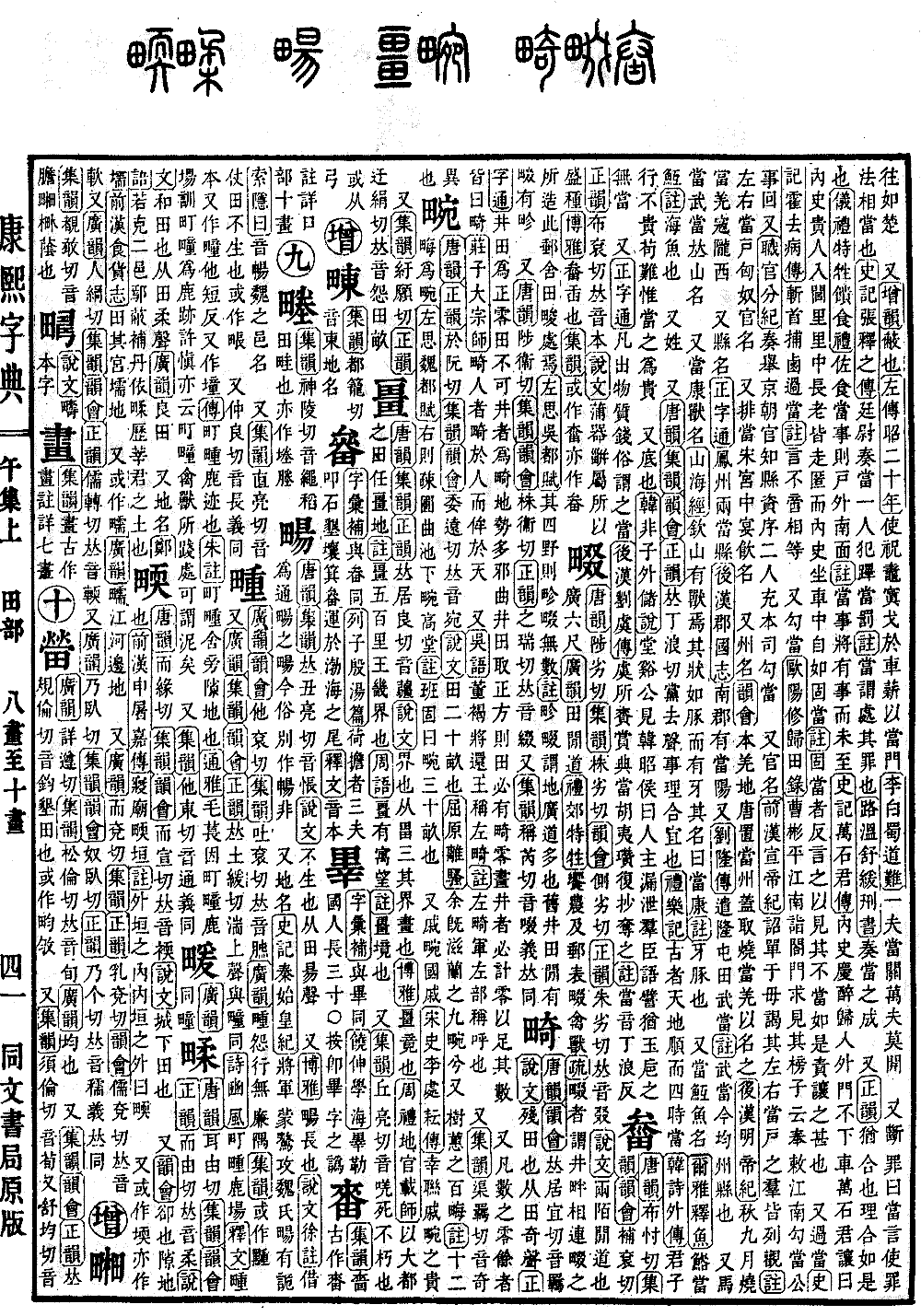
Wu Collection, Upper Volume
Radical: Field (tián)
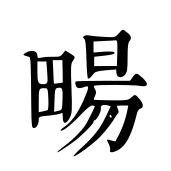
Entry: Chang
Kangxi Strokes: 14
Page 765, Entry 11
According to the Tang Rhyme (Tangyun) and the Collected Rhymes (Jiyun), the pronunciation is chang (falling tone).
According to the Explaining Graphs and Analyzing Characters (Shuowen), it means not growing. It is composed of the radical for field and the phonetic component chang.
Also, according to the Erudite Refinements (Boya), chang means long.
According to the Xu annotations on the Explaining Graphs and Analyzing Characters (Shuowen), it is borrowed to serve as the character for flowing or unobstructed. The current common variant form is an error.
Also a place name. According to the Records of the Grand Historian (Shiji), Chronicle of the First Emperor of Qin, the general Meng Ao attacked the Wei state city of Changyougui. The Annotated Records (Suoyin) states it is pronounced chang, and it is a city name of the Wei state.
According to the Collected Rhymes (Jiyun), the pronunciation is zhang (falling tone), meaning fields that do not grow. It is sometimes written in a variant form.
Also pronounced chang (level tone), with the same meaning.