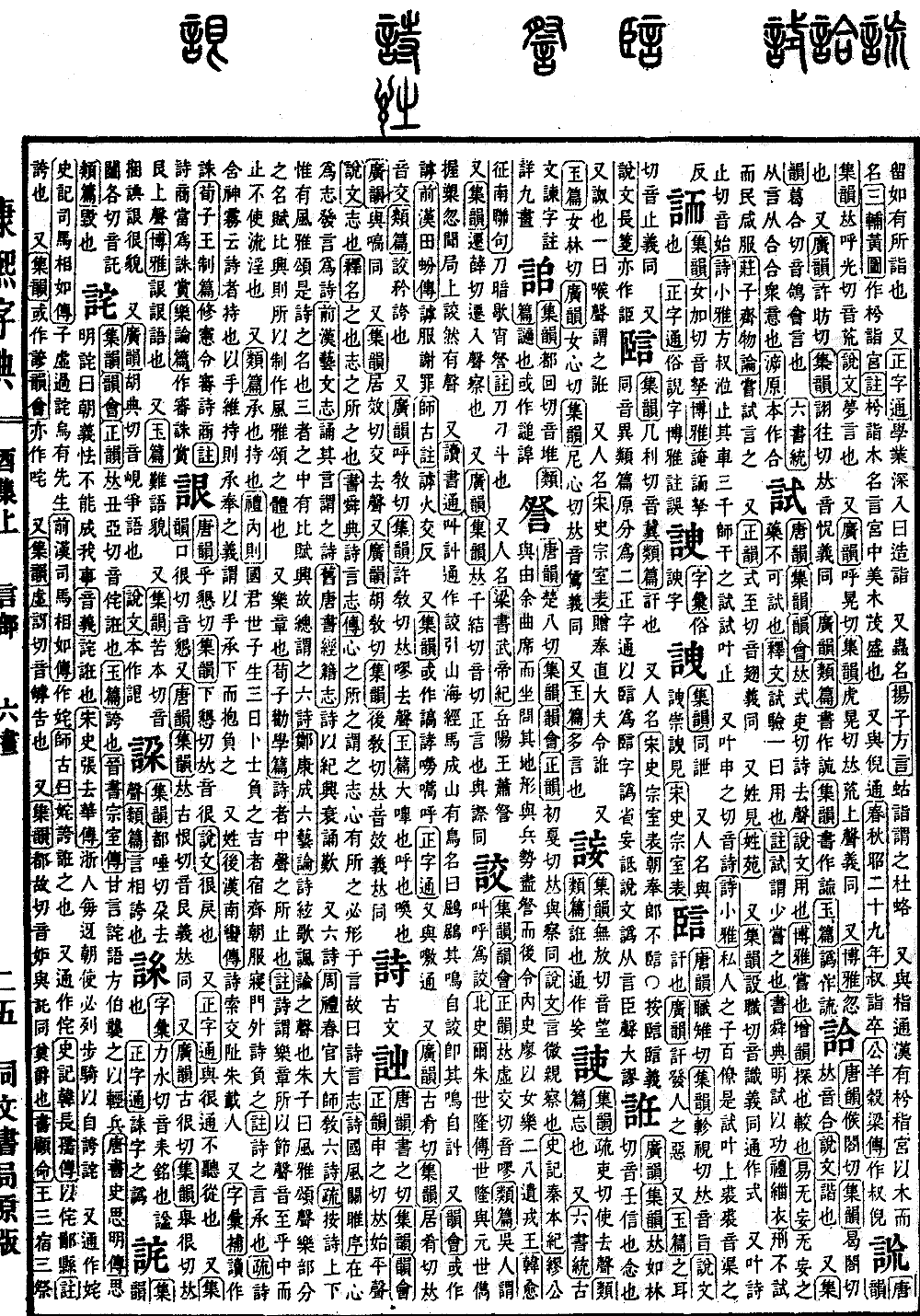
You Collection, Upper Volume
Radical: Speech (yán)
詫
Kangxi strokes: 13
Page 1157, Entry 21
Compendium of Rhymes (Jiyun), Dictionary of Rhymes (Yunhui), and Correct Rhymes (Zhengyun): Pronounced cha. The meaning of to deceive.
Jade Chapters (Yupian): The meaning of to boast or show off.
History of Jin (Jinshu), Biography of the Imperial Clan: Using sweet words and deceptive talk, the regional governor used light cavalry to attack them.
History of Tang (Tangshu), Biography of Shi Siming: Shi Siming deceived them, saying: Chaoyi is timid and cannot accomplish my affairs.
Pronunciation and Meaning: Cha, the meaning of to deceive.
History of Song (Songshu), Biography of Zhang Quhua: People of Zhejiang, whenever they welcomed an imperial envoy, would always display infantry and cavalry to show off themselves.
Also used interchangeably with the variant form (cha).
Records of the Grand Historian (Shiji), Biography of Sima Xiangru: Zixu went to deceive Mr. Wuyou.
History of the Former Han (Qian Hanshu), Biography of Sima Xiangru: Written as (cha).
Shigu says: Cha is the meaning of to boast or to deceive.
Also used interchangeably with the variant form (cha).
Records of the Grand Historian (Shiji), Biography of Han Changru: Using this to boast toward the remote border counties.
Commentary: The meaning of to boast.
Also, Compendium of Rhymes (Jiyun): Sometimes written as (variant form).
Dictionary of Rhymes (Yunhui): Also written as (zha).
Also, Compendium of Rhymes (Jiyun): Pronounced xia. The meaning of to tell or inform.
Also, Compendium of Rhymes (Jiyun): Pronounced du. Same as (tuo). The meaning of placing a wine cup.
Book of Documents (Shujing), Testament of King Cheng (Guming): The King thrice paused, thrice poured a libation, and thrice placed the wine cup.
Explanation of Text: Zha, also written as (zhai). Ma Rong says: Also written as (cha).
Explication of Written Characters (Shuowen): Written as (variant form).