Zi Collection, Middle Volume
Radical: Person (rén)
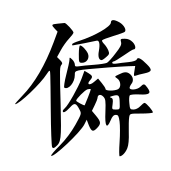
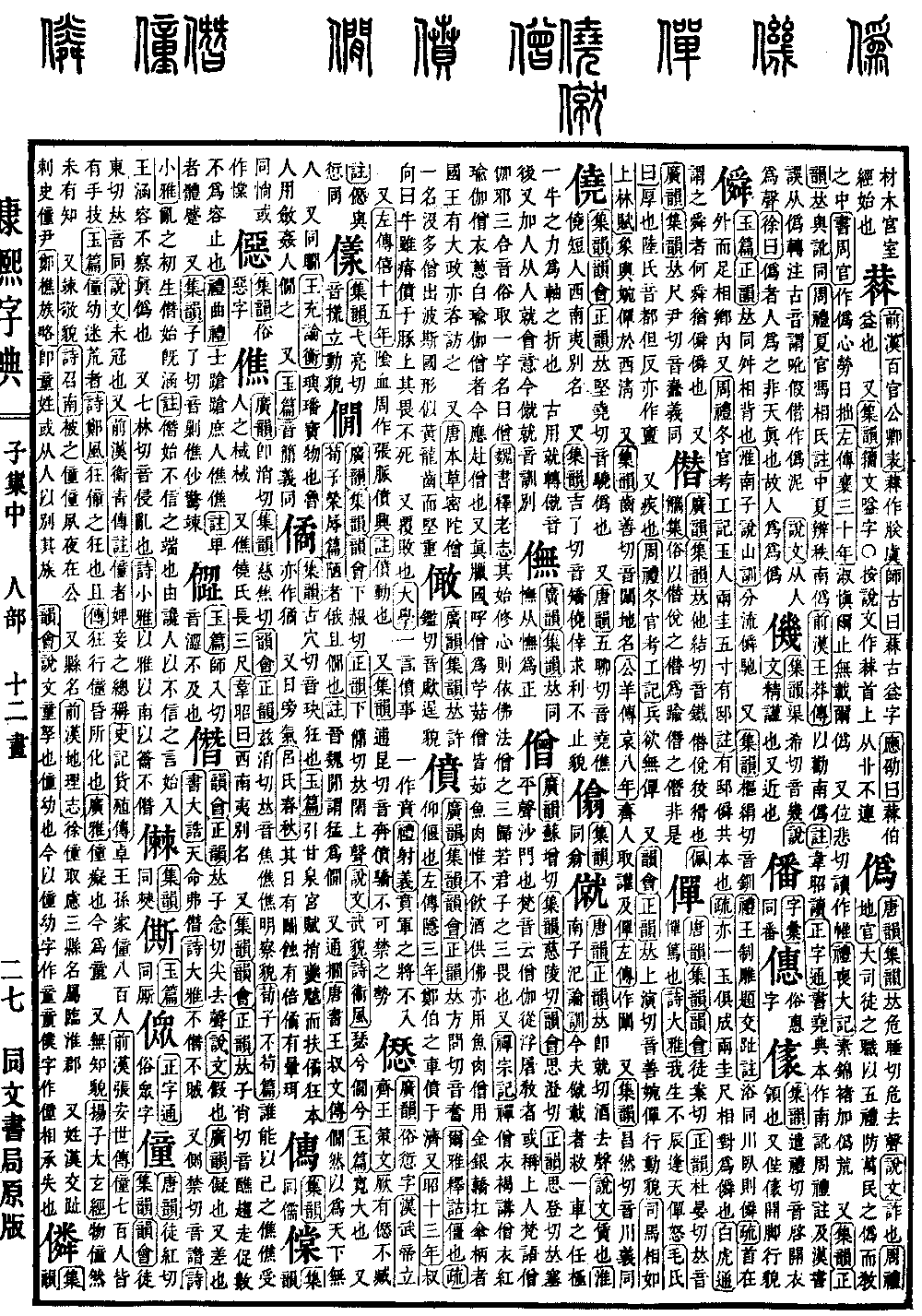
Entry: 僢
Kangxi Stroke Count: 14
Page 117, Entry 07
According to the Jade Chapters (Yupian) and the Correct Rhymes (Zhengyun), this is identical to the character meaning to deviate or go against. It means to be mutually contrary or to have opposing directions.
As stated in the Huainanzi: Sayings of the Mountains (Huainanzi: Shuoshanxun), water flows apart and rushes in opposite directions.
Furthermore, according to the Collected Rhymes (Jiyun), it is pronounced chuan.
According to the commentary on the Book of Rites: Royal Regulations (Liji: Wangzhi), when bathing in the same river, one sleeps back to back. The sub-commentary explains that the heads point outward while the feet point toward each other.
Also, according to the commentary on the Rites of Zhou: Winter Offices, Artificers' Record (Zhouli: Dongguan Kaogongji), in reference to a double jade tablet five inches in size with a base, the term base refers to where the bottoms are connected. The sub-commentary notes that this is made from the same piece of jade, and two jade tablets standing opposite one another are called chuan.
According to the Comprehensive Discourses (Baihu Tong), why is it called Shun? The meaning of Shun is similar to the appearance of things facing away from each other.
Additionally, according to the Broad Rhymes (Guangyun) and the Collected Rhymes (Jiyun), it is pronounced chun. The meaning remains the same.