Wu Collection, Lower Volume
Radical: Cave (xué)
Kangxi Strokes: 12
Page 865, Entry 32
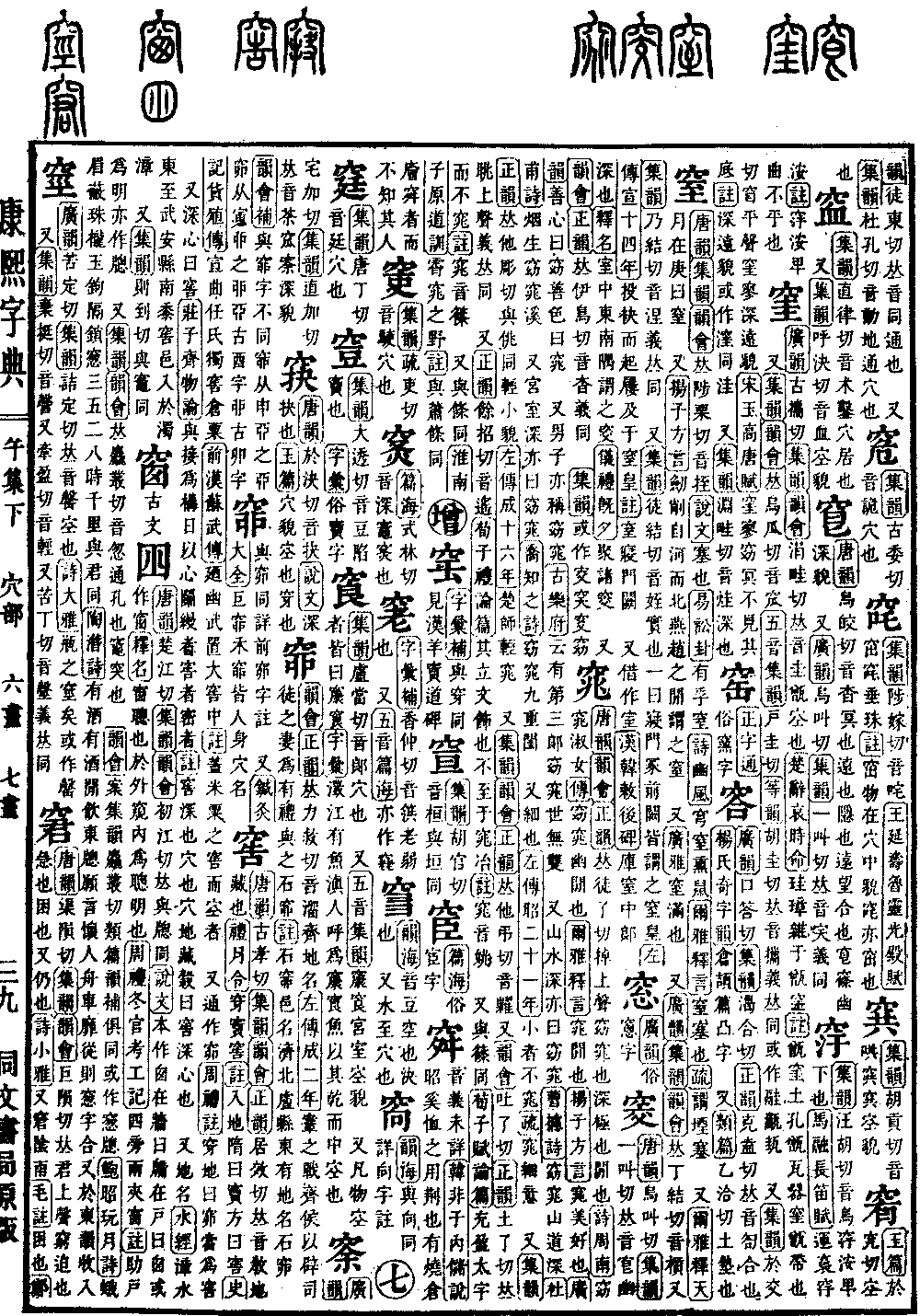
Ancient form. According to the Tang Rhyme (Tangyun), pronounced chuang. According to the Collected Rhymes (Jiyun) and the Rhyme Anthology (Yunhui), pronounced chuang. Identical to the variant form. According to the Explaining Graphs and Analyzing Characters (Shuowen), it was originally written as the character for chimney. When located in a wall it is called a window, when located in a door it is called a chimney. Sometimes written as the variant form. According to the Explanations of Names (Shiming), the word for window means clear; peering from the outside into the inside is for the sake of intelligence. According to the Rites of Zhou (Zhouli), section Winter Offices, Artificers Record (Kaogongji), on the four sides the rain enters the window. The commentary notes that it assists the door in providing light. Also written as the variant form. Also, according to the Collected Rhymes (Jiyun) and the Rhyme Anthology (Yunhui), pronounced cong. It means an opening or a chimney flue. The Rhyme Anthology (Yunhui) notes that the Collected Rhymes (Jiyun) and the Supplement to the Classified Dictionary (Leipian) agree on this pronunciation. Sometimes written as the variant form. In the Poem on Playing with the Moon by Bao Zhao, it says: The moth-eyebrowed beauty hides behind the beaded lattice, the jade hook is separated by the window. At the time of fifteen or sixteen, I am with you across a thousand miles. In the poetry of Tao Qian, it says: Having wine, having wine, I drink leisurely by the eastern window. I wish to think of the person, but no boat or carriage comes to follow. This character should be included under the eastern rhyme category.