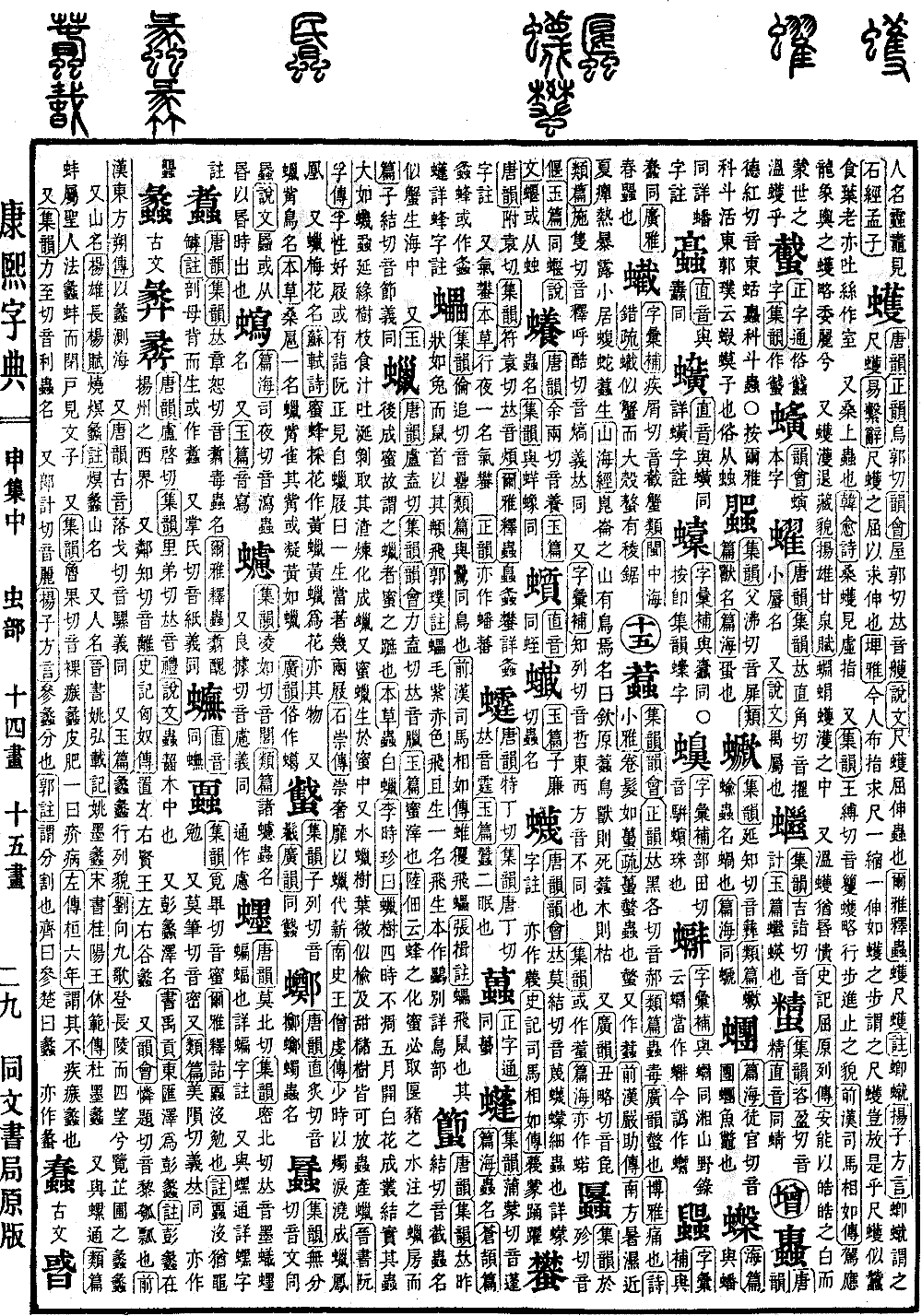
Shen Collection, Middle Volume. Radical: Insect (chóng). Kangxi stroke count: 21. Page 1101, Entry 44.
Ancient text references: Tang Rhymes (Tangyun) and Rhyme Collections (Yunhui) note the pronunciation as chi (rising tone). Correct Rhymes (Zhengyun) notes the pronunciation as chi (rising tone). The pronunciation is the same as chun.
Explanations from the Analytical Dictionary of Characters (Shuowen Jiezi) describe the term as the wriggling motion of insects.
The Erya: Explaining Ancient Words (Erya Shigu) defines it as meaning to rise or to act. The commentary notes that this term refers to movement or activity.
The Book of Rites (Liji), in the chapter Meaning of the Village Drinking Ceremony (Xiang Yinjiu Yi), states that the meaning of spring (chun) is the movement of life (chundong).
The Zhuangzi, in the chapter Heaven and Earth (Tiandi), records: All things move and act, using one another, yet do not consider it a favor.
Furthermore, the Erya: Explaining Words (Erya Shiyan) defines it as meaning lacking humility or being impolite.
The Book of Odes (Shijing), in the section Lesser Odes (Xiaoya), contains the phrase, You foolish, unruly southern tribes.
The sub-commentary by Guo Pu explains that this term refers to evil actions or a lack of humility.
The Jade Chapters (Yupian) records that this character is sometimes written in a variant form (chun).