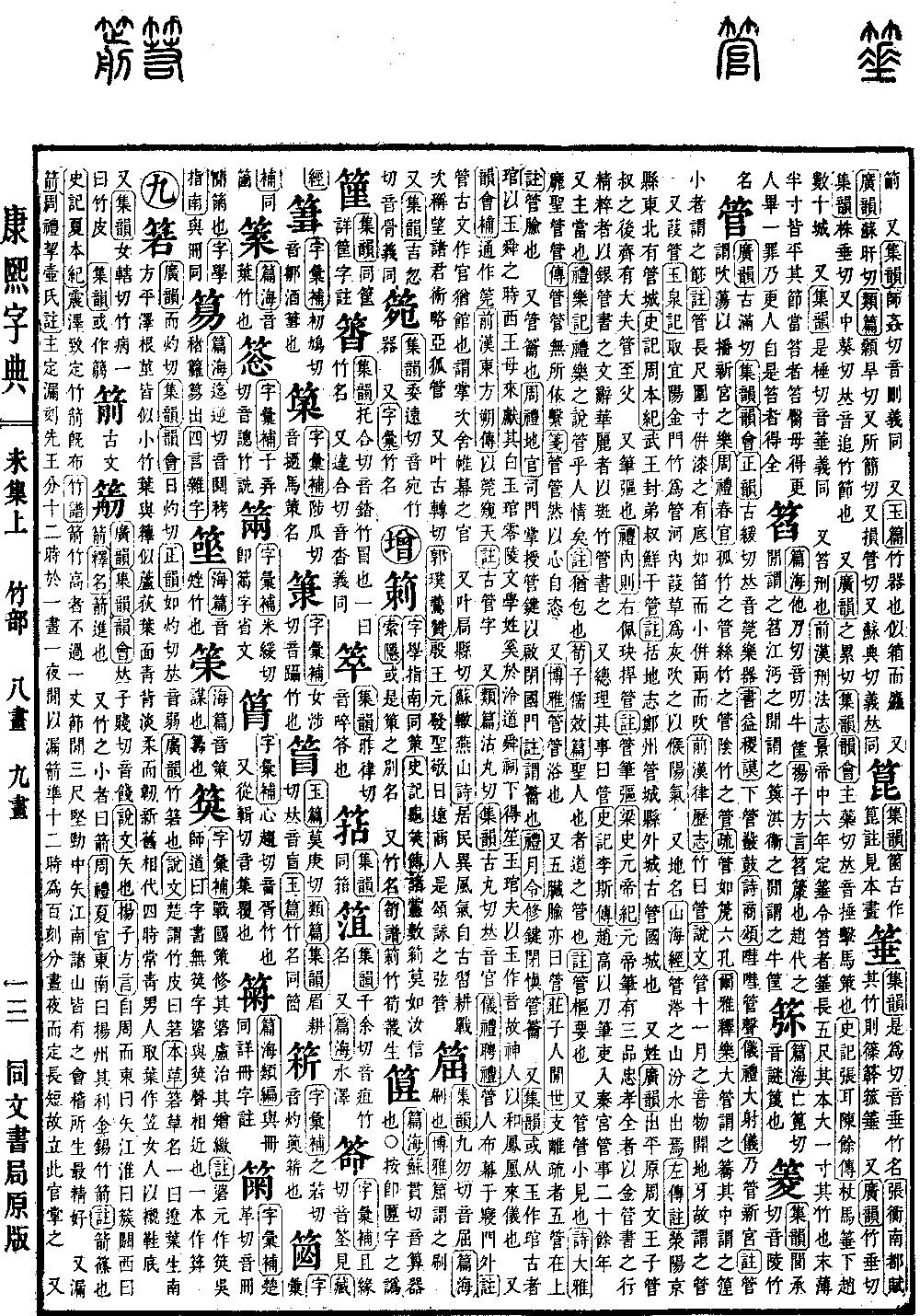
Wei Collection, Upper Volume
Radical: Bamboo (zhú)
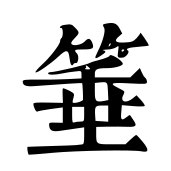
Chui
Kangxi strokes: 14
Page 889, Entry 02
According to the Collected Rhymes (Jiyun), pronounced chui. The name of a type of bamboo. In the Southern Capital Rhapsody (Nandu Fu) by Zhang Heng, the bamboos mentioned include xiao, gan, gu, and chui.
Also, according to the Expanded Rhymes (Guangyun), pronounced chui, and according to the Collected Rhymes (Jiyun), pronounced chui and pronounced zhui. Refers to the joints of bamboo.
Also, according to the Expanded Rhymes (Guangyun), pronounced chui, and according to the Collected Rhymes (Jiyun) and the Rhyme Collection (Yunhui), pronounced chui. Refers to a whip used for driving horses. In the Records of the Grand Historian (Shiji), Biography of Zhang Er and Chen Yu, it is written: Holding a horse whip in hand, he attacked and captured several dozen cities in the Zhao state.
Also, according to the Collected Rhymes (Jiyun), pronounced chui. The meaning is the same.
Also refers to beating with a bamboo rod. In the History of the Former Han (Qian Han Shu), Treatise on Law, it is written: In the sixth year of the Zhongyuan era of Emperor Jing of Han, a statute regarding corporal punishment was established, stipulating that the bamboo rod used for beating should be five feet long, one inch thick at the root, and half an inch thick at the tip, with all bamboo joints smoothed down. The person receiving the beating should be struck on the buttocks, and the executioner may not be swapped mid-process. Only after the beating for one criminal charge is completed may the executioner be changed. From then on, those receiving the beating were able to preserve their lives.