Si Collection, Upper Volume
Radical: Splinter (piàn)
Kangxi Strokes: 13
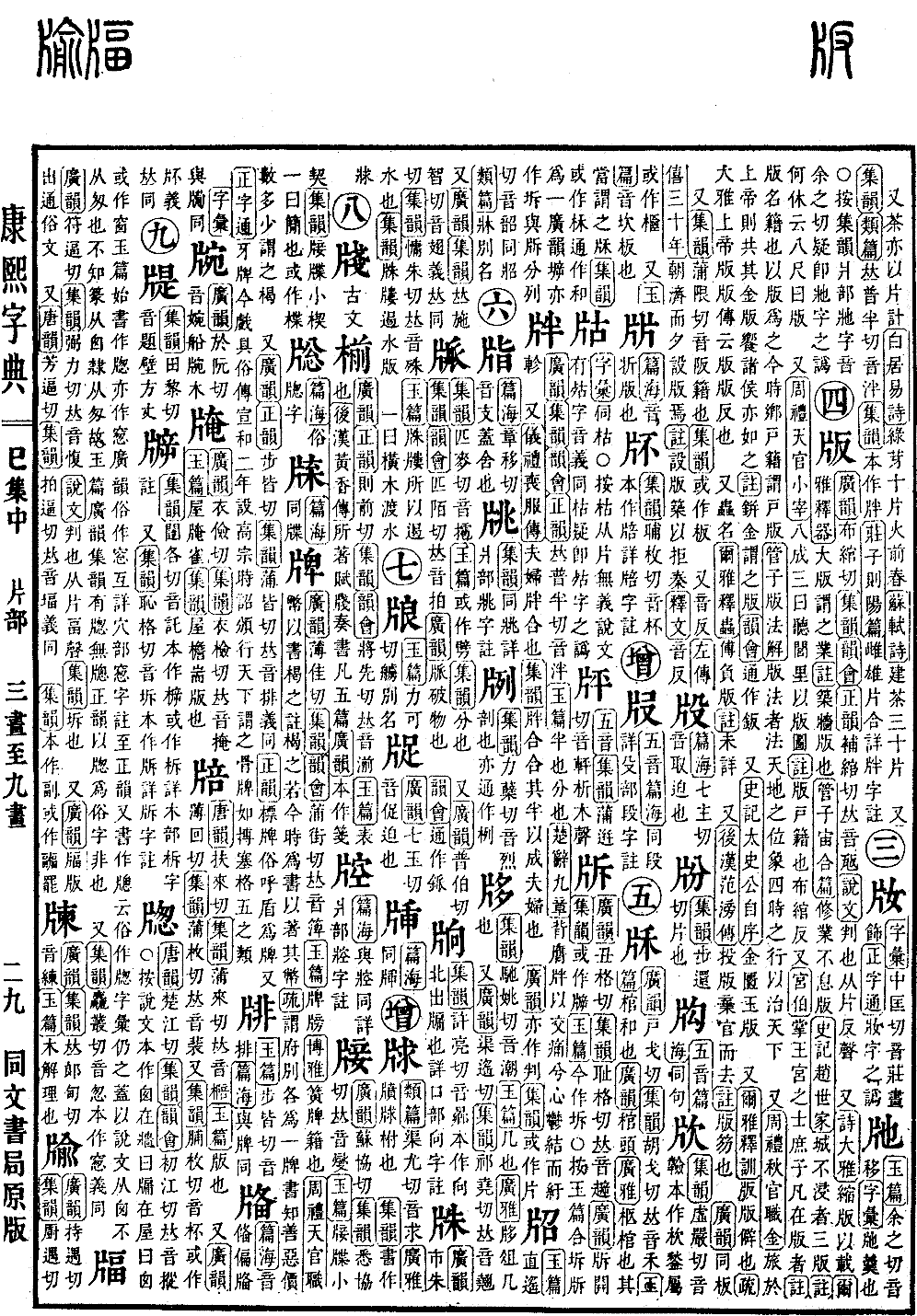
Page 693, Entry 42
Pronounced chuāng. According to the Tang Rhyme (Tangyun), Collection Rhymes (Jiyun), and Rhyme Meeting (Yunhui), the pronunciation is the same as cong.
According to the Explanation of Simple and Compound Characters (Shuowen Jiezi), it was originally written as cong. An opening in a wall is called you, and an opening in a roof is called cong. It is also sometimes written as chuāng. The Jade Compilation (Yupian) first recorded it as chuāng, and it was also written in a variant form. The Wide Rhyme (Guangyun) recorded a common variant form; for further details, refer to the notes under the Cave radical for that character.
By the time of the Correct Rhymes (Zhengyun), it was written as chuāng, noting it as a common variant. The Collection of Characters (Zihui) adopted this usage. This is likely because, although the head character in the Explanation of Simple and Compound Characters (Shuowen Jiezi) is cong and not cong, the compilers were unaware that the seal script version follows cong, while the clerical script follows cong. Thus, the Jade Compilation (Yupian), Wide Rhyme (Guangyun), and Collection Rhymes (Jiyun) all recorded chuāng and did not include chuāng. The Correct Rhymes (Zhengyun) treats chuāng as a common variant, which is incorrect.
Also, according to the Collection Rhymes (Jiyun), pronounced cōng, the same as the pronunciation of cōng. Originally written in a variant form. The meaning is the same.