Wu Collection, Lower Volume
Radical: Grain (hé)
Kangxi Strokes: 14
Page 856, Entry 24
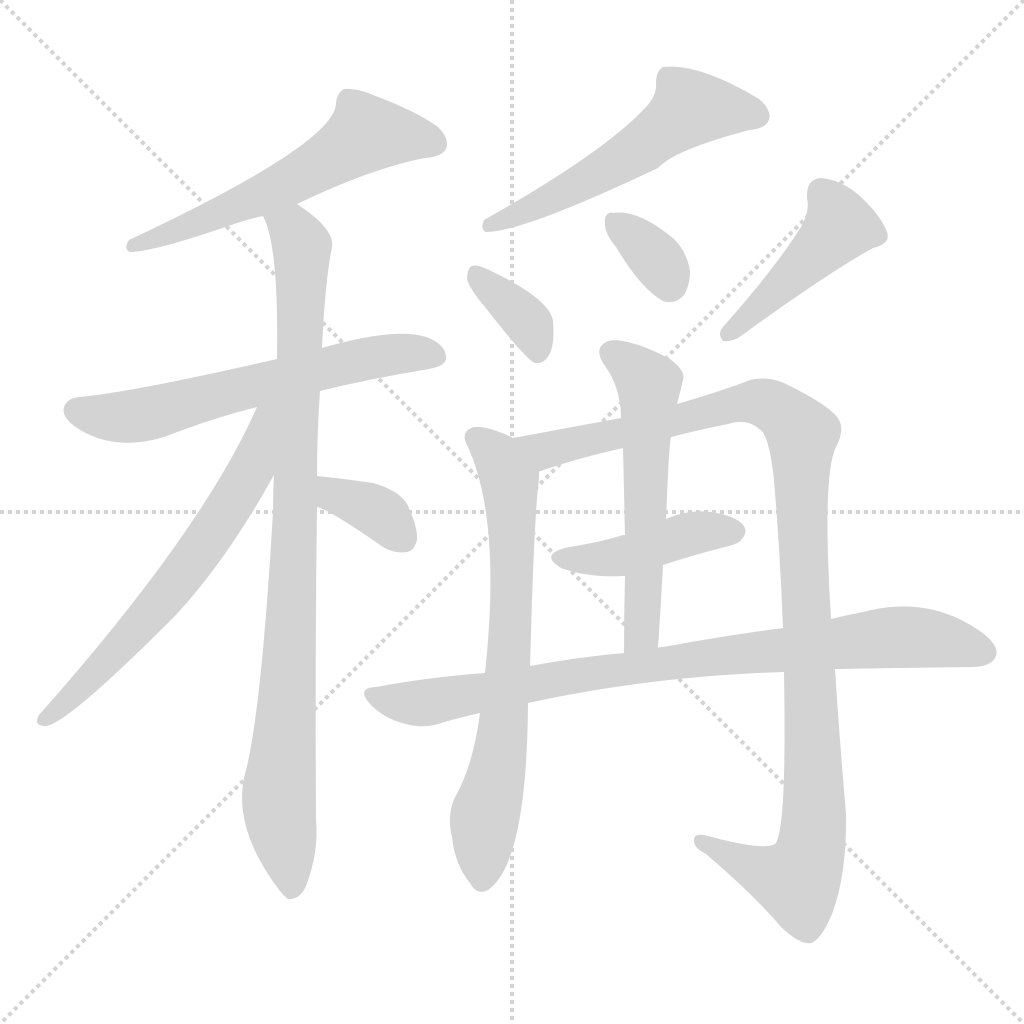
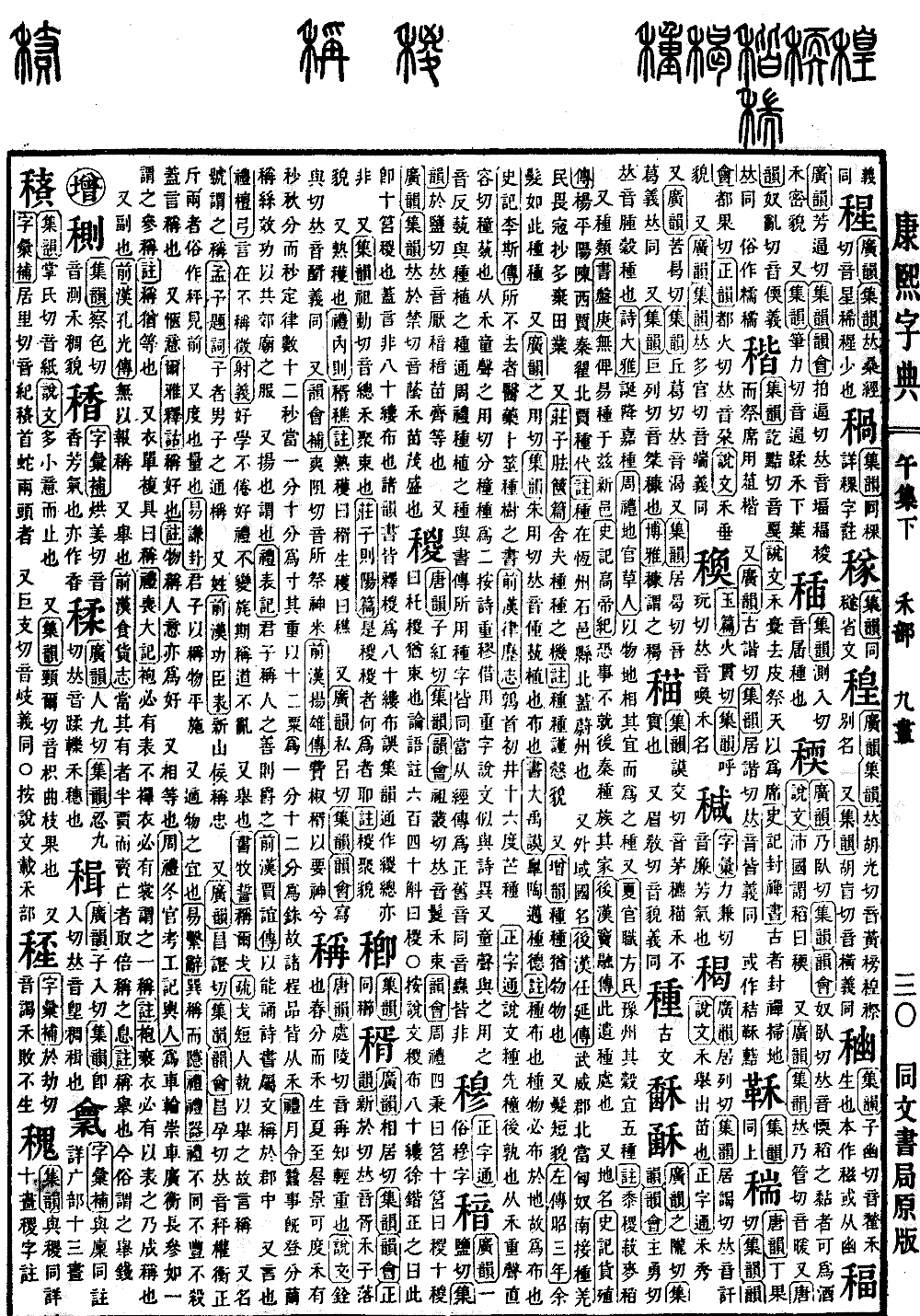
Pronounced cheng. To measure the weight of an object. Shuo Wen Jie Zi (Explaining Graphs and Analyzing Characters) states it means to weigh. At the spring equinox, grain sprouts grow; at the summer solstice, the shadow of the sun can be measured. Grain has awns, and by the autumn equinox, the awns have taken shape. In musical pitch, twelve awns equal one fen, and ten fen equal one cun. The unit of weight is derived from twelve millet grains equaling one fen, and twelve fen equaling one zhu. Therefore, all standards of measurement are derived from the grain radical. The Book of Rites (Liji), Yue Ling section, states that the work of silkworm rearing is complete, and cocoons are distributed and silk weighed to assess productivity, which is used to provide ceremonial robes for the worship of Heaven, Earth, and the ancestral temples.
Also, to praise or recount. The Book of Rites (Liji), Biao Ji section, states that a gentleman praises the good deeds of others and confers titles upon them. In the History of the Former Han (Qian Hanshu), Biography of Jia Yi, it is recorded that because he could recite the classics and compose essays, he was praised within the commandery.
Also, to speak. The Book of Rites (Liji), Tan Gong section, states that one should not avoid naming names when speaking. The Book of Rites (Liji), She Yi section, states that one who is diligent in study and steadfast in ritual, even at the age of eighty or ninety, can still speak of the correct path without becoming confused.
Also, to lift. The Book of Documents (Shushu), Mu Shi section, states to raise your spears. The commentary explains that since spears are short, one lifts them by hand, which is why it is called cheng.
Also, a name or title. In the preface to the Book of Mencius (Mengzi), it states that zi is a general term for men.
Also, a surname. In the History of the Former Han (Qian Hanshu), Table of Meritorious Officials, there is a Marquis of Xinshan named Cheng Zhong.
Also, pronounced cheng (falling tone). An instrument used to accurately measure weight. It is commonly written as the character for scale. See above.
Also, to weigh or measure. The Book of Changes (Yijing), Qian hexagram, states that a gentleman uses measurement to distribute goods fairly.
Also, to conform to the appropriate state of things. The Book of Changes (Yijing), Xi Ci section, speaks of being compliant and appropriate yet subtle. The Book of Rites (Liji), Li Qi section, states that when ritual systems differ, one should neither add to nor subtract from them; this is what is meant by being appropriate.
Also, to be satisfied. The Erya (Approaching Elegance), Shi Gu section, states that cheng means good. The commentary notes that when things accord with a person's wishes, it is also called good.
Also, to be equal. The Rites of Zhou (Zhouli), Winter Official, Artificer's Record, states that the height of the wheels, the width of the carriage, and the length of the crossbar, when all three are uniform, is called three-fold equality. The commentary explains that cheng means to be the same or equal.
Also, a set of clothing consisting of a lined garment and an outer garment is called one cheng. The Book of Rites (Liji), Sang Da Ji section, states that a padded robe must have an outer garment and cannot be worn alone. An upper garment must have a lower skirt, which is called one cheng. The commentary notes that a padded robe is an undergarment worn close to the body, and it must be covered by an outer garment to be considered a complete set.
Also, to match or correspond. The History of the Former Han (Qian Hanshu), Biography of Kong Guang, states there is nothing that can be done to repay (the Emperor's favor) in a way that matches it.
Also, to borrow or lend. The History of the Former Han (Qian Hanshu), Treatise on Food and Money, states that when the common people have grain, they sell it at half price, and those who do not have grain must take out loans with double interest. The commentary notes that cheng means to borrow or lend. This is commonly referred to in vernacular language as borrowing money.