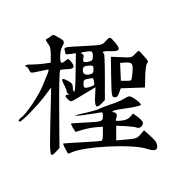
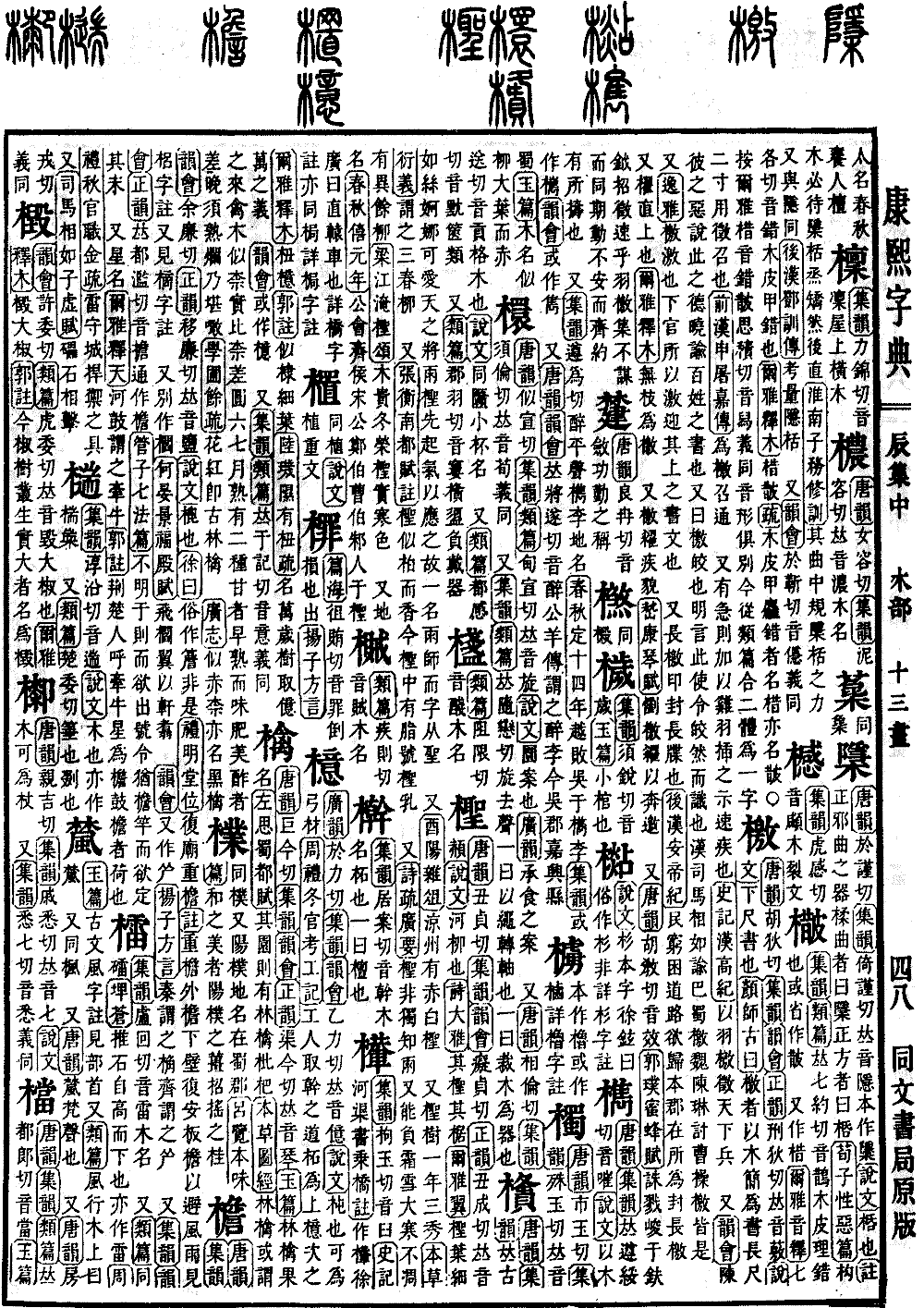
Chen Collection, Middle Volume. Radical: Tree (mù). 17 strokes. Page 556, Entry 18.
Pronounced cheng.
As defined in the Analytical Dictionary of Characters (Shuowen Jiezi), it is the river willow. In the Book of Odes (Shijing), Great Odes, it is written: Their tamarisks, their oak trees. According to the Wing of the Erya (Eryayi), the leaves of the tamarisk are fine as silk and gracefully lovely; when rain is about to fall, the tree releases an essence to respond to it, which is why it is also known as the Rain Master, and the structure of the character itself contains the component for sage.
According to the Miscellaneous Morsels from Youyang (Youyang Zazu), in Liangzhou there are both red and white varieties of the tamarisk. The tamarisk blooms three times a year. In the Extended Meaning of the Materia Medica (Bencao Yanyi), it is referred to as the three-spring willow.
According to the commentary on Zhang Heng’s Rhapsody on the Southern Capital (Nandu Fu), the tamarisk resembles a cypress and is fragrant; it is known that the tree contains a resin called tamarisk milk.
According to the Explication of the Book of Odes (Shi Shu Guang Yao), the tamarisk not only predicts rain but also withstands frost and snow. Even in extreme cold, it does not wither, which distinguishes it from other willow species. In Jiang Yan’s Eulogy on the Tamarisk (Cheng Song), it is noted that trees that flourish in winter are valued, and the tamarisk indeed possesses the quality of cold resistance.
Also refers to a place name. In the Spring and Autumn Annals (Chunqiu), during the first year of Duke Xi of Lu, the Duke met with the Marquis of Qi, the Duke of Song, the Earl of Zheng, the Earl of Cao, and the people of Zhu at the location of Cheng.