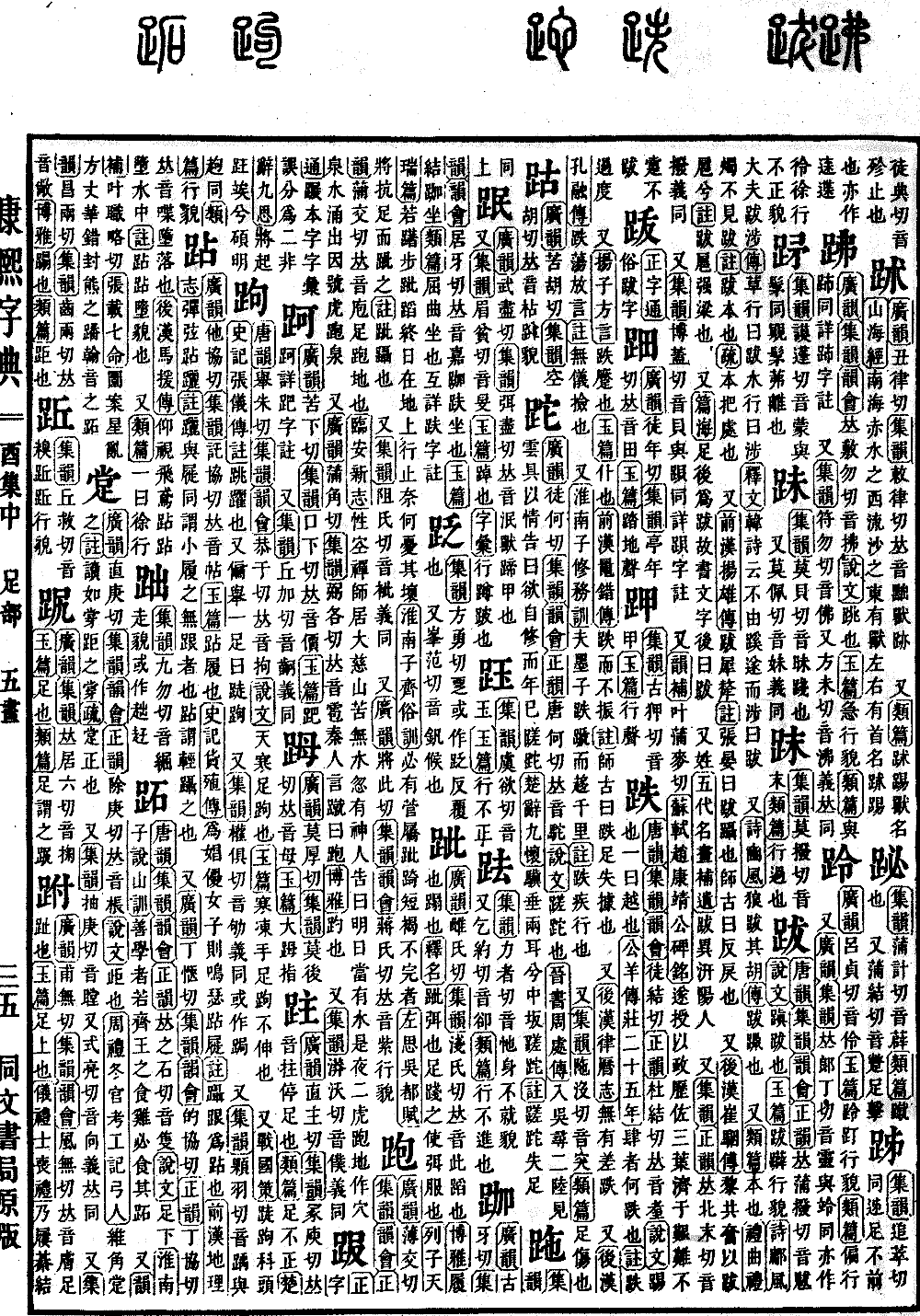
Pronounced zhí (entering tone) in Guangyun, and chú (entering tone) in Jiyun, Yunhui, and Zhengyun, with the same pronunciation as "chēng". In Shuowen Jiezi, it is explained as "to stumble". In the "Book of Rites (Zhou Li), Winter Official Kao Gong Ji, Bow Maker (Dongguan Kaogongji Gongren)", there is the phrase "wei jiao táng zhī". [Note] Pronounced like the "táng" in "táng jù". [Shu] Explains "táng" as meaning "correct".
Also, in Jiyun, it is pronounced chōu (entering tone), with the same pronunciation as "chēng". Also pronounced shì (falling tone), with the same pronunciation as "xiàng". The meanings are the same.
Also, in Jiyun, it is pronounced chāng (falling tone), and in Jiyun, it is pronounced chǐ (falling tone), with the same pronunciation as "chǎng". In Boya, it is explained as "to tread". In Leipian, it is explained as "distance".