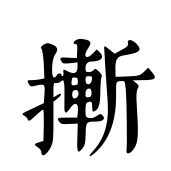
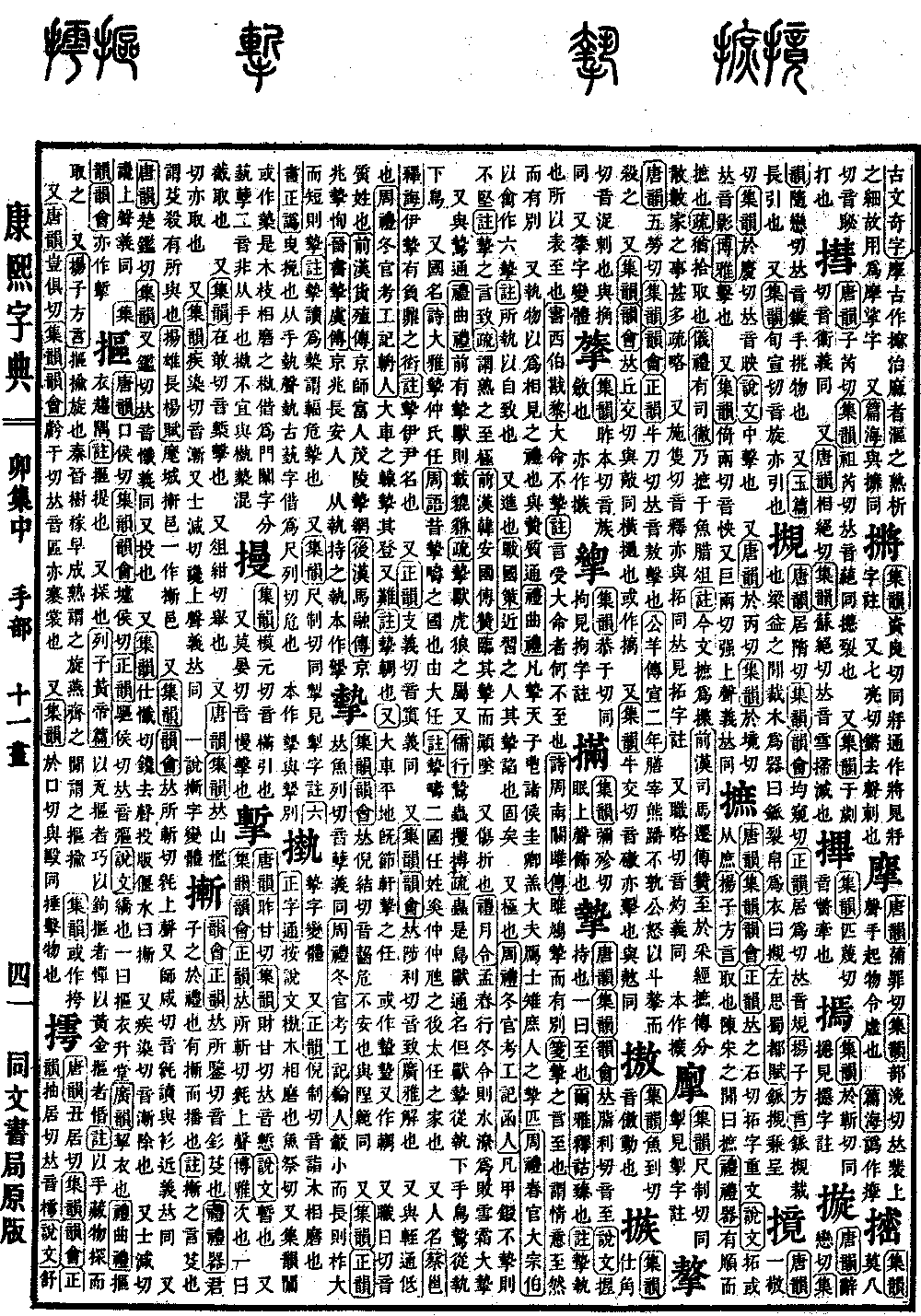
Mao Collection, Middle Volume. Radical: Hand (shǒu). 15 Kangxi strokes. Page 451, Entry 23.
According to the Rhyme Dictionary of Ancient Chinese (Yunhui) and the Standard Rhymes (Zhengyun), it is pronounced shan. It means to cut away or remove. In the Book of Rites (Liji), specifically the section on Ritual Vessels (Liqi), it describes that a superior person, in regards to ritual etiquette, has a practice of reducing and distributing to others. The commentary notes that this term means to cut away, referring to reducing a portion in order to distribute it to others. In Yang Xiong's Rhapsody on the Long Yang Palace (Changyang Fu), it refers to attacking and capturing cities or pushing over city walls. It is also written in a variant form.
Furthermore, according to the Collected Rhymes (Jiyun) and the Rhyme Dictionary of Ancient Chinese (Yunhui), it is pronounced san (rising tone). It is also pronounced san. The pronunciation is similar to the word for shirt, and the meaning is the same. It also possesses the meaning of throwing or tossing.
According to the Tang Rhyme (Tangyun), it is pronounced chan. According to the Collected Rhymes (Jiyun), it is also pronounced chan, and the meaning is the same. It also possesses the meaning of throwing or tossing.
Additionally, according to the Collected Rhymes (Jiyun), it is pronounced chan (falling tone). This refers to tossing a wooden board to make the water flow level, which is called this term.
It is also pronounced jian (falling tone), meaning to remove.
Finally, it is pronounced chan (rising tone), and the meaning is the same. According to the Collected Rhymes (Jiyun) and the Rhyme Dictionary of Ancient Chinese (Yunhui), it is also written in a variant form.