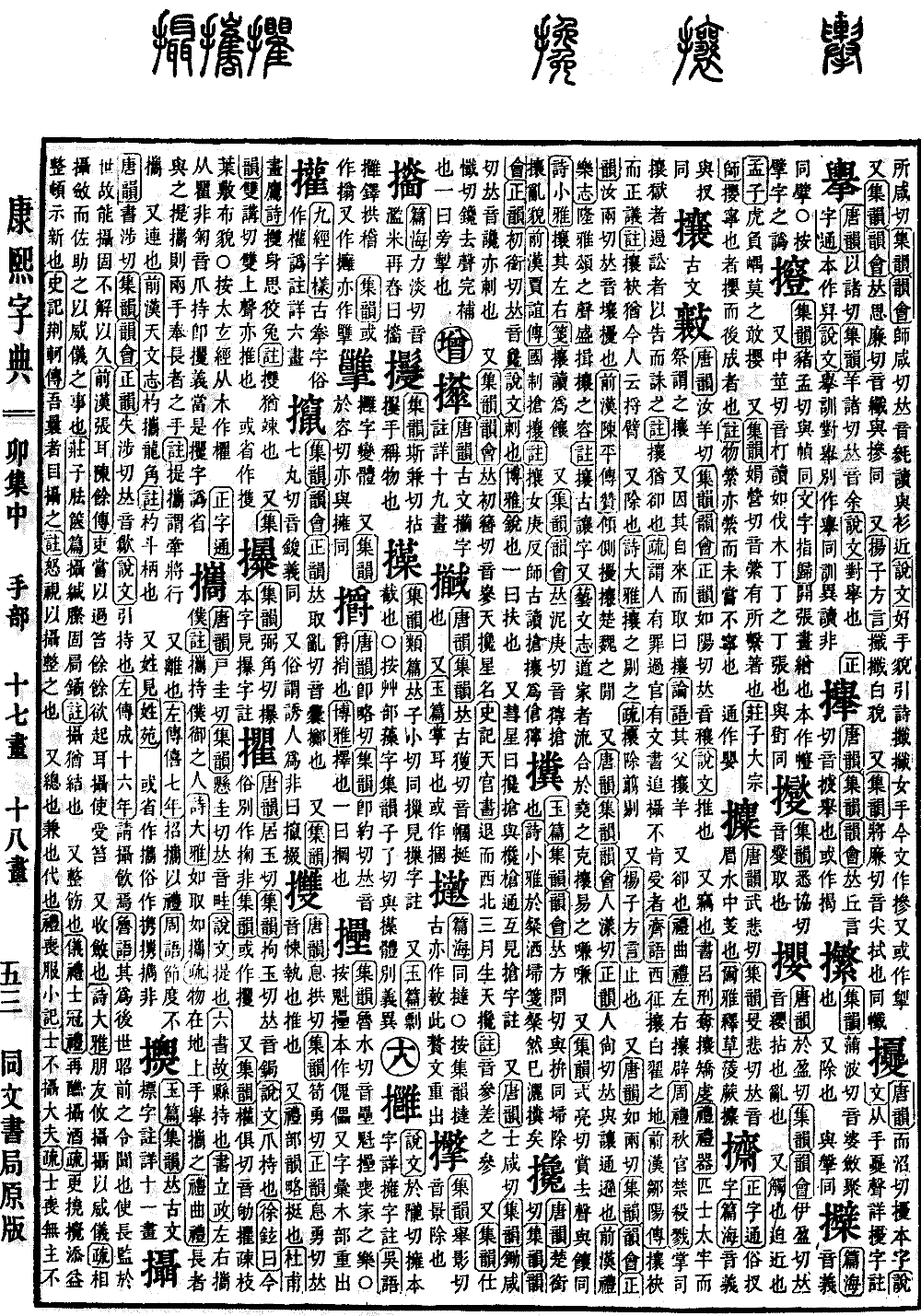
Mao Collection, Middle Volume. Radical: Hand (shǒu). Kangxi stroke count: 21. Page 463, Entry 01.
According to Tang Rhymes (Tang yun), the pronunciation is chan (level tone). According to Collected Rhymes (Jiyun), Rhyme Meetings (Yunhui), and Orthodox Rhymes (Zhengyun), the pronunciation is chan (level tone). In the Shuowen Jiezi, it is defined as to pierce or to stab. In the Guangya, it is defined as sharp. Another source suggests it means to support or to assist. It is also used to refer to a comet, known as a chanqiang. This is interchangeable with the variant form chanqiang. See the entry for qiang for further reference.
Also, according to Tang Rhymes (Tang yun), it is pronounced chan (level tone). According to Collected Rhymes (Jiyun), it is pronounced chan (level tone). It also carries the meaning of to pierce or to stab.
Also, according to Collected Rhymes (Jiyun) and Rhyme Meetings (Yunhui), it is pronounced cen (level tone). Tianchan is the name of a celestial constellation. In the Records of the Grand Historian (Shiji), specifically the Book of Celestial Offices (Tianguanshu), it states: It recedes to the northwest and after three months the tianchan appears. The commentary notes that the pronunciation is the same as the cen in cenci (uneven).
Also, according to Collected Rhymes (Jiyun), it is pronounced chan (falling tone). It carries the meaning of to repair or to mend. Another source suggests it means to lead or to pull from the side.