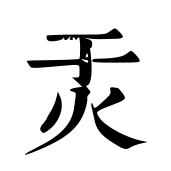
Pronounced zhi-lian (zhi-lian), and chizhi-lian (chizhi-lian) in "Guangyun" and "Jiyun" respectively, with the same pronunciation as "xiǎng". "Shuowen Jiezi" explains it as slight heat.
Also, pronounced tu-gan (tu-gan) in "Guangyun" and "Jiyun", with the same pronunciation as "tán". The meaning is the same.
It also has the meaning of burning.
Additionally, pronounced yi-zhen (yi-zhen) in "Jiyun", with the same pronunciation as "yín". "Yangzi Fangyan" explains it as bright. Sometimes written as "guāng". "Zhengzitong" states that "Shuowen Jiezi" quotes the "Book of Odes (Shijing)" as "yōuxīn liánlián". This phrase does not appear in the "Book of Odes (Shijing)", and may be a variant of "yán yán". "Shijin Jiujing Kaoyi" records "yōuxīn rú tān". "Han Shi" writes it as "yán", "Shuowen Jiezi" writes it as "liánlián", meaning "as if burning". "Han Shi" and "Hanshu" quote it as "rú", and the use of the character "yán" is sufficient proof. The character "guāng" was originally written as "kāi" with "huǒ" below.