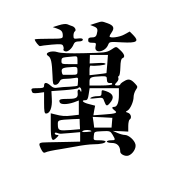
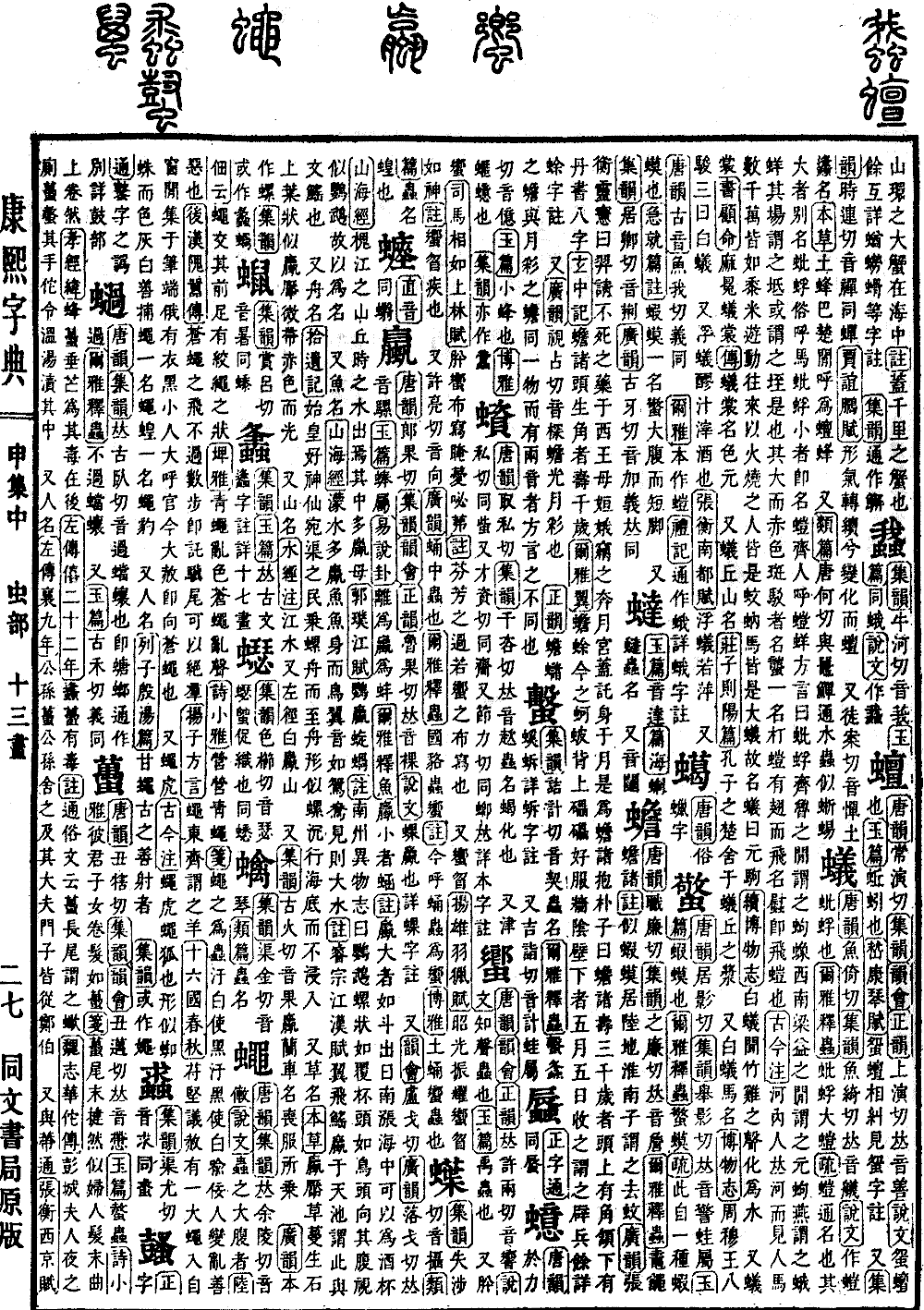
Shen Collection, Middle Volume. Radical: Insect (chóng). Character: chài. Kangxi stroke count: 19. Page 1099, Entry 24.
Pronounced chài.
Jade Chapter (Yupian): A stinging insect.
Book of Odes (Shijing), Lesser Odes of the Kingdom: Those noble ladies, with hair gathered in tufts like scorpions (chài). Commentary: The tail of a scorpion is lifted and curved, resembling the way women curl the ends of their hair upward.
Apocrypha to the Classic of Filial Piety (Xiaojing wei): Bees and scorpions have stingers; their venom lies at the rear.
Zuo Commentary (Zuozhuan), Twenty-second Year of Duke Xi: Bees and scorpions have venom. Annotation: The Common Records (Tongsu wen) states: A long-tailed scorpion is called a xiē.
Records of Wei (Weizhi), Biography of Hua Tuo: When the wife of the Governor of Pengcheng went to the latrine at night, a scorpion stung her hand; Hua Tuo ordered her to soak the area in warm water.
Also a name. Zuo Commentary (Zuozhuan), Ninth Year of Duke Xiang: Gongsun Chài, Gongsun Shezhi, and their senior officials and gate attendants all followed the Earl of Zheng.
Also used interchangeably with dì (stalk). Zhang Heng, Western Capital Rhapsody (Xijing fu): Like the irritation of a scorpion or a mustard seed. Annotation: Scorpion and mustard seed refer to stings and bones stuck in the throat.
Also pronounced tà. Same meaning. Sometimes written in a variant form.