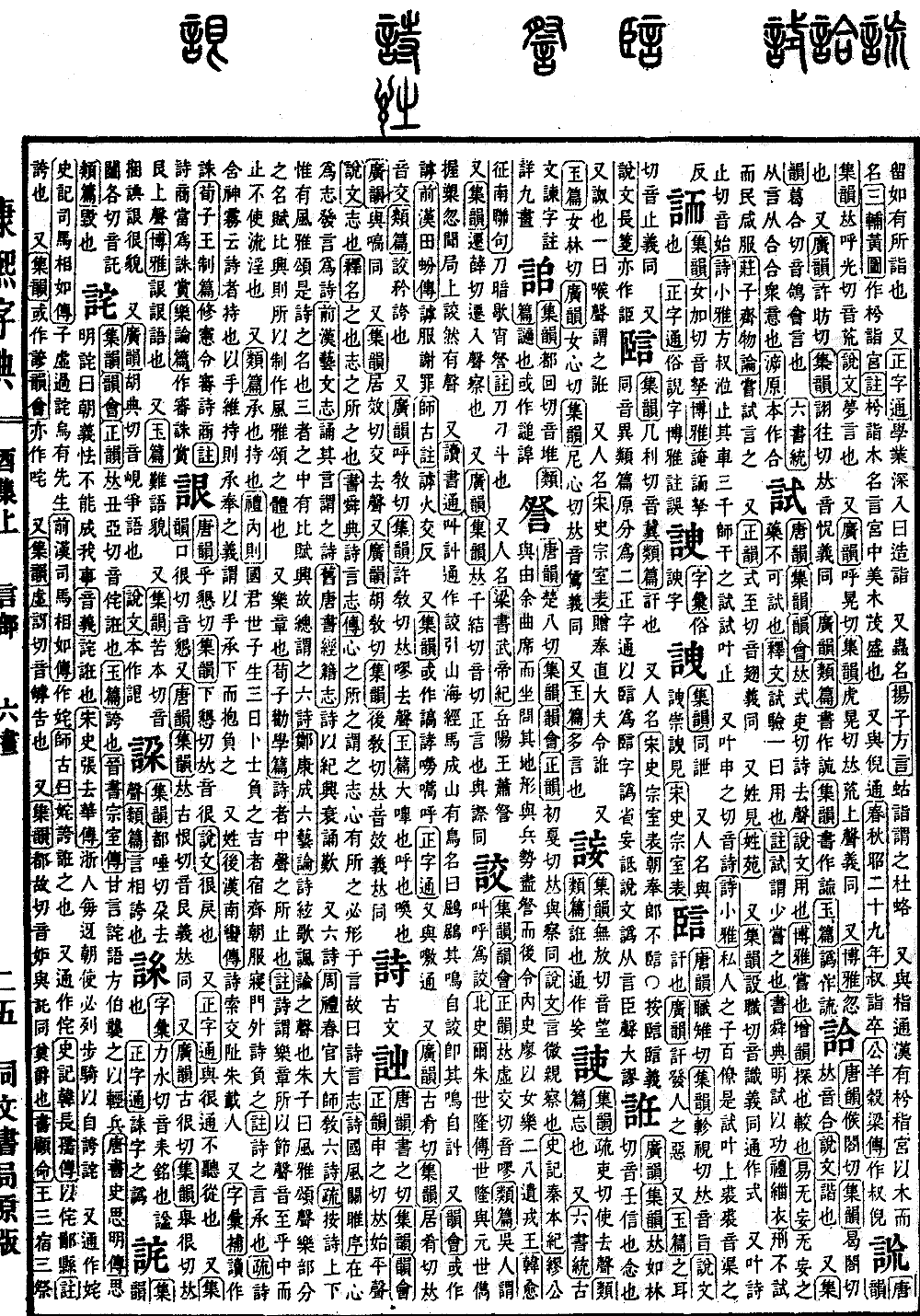
You Collection, Upper Volume
Radical: Speech (yán)
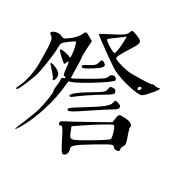
Character: Cha
Kangxi Stroke Count: 13
Page 1157, Entry 13
According to the Tang Rhyme (Tangyun), the pronunciation is cha (rising tone). According to the Collected Rhymes (Jiyun), Rhyme Meetings (Yunhui), and Orthodox Rhymes (Zhengyun), the pronunciation is cha (entering tone). It is the same as the character for examine.
According to the Explaining Graphs and Analyzing Characters (Shuowen), it refers to examining speech in minute detail.
Records of the Grand Historian (Shiji), Annals of Qin: Duke Mu and You Yu sat on a curved mat; he asked about the terrain and military strength, examined everything in detail, and then ordered the Grand Historian Liao to present sixteen female musicians to the Rong King.
Han Yu, Joint Verses on the Southern Expedition: The blades remain silent during the nightly watch. Annotation: Blades refers to the bronze cooking vessel used as a watch signal.
Also used in names. Book of Liang (Liangshu), Annals of Emperor Wu: Xiao Cha, Prince of Yueyang.
According to the Collected Rhymes (Jiyun), the pronunciation is qie (entering tone). It means to examine.
According to the Broad Rhymes (Guangyun) and Collected Rhymes (Jiyun), the pronunciation is qie. It means correct speech. It is the same as the character for correct.