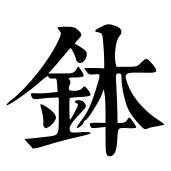
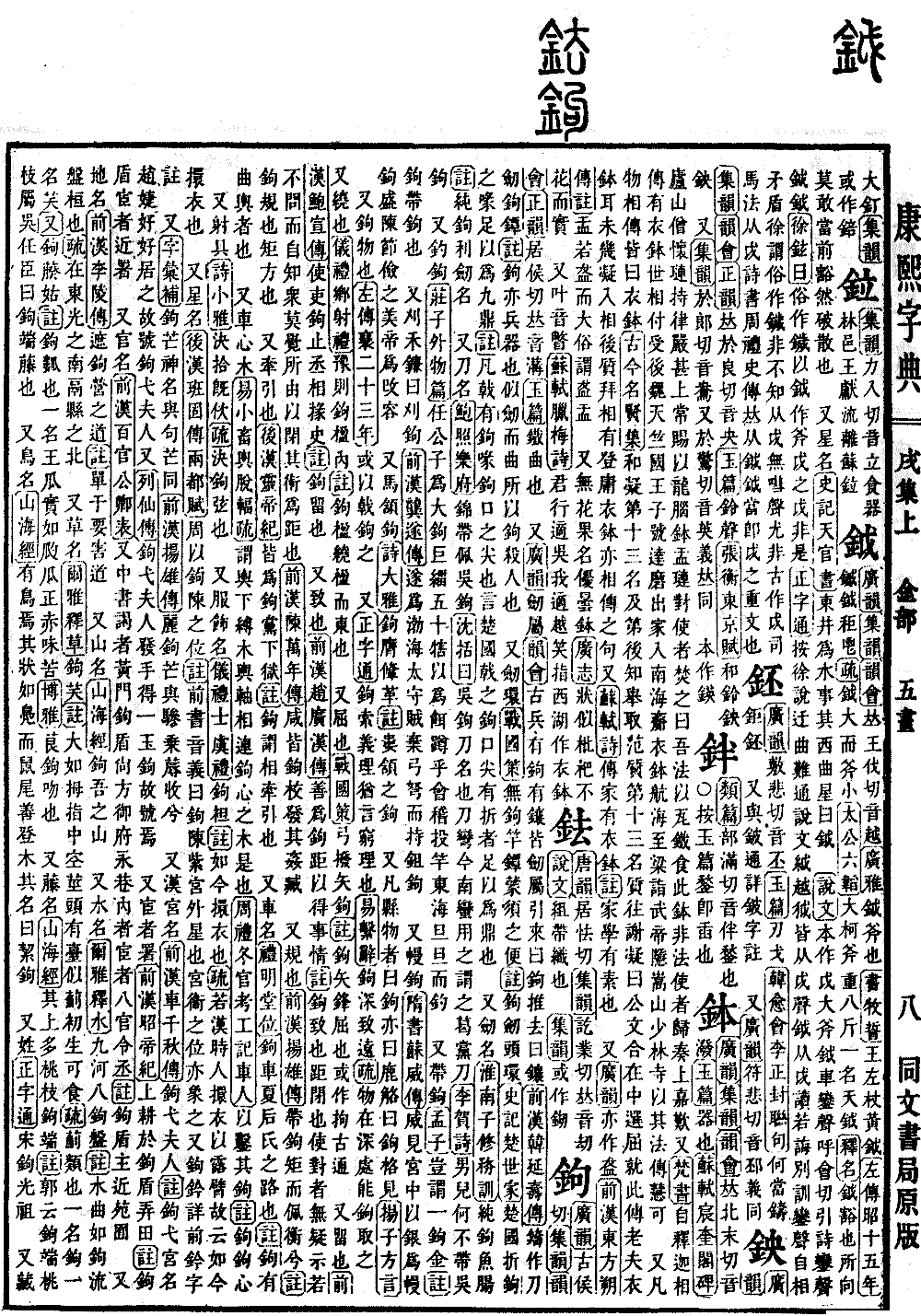
Xu Collection, Upper Volume
Radical: Metal (jīn)
Page 1302, Entry 06
Pronounced po.
In the Comprehensive Rhymes (Guangyun), Extensive Rhymes (Jiyun), and Collection of Rhymes (Yunhui), it is defined as a vessel.
According to the Book of Fragments (Yupian), it is a type of vessel.
In the writings of Su Shi regarding the Chenkui Pavilion, it is recorded that the monk Huailian of Mount Lu observed the commandments very strictly. The Emperor once bestowed upon him a dragon-brain bowl (bo-yu). Huailian burned it in the presence of the imperial messenger, stating that he used earthenware and iron vessels for meals according to the commandments, and this bowl did not conform to them. When the messenger reported this, the Emperor praised him highly.
According to Buddhist scriptures, ever since the time of Shakyamuni, there has been the transmission of the robe and bowl (yi-bo), passed down through generations. The prince of the Tianzhu kingdom during the Northern Wei dynasty, known as Bodhidharma, became a monk and traveled to the South Seas, crossing the ocean while carrying his robe and bowl. He visited Emperor Wu of the Liang dynasty and later lived in seclusion at the Shaolin Temple on Mount Song, transmitting his Buddhist teachings to Huike.
Everything passed down from a predecessor is referred to as a robe and bowl.
In the Collection of Ancient and Modern Worthies (Gujin Mingxian Ji), it is noted that He Ning placed thirteenth in the imperial examinations. Later, when he presided over the examinations, he selected Fan Zhi as the thirteenth-place candidate. Fan Zhi went to express his gratitude. He Ning said, Your essay should have been ranked higher; for now, you must accept this lower rank, as this is the transmission of my robe and bowl. Soon after, He Ning became Grand Councilor. Later, Fan Zhi also attained the rank of Grand Councilor, and there is a line of verse that says, Ascending to the highest office, the robe and bowl are also transmitted.
In the poems of Su Shi, there is the line, Inheriting the family robe and bowl. The commentary notes that this refers to the inheritance of family scholarly traditions.
In the Comprehensive Rhymes (Guangyun), it is also written in a variant form (bo).
In the commentary to the Biography of Dongfang Shuo in the History of the Former Han (Qian Han Shu), it is stated that a basin resembles a bowl but is larger, commonly called a bowl-basin (bo-yu).
The fig is called Udumbara (udunbo). According to the Extensive Records (Guangzhi), its shape resembles a loquat; it bears fruit without blooming.
Also pronounced pie. In the Plum Blossom poems by Su Shi, there is a line: You depart for the Wu region and I for the Yue region, pointing and laughing at the West Lake as the robe and bowl of our legacy.