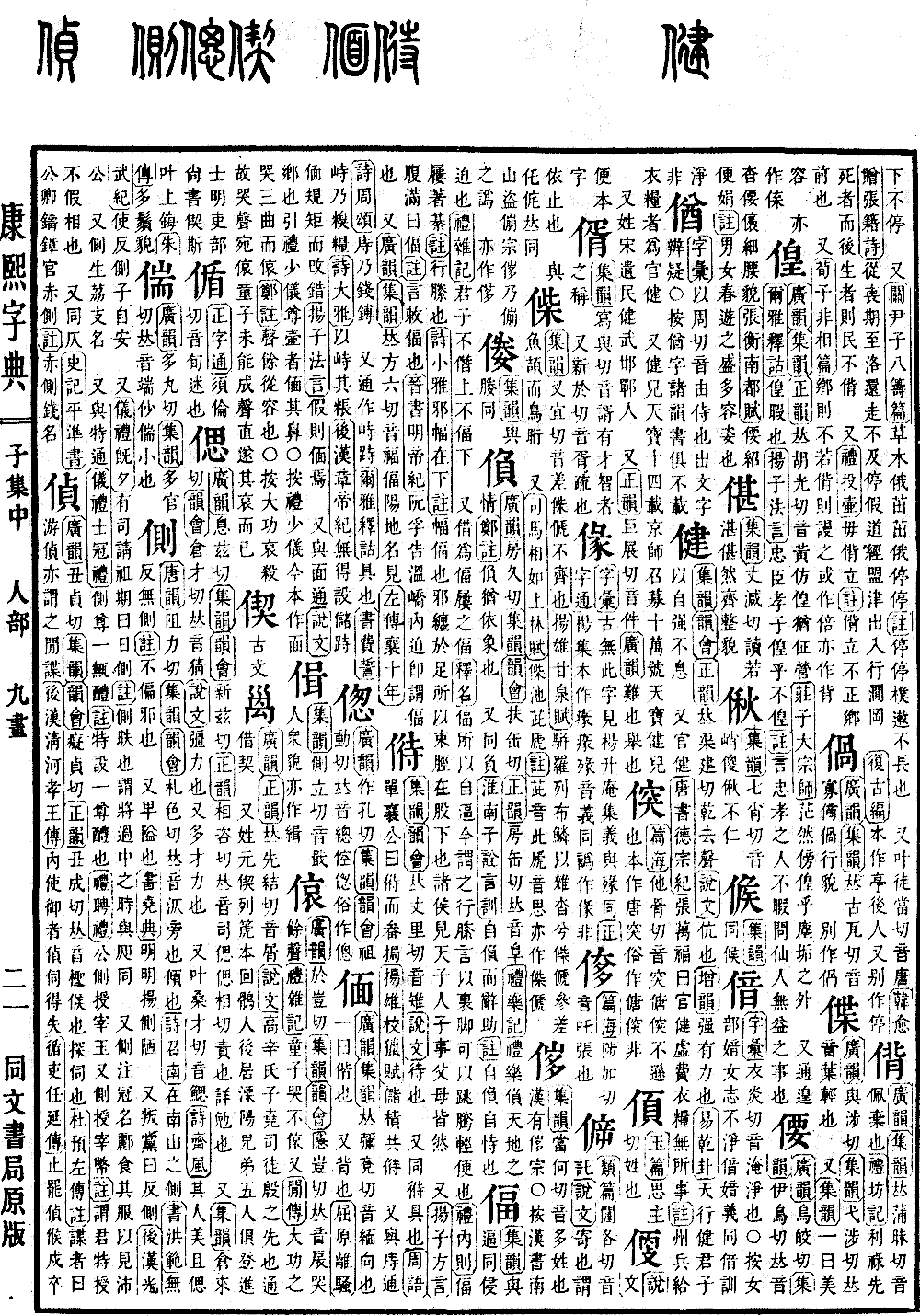
Zi Collection, Middle Volume
Radical: Person (rén)
Kangxi Strokes: 11
Page 111, Entry 23
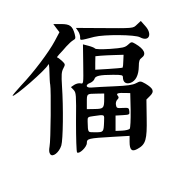
In the Collection of Rhymes (Jiyun), it is the same as the character for force or compel (bi). It means to infringe upon or to pressure. In the Book of Rites (Liji), specifically in the Miscellaneous Records (Zaji), it says that a superior person does not overstep those of higher rank and does not pressure those of lower rank.
It also refers to the name of a leg wrapping. In the Explanations of Names (Shiming), it states that the term refers to what one uses to restrain one's own legs and feet. Nowadays it is called a legging, meaning it is used to wrap the feet to allow for light and agile movement. In the Book of Rites (Liji), in the section on Inner Precepts (Neize), it says leggings are worn and tied with shoe straps. The commentary notes that this refers to leggings. In the Book of Odes (Shijing), in the Lesser Odes of the Kingdom (Xiaoya), the commentary on the passage concerning slanted leggings says that the term refers to the same object as the present entry. They are wrapped diagonally around the feet to bind the lower legs. When feudal lords meet the Son of Heaven, or children serve their parents, this is the attire worn.
Additionally, in Yangzi’s Regional Speech (Fangyan), a distended stomach is called by this term. The commentary explains that this refers to the feeling of being bloated or constricted. In the History of Jin (Jinshu), in the Biography of Emperor Ming (Mingdiji), Ruan Fu tells Wen Qiao that his stomach feels bloated, which uses this term.
Furthermore, according to the Extensive Rhymes (Guangyun) and the Collection of Rhymes (Jiyun), it is pronounced fu. It is also found in the name of the place Biyang, which appears in the Commentary of Zuo (Zuozhuan) in the tenth year of Duke Xiang.
Textual Research: Regarding the usage of this term as a legging, in the Book of Rites (Liji), Inner Precepts (Neize), the phrase mentions leggings and tying shoe straps. It is noted that the character functions as an independent term and should not be read in connection with the word for shoes. We have corrected the reading of the term to reflect its meaning as a name for a legging. In the Explanations of Names (Shiming), the text has been adjusted to add the word for bind after the word for force to reflect the original meaning.