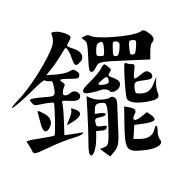
Pronounced bǐ wèi qiē in the "Tang Yun" (Tang Yun) and bān mí qiē in the "Ji Yun" (Ji Yun), with the same pronunciation as "pō". The "Shuowen Jiezi" (Shuowen Jiezi) explains it as a type of farming tool similar to a 耜 (sì). The "Guang Ya" (Guang Ya) explains it as the meaning of plowing. The "Ji Yun" (Ji Yun) records that it is sometimes written with a different character form. Nowadays, those who plow first use a 耜 (sì) to turn over the soil, then store water and use a 镈 (bó) to level the land; its handle is similar to a 耒 (lěi), and its flat bottom has teeth. It is sometimes also written as 𠕗.
Additionally, pronounced bó xiè qiē in the "Guang Yun" (Guang Yun) and bù mǎi qiē in the "Ji Yun" (Ji Yun), with the same pronunciation as "bà". It refers to a large iron staff.
Furthermore, pronounced bǔ mǎi qiē in the "Ji Yun" (Ji Yun), with the same pronunciation as "bǎi". The meaning is the same.
Also, pronounced bù huà qiē in the "Ji Yun" (Ji Yun), with the same pronunciation as "pá". It refers to the meaning of plowing.