You Collection, Lower Volume
Radical: City (yì)
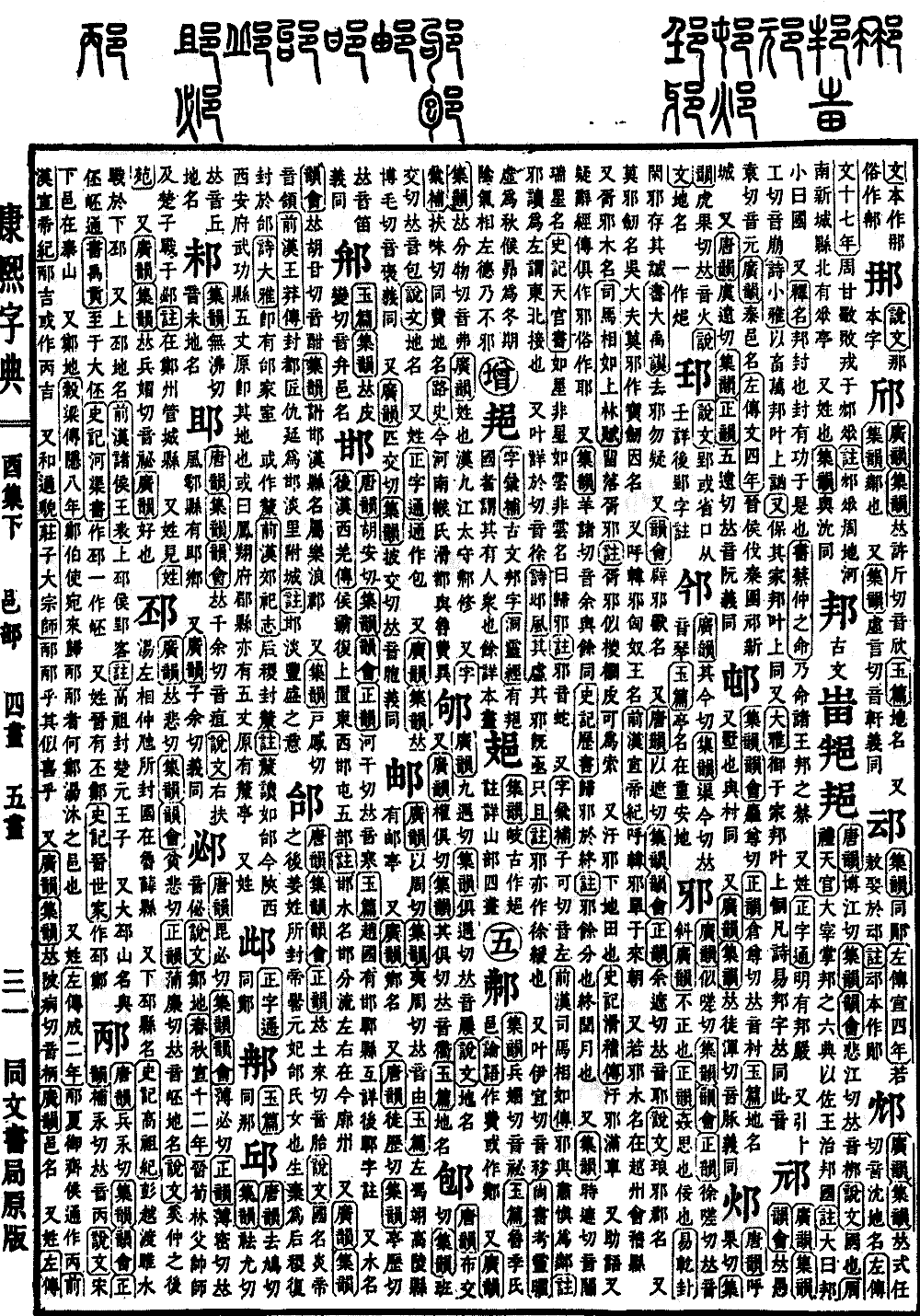
Character: 邦
Stroke Count: 11
Page 1269, Entry 05
Ancient script form: "邫".
Pronunciation: bāng (entering tone) from "Bōjiāng qiè" in Tang Yun (唐韵), and bāng from "Bēijiāng qiè" in Jiyun (集韵) and Yunhui (韵会).
Definition: "State" or "country" according to Shuowen Jiezi (说文解字).
Example: "The Grand Minister manages the six codes of the state, assisting the king in governing the state and country." — Zhou Li (周礼), Tian Guan (天官).
Annotation: Large states are called "bāng," and small states are called "guó."
Also, "bāng" means "to enfeoff," meaning to grant land to those who have rendered meritorious service. — Shiming (释名).
Example: "Then ordered the various kings to enfeoff the territory of Cai." — Book of Documents (Shu), Cai Zhong zhi Ming (蔡仲之命).
Also used as a surname.
Example: In the Ming Dynasty, there was a person named Bang Yan (邦严). — Zhengzitong (正字通).
Another pronunciation: bōng (entering tone) from "Bǔgōng qiè."
Rhyme: In the Book of Odes (Shijing), Xiaoya (小雅), "yǐ chù wàn bāng" rhymes with "fán" in the preceding line. Also, "bǎo qí jiā bāng" rhymes with the preceding line. In the Book of Odes (Shijing), Dayà (大雅), "yù yú jiā bāng" rhymes with "tòng" in the preceding line. The character "bāng" in the Book of Odes (Shijing) and Book of Changes (Yijing) is always pronounced this way.