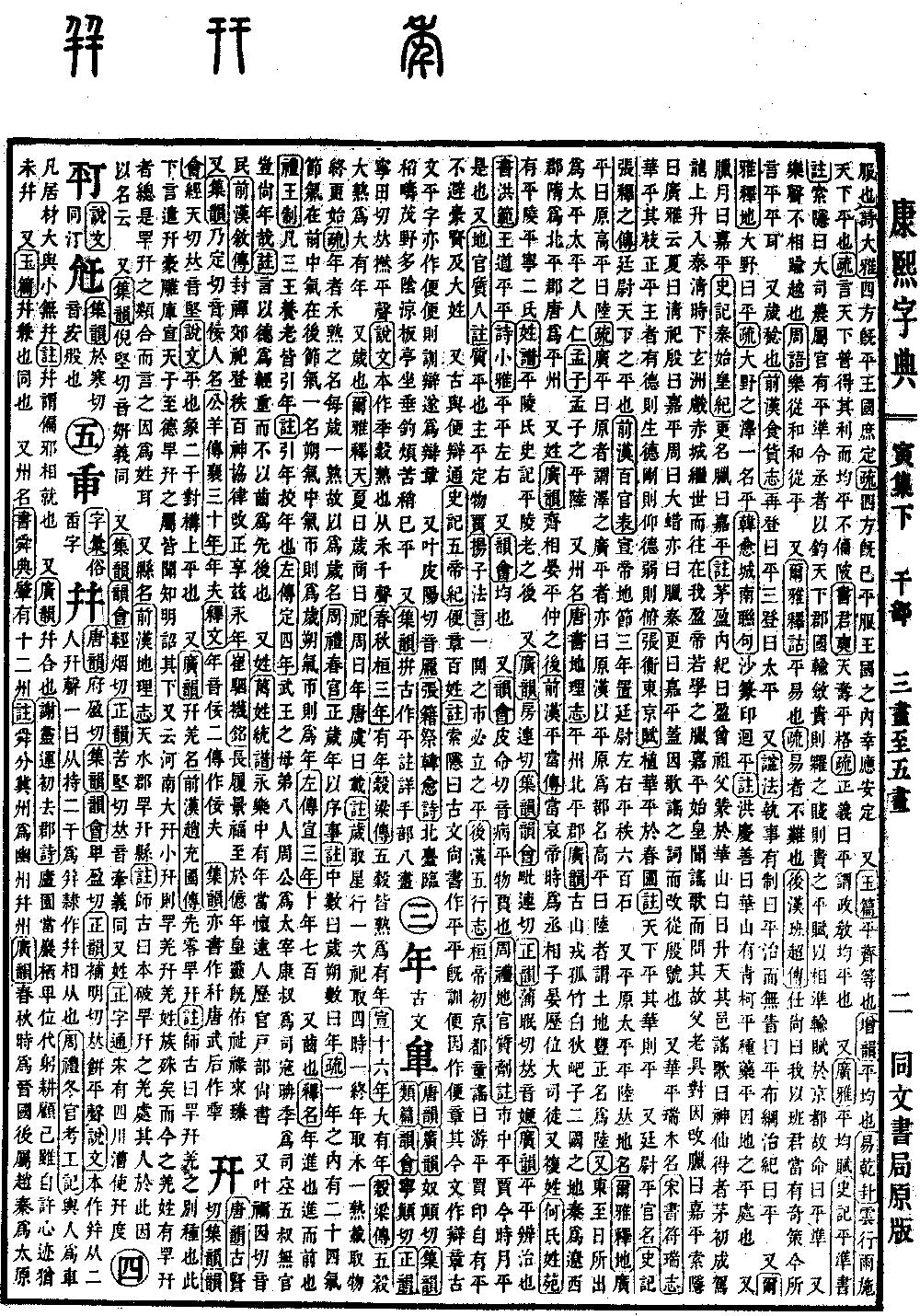
Yin Collection, Lower Volume
Radical: Dry (gàn)
Page 340, Entry 07
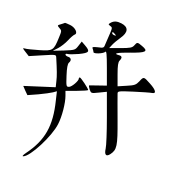
Pronounced bing (level tone).
Original text in Explaining Graphs and Analyzing Characters (Shuowen Jiezi) was written as a combination of two people with the phonetic component meaning flat (jian). Another account states it is formed by hands holding two dry characters. The clerical script variant is written as bing. It means to follow one another or to combine.
As recorded in the Rites of Zhou (Zhouli), section on Winter Offices, Artificers Record (Kaogongji), when a wheelwright constructs a carriage, all materials, whether large or small, must not be forced or pieced together improperly. The commentary notes that the bing here refers to crooked or improperly forced assembly.
Also, according to the Broad Rhymes (Guangyun), bing means to merge or unite.
In the poem Initial Departure from the Commandery by Xie Lingyun, it is written: I built a hut by the cliff to live in seclusion, substituting this for personal farming. Looking back, although I allowed myself this path, my inner thoughts and actual actions were not yet fully in harmony.
Also, the Jade Chapters (Yupian) states that bing carries the meaning of annexation or likeness. It is also the name of a province.
According to the Book of Documents (Shangshu), Canon of Shun (Shundian), it records the initial division into twelve provinces. The commentary notes that Emperor Shun divided Jizhou to establish Youzhou and Bingzhou.
The Broad Rhymes records that during the Spring and Autumn period, it belonged to the State of Jin, later reverting to the State of Zhao; the Qin dynasty established it as Taiyuan Commandery, and the Wei dynasty re-established Bingzhou.
The Collection of Rhymes (Yunhui) records that during the Tang dynasty, it was known as Taiyuan Prefecture.
It is also a surname. The Broad Rhymes notes it originates from the Garden of Surnames (Xingyuan). The Complete Genealogy of Ten Thousand Surnames (Wanxing Tongpu) records that a man named Bing Shao possessed literary talent, but the Ministry of Personnel lowered his selection ranking because the Bing surname had no historical sages.
Pronounced bing (falling tone).
The Broad Rhymes explains that bing means to act arbitrarily or to monopolize.
In the Book of Rites (Liji), section on Tan Gong, it records Zhao Wenzi saying: Yang Chufu acted arbitrarily and obstinately within the state. The commentary notes that bing means to act with total autonomy. It refers to a character that is rigid and self-willed. The Explanatory Text (Shiwen) notes the pronunciation as bing.
It is also identical to the character bing (variant form). The Collection of Rhymes states that the character bing is sometimes written in the simplified form of bing.
In the Essay on the Faults of Qin (Guoqin Lun) by Jia Yi: Annexing the remote lands in all eight directions.
In the Preface to Imitating the Poems of Yezhong by Xie Lingyun: The four things—fine days, beautiful scenery, joyous hearts, and pleasurable events—are difficult to possess all at once.
Also, it is interchangeable with the character bing (to discard). In the Zhuangzi, section on The Revolution of Heaven (Tianyun), it speaks of the most noble man discarding even the titles of the state. The commentary notes that bing means to cast aside or remove.
Also pronounced pang (level tone).
In the poem Sacrificing to Han Yu by Zhang Ji: By chance, a scholar named Jia arrived here to accompany me. Moving the boat into the southern creek, we poled east and west as we pleased.
The character was originally written using the components for bottom and flat. It is also written as bing.
Textual research: In the Book of Documents (Shangshu), Canon of Shun (Shundian), the text states: Initially, there were twelve provinces. Following the original text, the phrasing ten there is corrected to there are ten.