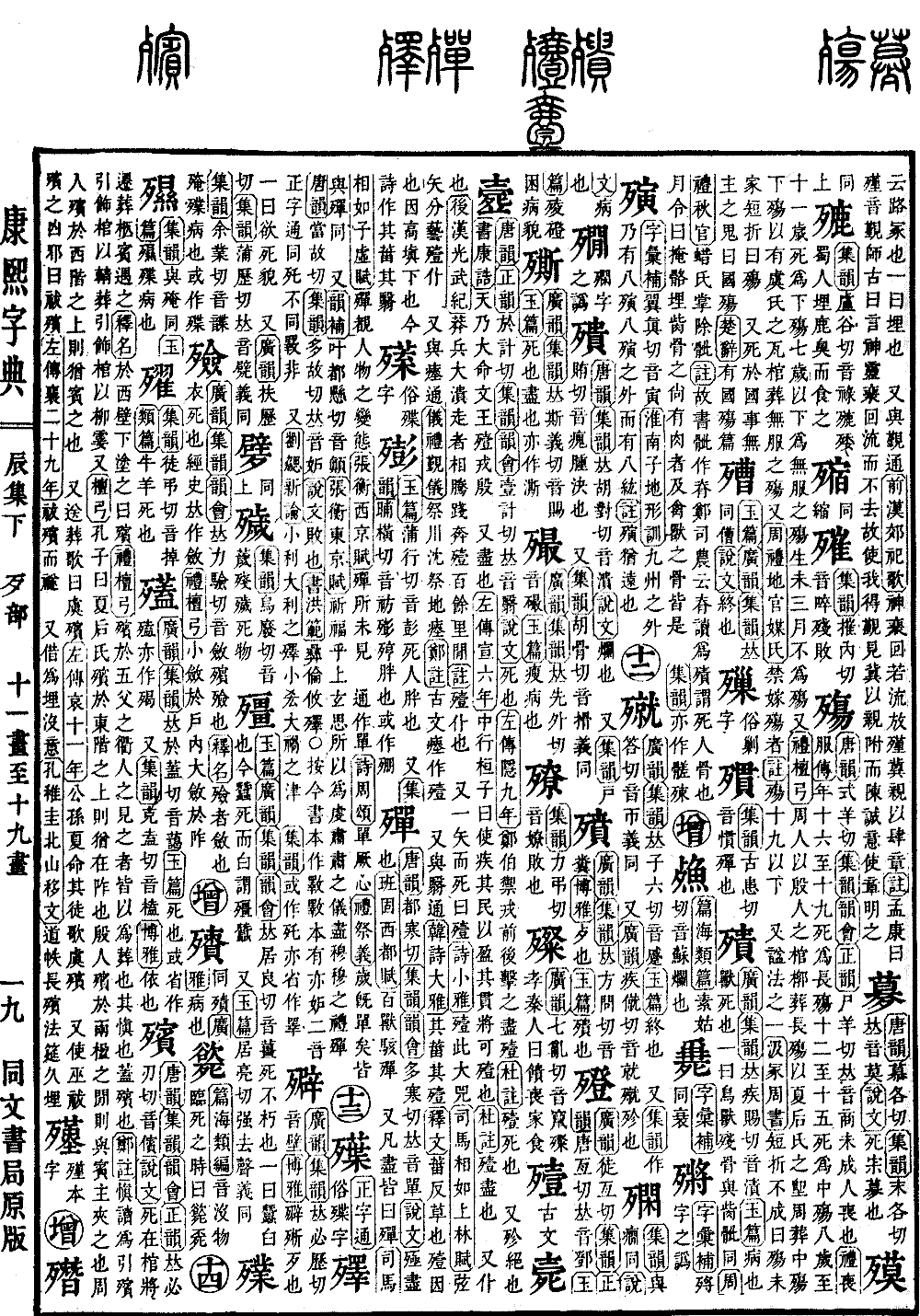
Chen Collection, Lower Volume
Radical: Bad (dǎi)
Kangxi Strokes: 18
Page 583, Entry 44
Pronounced bin (falling tone), same pronunciation as bin (level tone).
Explaining the meaning: The body is already in the coffin, and the casket is about to be transported for burial, treated with the rites accorded to a guest.
Explication of Names (Shiming) states: Placing a casket under the western wall for adornment is called bin (the funeral rite).
Book of Rites (Liji), Tan Gong states: The casket was placed at the intersection of Wufu, and all who saw it thought it was a burial. In truth, that represents the meaning of caution (yin), which is the rite of funeral preparation.
Zheng Xuan's commentary: The character for caution is read as yin (to lead). During the funeral rite, a decorated cart (qian) is used to adorn the coffin, and during the interment, a willow canopy (sha) is used to adorn the coffin.
Furthermore, Book of Rites (Liji), Tan Gong states: Confucius said: The people of the Xia Dynasty placed the casket on the eastern steps, indicating that they still regarded the deceased as the master of the house. The people of the Shang Dynasty placed the casket between the two pillars of the hall, which is the position between the host and the guest. The people of the Zhou Dynasty placed the casket on the western steps, which is treating the deceased as a guest.
Also, the dirge sung during a funeral procession is called Yu Bin.
Zuo Tradition (Zuo Zhuan), Year 11 of Duke Ai: Gongsun Xia ordered his subordinates to sing Yu Bin.
Also, requesting a shaman to expel baleful influences during the funeral rite is called fu bin (purification of the funeral).
Zuo Tradition (Zuo Zhuan), Year 29 of Duke Xiang: Performed the purification rite and then bestowed burial garments.
Also, it is used to signify being buried or neglected.
Kong Zhigui, North Mountain Proclamation (Beishan Yiwen): The Taoist texts have long been buried (neglected), and the lecture seats have long since fallen into ruin.