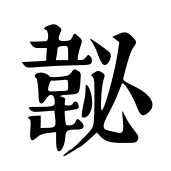
Pronounced bing mei (falling tone), same as "mi". "Yùpiān" explains it as a bowstring. "Book of Odes (Shijing), Qin Feng, Zhu Bi Geng Téng Shu" and "Jì Xī Jì" mention "yǒu yǎn" when referring to bows as burial objects. "Zhù" states: Yǎn is a bow quiver. When the bow is not in use, it is tied to the inside of the bow to prevent damage. It is made of bamboo. Quoting from "Book of Odes (Shijing)": "Zhú bì gēng téng." Therefore, zhú bì is also called yǎn. The meaning of "bì xiè" is to place the bow inside the yǎn and tie it with a rope, hence the yǎn is called xiè.
Furthermore, "Zhou Li, Dong Guan Kao Gong Ji, Gong Ren Zhu" states: Xiè is the bow quiver. If the bow horn is too long, it will cause the arrow to be sent out slowly, as if bound by the quiver. "Shì Wén" pronounces yǎn as bei wei (falling tone).
Also, in "Book of Odes (Shijing), Qin Feng, Shì Wén," Xu Miao annotates the pronunciation as bian hui (falling tone).
Furthermore, "Jí Yùn" annotates the pronunciation as bi jie (falling tone), same as "bì". The meaning is the same. "Book of Odes (Shijing), Qin Feng, Shì Wén" states: Yǎn, another pronunciation is bi jie (falling tone). Verification: [Book of Odes (Shijing), Qin Feng, Zhu Bi Geng Téng Shu] According to the original text, "téng" is changed to "téng." [Quoting from the Book of Odes, "Zhú bì gēng téng."] According to the original text, "téng" is changed to "téng."