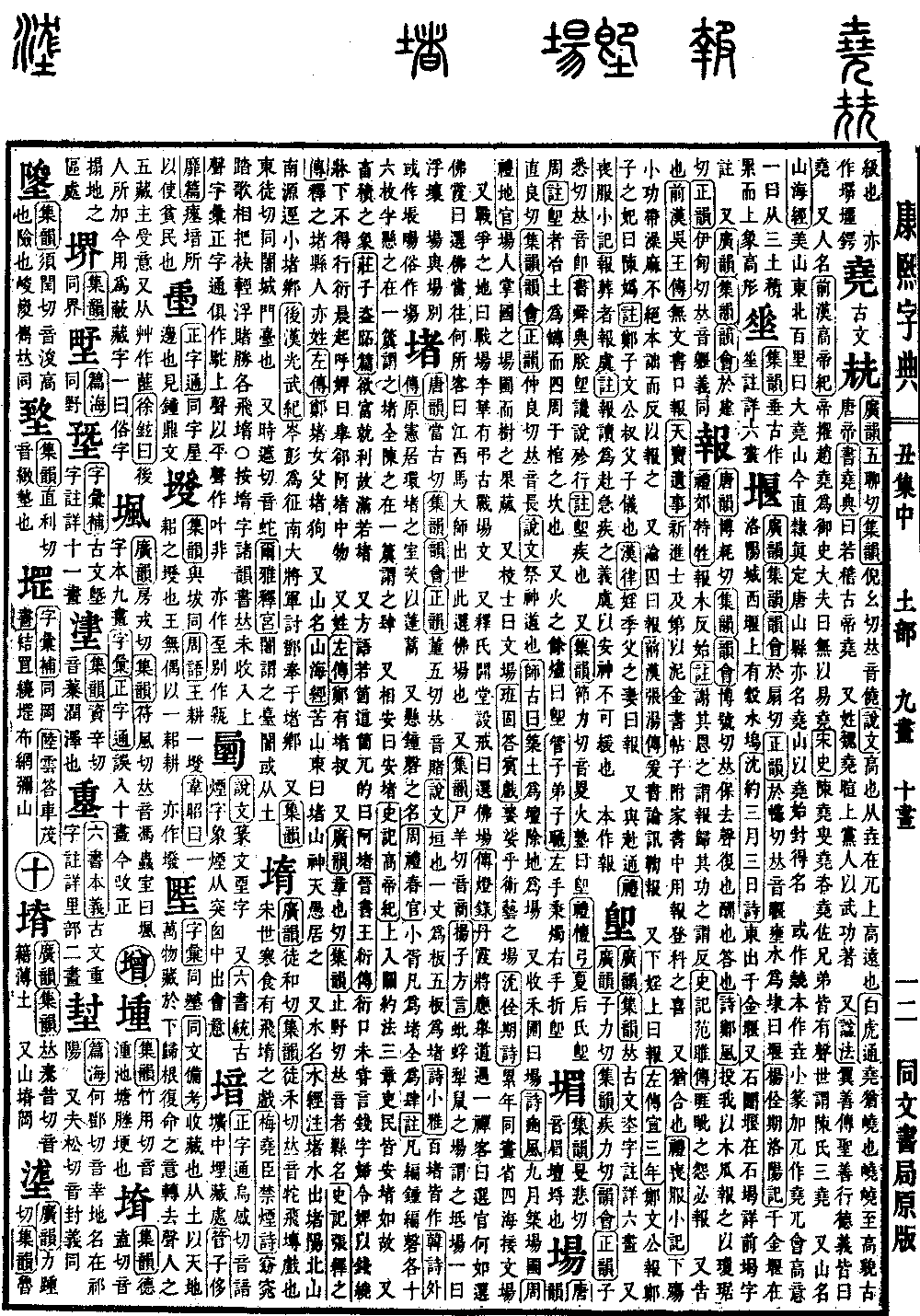
Chou Collection, Middle Volume. Radical: Earth (tǔ). 12 strokes. Page 234, Entry 05.
Pronounced bao (falling tone).
Meaning: To reply, to reward, or to requite.
Book of Odes (Shijing): If others gift me with a papaya, I will return the favor with a beautiful jade.
Book of Rites (Liji): To requite the original source and return to the beginning. Commentary: To acknowledge a kindness is called bao, and to attribute merit to the original source is called fan (returning).
Records of the Grand Historian (Shiji): Even a minor grievance, such as a hateful glare, must be retaliated against.
Also refers to informing or reporting.
Book of Han (Hanshu): Without official documentation, reported orally.
Anecdotes of the Tianbao Era (Tianbao Yishi): Newly successful candidates for the imperial examination would use gold powder to write notices, which they included with home letters to report the good news of their success.
Also refers to corresponding or matching.
Book of Rites (Liji): For the mourning belt of a minor youth (xiaoshang), use washed hemp, do not cut the base, but fold it so the two ends meet.
Also refers to the sentencing of criminals as bao.
Book of Han (Hanshu): To record testimonies, interrogate, convict, and pass judgment.
Also refers to illicit sexual relations between a younger generation and an elder generation as bao.
Zuo Tradition (Zuo Zhuan): Duke Wen of Zheng had an illicit affair with the concubine of Zuozi named Gui. Commentary: Zuozi was the uncle of Duke Wen, named Ziyi. The Han Legal Code states that illicit relations with an uncle's wife is called bao.
Also used interchangeably with fu (to go quickly), indicating haste.
Book of Rites (Liji): Those conducting a hasty burial must perform the yu ritual (a post-burial sacrificial rite) immediately. Commentary: Bao is read as fu, meaning urgency. The yu ritual is intended to comfort the spirit and cannot be delayed. The original character is written as a variant form.