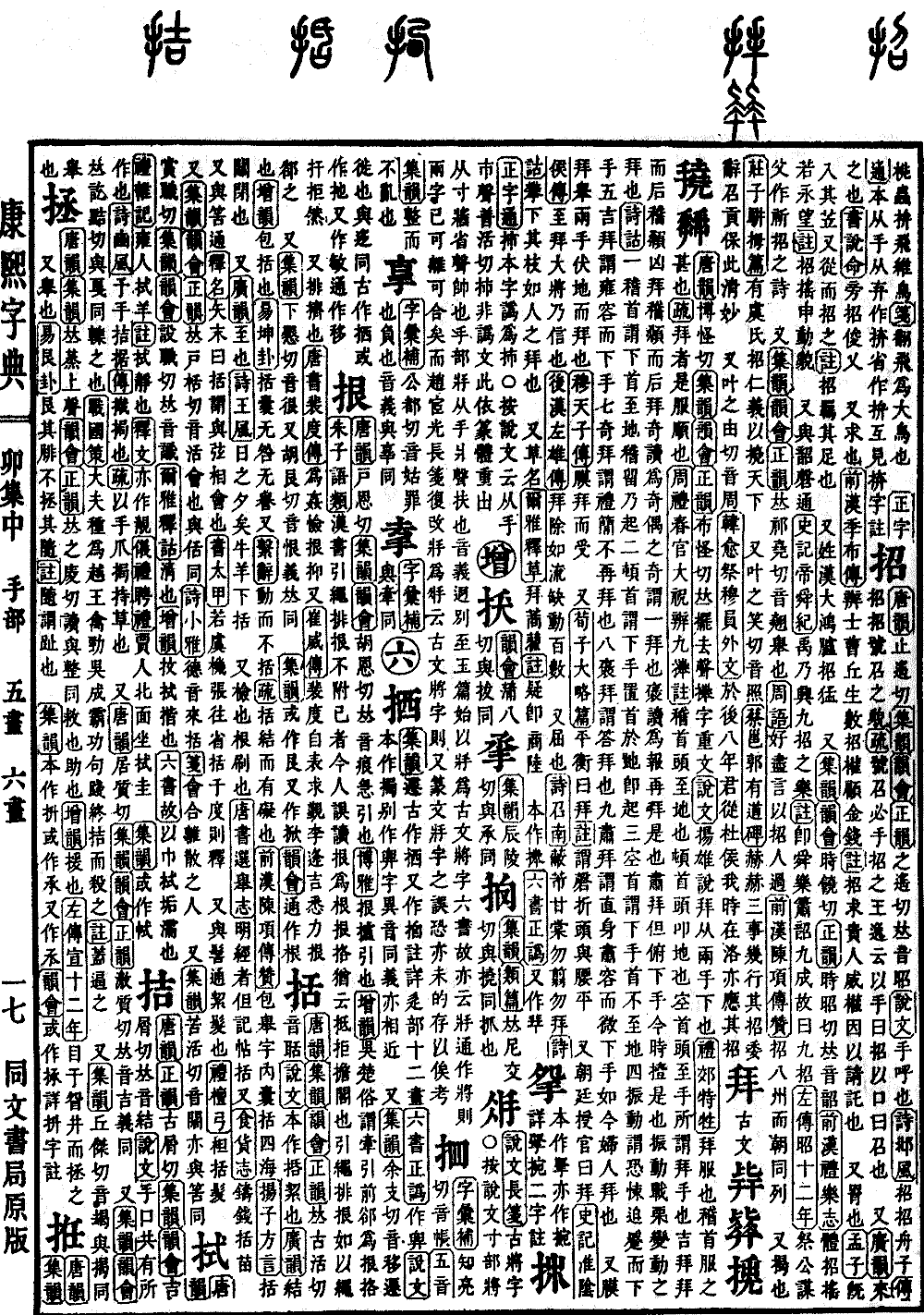
Mao Collection, Middle Volume
Radical: Hand (shǒu)
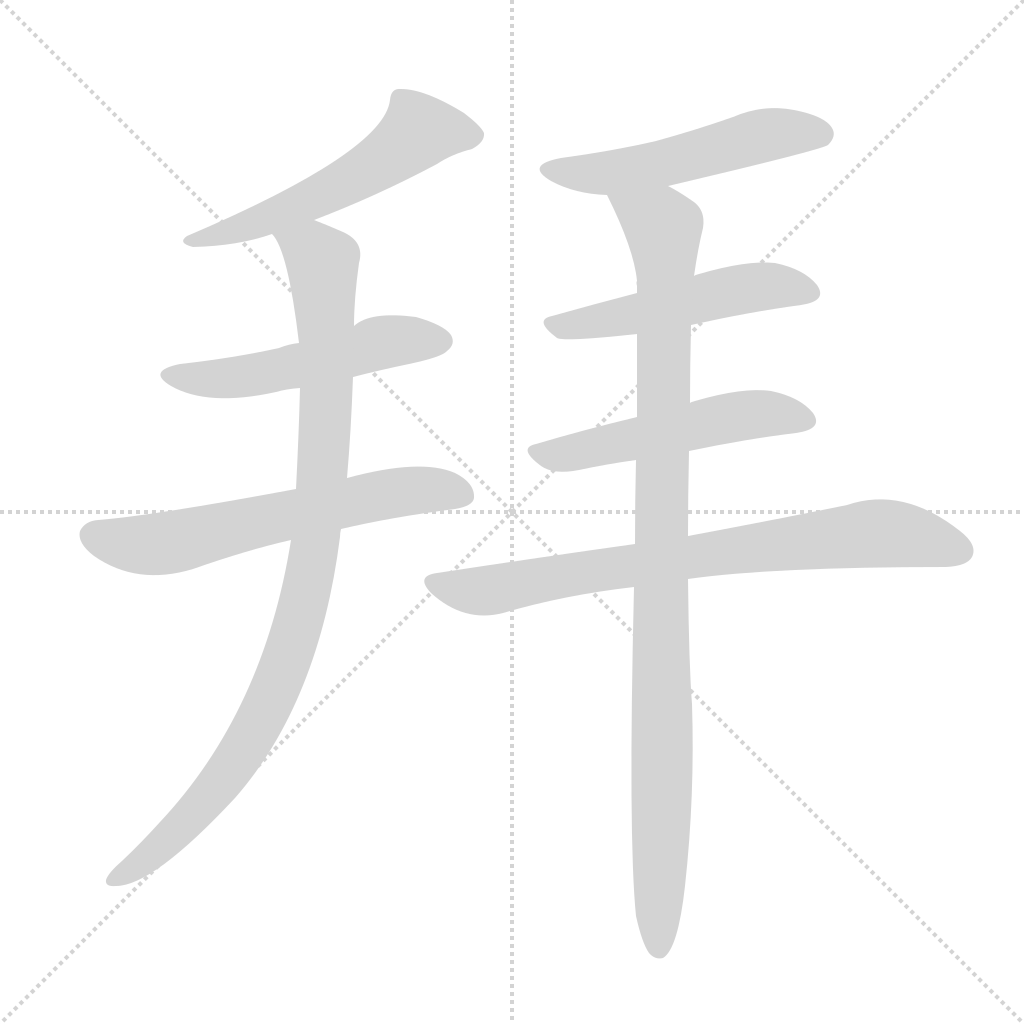
拜
Kangxi stroke count: 9
Page 427, Entry 02
Ancient form. Pronounced bài (falling tone). A variant of the character.
According to the Explaining Graphs and Analyzing Characters (Shuowen Jiezi), Yang Xiong explained that the character for bowing, bai, is formed by the two hands moving downward.
According to the Book of Rites (Liji), in the chapter "Suburban Sacrifice" (Jiao Tesheng), to bow is to submit; a kowtow (qishou) is the ultimate form of submission. The commentary notes that bowing represents submission and obedience.
According to the Rites of Zhou (Zhouli), in the section "Spring Officials" (Chunguan) regarding the Great Invocation (Dazhu), there are nine types of bows. A kowtow (qishou) means bringing the head to the ground. A head-knock (dunshou) means striking the head against the ground. A hollow bow (kongshou) means lowering the head to the hands, which is also called a hand-bow (baishou). For a lucky bow (jibai), one bows and then strikes the forehead; for a funerary bow (xiongbai), one strikes the forehead and then bows. The term for an odd bow (qibai) is read like the word for odd-numbered, referring to a single bow. The term for a praise bow (baobai) is read like the word for repaying, referring to a second bow. A solemn bow (subai) simply involves lowering the hands, similar to the modern-day salutation (yi). A trembling bow (zhendong) is a bow performed with fear and shivering.
According to the Poetry Exegesis (Shigu): 1. A kowtow (qishou), where the head is lowered to the ground and held there before rising. 2. A head-knock (dunshou), where the hands are lowered, the head is placed on the ground, and one rises immediately. 3. A hollow bow (kongshou), where the hands are lowered but the head does not touch the ground. 4. A trembling bow (zhendong), where one lowers the hands out of fear and urgency. 5. A lucky bow (jibai), where one lowers the hands gracefully. 7. An odd bow (qibai), where the ritual does not require a second bow. 8. A praise bow (baobai), where one returns a bow. 9. A solemn bow (subai), where one stands straight with a solemn expression and slightly lowers the hands, similar to how women bow today.
Also, a prostrate bow (mobai) involves raising both hands and bowing while lying on the ground. According to the Biography of the Son of Heaven (Tianzi Zhuan), one prostrates to receive an order.
Also, according to the Xunzi, in the chapter "Great Summary" (Dalyue Pian), bowing is described as balancing, meaning the body is bent like a stone chime, with the head and waist level.
Also, to be appointed to office by the imperial court is called a bai. According to the Records of the Grand Historian (Shiji), in the "Biography of the Marquis of Huaiyin," when he was appointed as a great general, it was indeed him. According to the Book of the Later Han (Hou Hanshu), in the "Biography of Zuo Xiong," appointments and dismissals occurred like a flowing stream, with hundreds of positions becoming vacant or filled.
Also, to bend. According to the Classic of Poetry (Shijing), in the "Shao Nan" section: Do not prune or bend the small sweet-pear tree. The Poetry Exegesis (Shigu) notes that this means pulling down the branches, as a person would bow.
Also a plant name. According to the Erya (Approaching Elegance), in the chapter "Explanations of Grasses" (Shicao), there is a plant called baishangdiao. The commentary suspects this is the pokeweed (shanglu). Originally written as a variant form (zhuang). According to the Six Categories of Writing Corrected (Liushu Zheng'e), it is also written in a variant form.