Xu Collection, Middle Volume
Radical: Rain (yǔ)
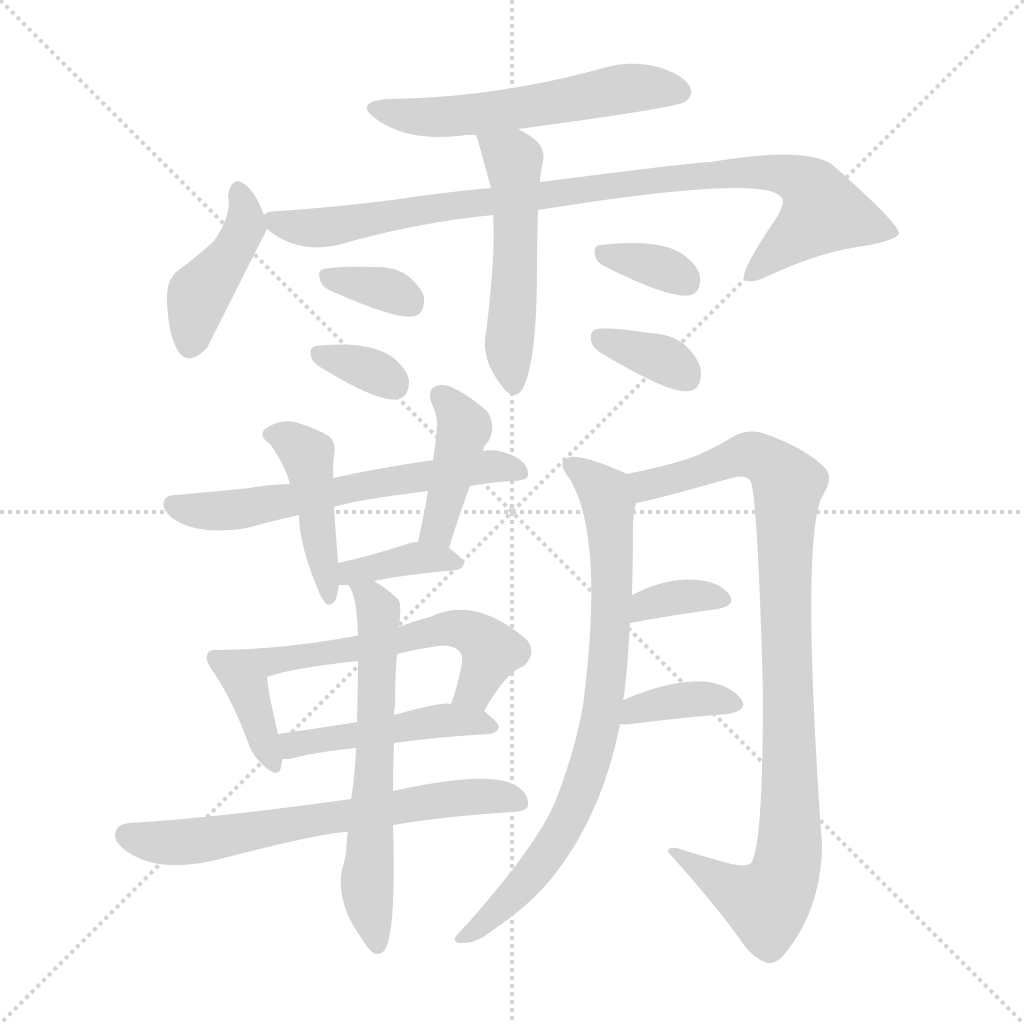
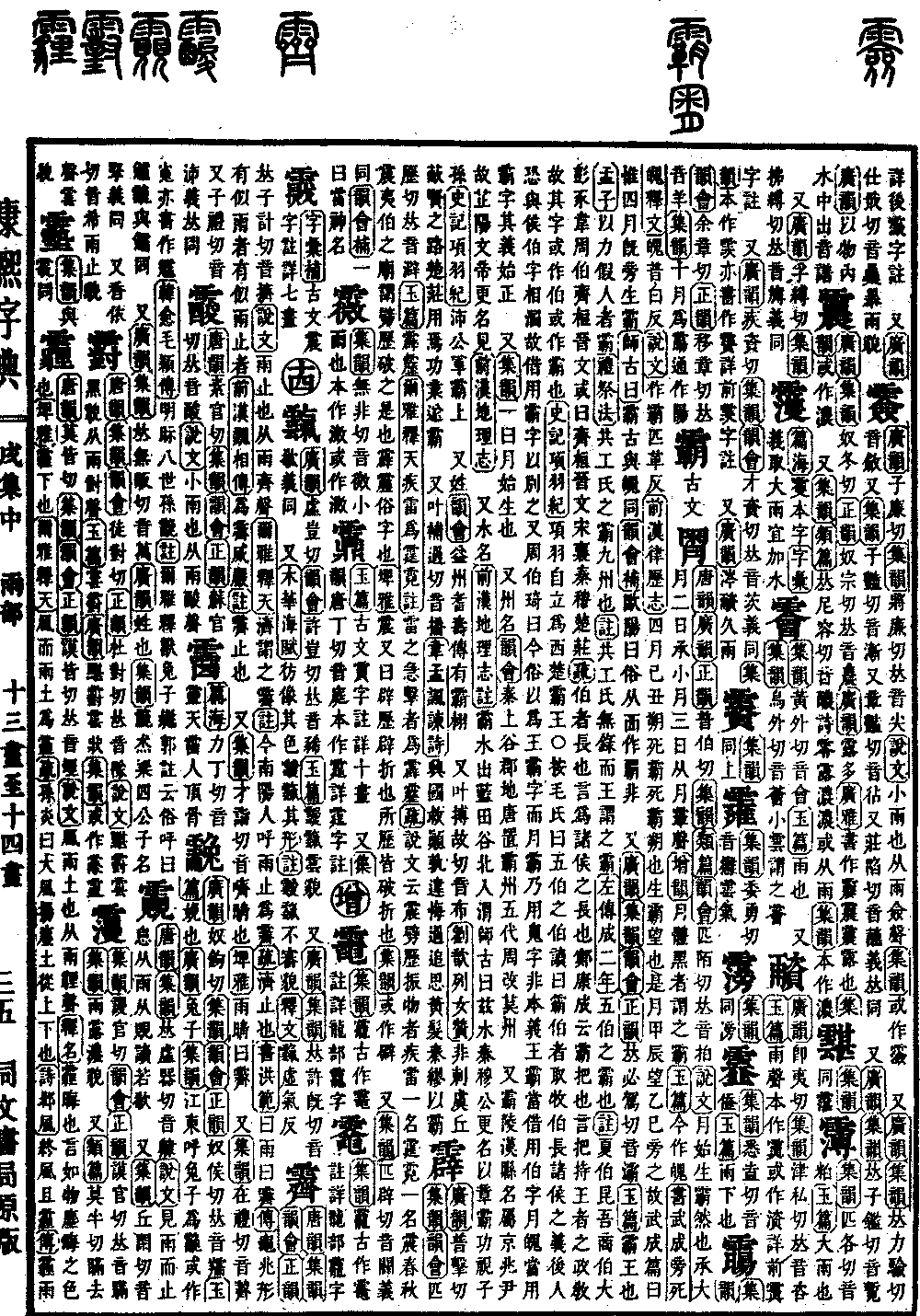
霸; Kangxi strokes: 21; Page 1379, Entry 13
Ancient texts. Pronounced pai.
Shuowen Jiezi (Dictionary of Characters): The appearance of the moon just as it begins to wax. It is the second day following the first day of a large month, or the third day following the first day of a small month. The character is formed from the moon radical with a phonetic component.
Zengyun (Additional Rhymes): The dark portion of the moon's surface is called ba.
Yupian (Jade Chapters): Now written as the variant form (po).
Book of Documents (Shujing), Wu Cheng chapter: Commentary on the passage concerning the death of the moon. Po is pronounced bai (rising tone).
Shuowen Jiezi (Dictionary of Characters): Written as ba, pronounced ge (rising tone).
History of the Former Han (Qian Hanshu), Treatise on Harmonics and Calendars: In the fourth month, on the day jichou, the new moon occurred. Si ba is the day of the new moon. Sheng ba is the day of the full moon. In this month, the day jiachen was the full moon; yisi was adjacent to it, which is why the Wu Cheng chapter says: During the fourth month, the new moon began to appear.
Shigu says: Ba, in ancient times, was identical to (po).
Yunhui Bu (Supplement to the Collection of Rhymes): Ouyang Xiu says: The common form written with the west radical is incorrect.
Pronounced ba (falling tone).
Yupian (Jade Chapters): Means a hegemon or overlord.
Mencius: One who relies on force while feigning benevolence to command others is called a hegemon (ba).
Classic of Rites (Liji), Rite of Sacrifices: The Gonggong clan claimed hegemony over the nine provinces. Commentary: The Gonggong clan lacked the mandate of heaven yet claimed royal authority, thus they are called hegemons.
Zuo Tradition (Zuozhuan), Second Year of Duke Cheng: The hegemonic achievements of the Five Hegemons. Commentary: The hegemon of the Xia dynasty was Kunwu; the hegemons of the Shang dynasty were Dapeng and Shiwei; the hegemons of the Zhou dynasty were Duke Huan of Qi and Duke Wen of Jin. Some also identify the Five Hegemons of the Spring and Autumn period as Duke Huan of Qi, Duke Wen of Jin, Duke Xiang of Song, Duke Mu of Qin, and King Zhuang of Chu. Exegesis: Bo signifies a leader. It refers to being the leader of the feudal lords. Zheng Kangcheng says: Ba means to control; it refers to controlling the political and religious affairs of the Son of Heaven, which is why this character is sometimes written as bo and sometimes as ba.
Records of the Grand Historian (Shiji), Annals of Xiang Yu: Xiang Yu declared himself the Hegemon-King of Western Chu. Note: Mr. Mao says: The bo in the Five Hegemons is read as ba. The character bo signifies the head of the local feudal lords; later generations feared it would be confused with the noble title bo, so they borrowed the character ba to distinguish it.
Zhou Boqi says: Now the common usage employs ba for the character meaning royal hegemony, while using (po) for the lunar ba (lunar shadow), which is not the original meaning. Royal hegemony should borrow the character bo, and lunar (po) should use the character ba; only then are the meanings correct.
Jiyun (Collection of Rhymes): Another interpretation refers to the moon just as it begins to wax.
Name of a prefecture. Yunhui (Collection of Rhymes): The site of Shanggu Commandery during the Qin dynasty; Ba Prefecture was established during the Tang dynasty and changed to Mo Prefecture during the Later Zhou of the Five Dynasties period.
Baling, a county name from the Han dynasty, belonging to the Jingzhao Yin; originally called Zhiyang, it was renamed by Emperor Wen of Han, see History of the Former Han (Qian Hanshu), Treatise on Geography.
Name of a river. History of the Former Han (Qian Hanshu), Commentary on the Treatise on Geography: Ba River, originates in Lantian Valley and flows north into the Wei River. Shigu says: Duke Mu of Qin renamed this river to manifest his hegemonic achievements to his descendants. Records of the Grand Historian (Shiji), Annals of Xiang Yu: The Prince of Pei stationed his troops at Bashang.
Surname. Yunhui (Collection of Rhymes): In the Biographies of the Elders of Yizhou, there is a person named Ba Xu.
Also pronounced bo. Liu Xin, Praise of Exemplary Women: Not to disparage Yu Qiu, by blocking the path of the worthy. King Zhuang employed this, and his achievements reached hegemony.
Also pronounced bo. Wei Meng, Satirical Odes: To revive the state and save it from collapse, who would violate repentance? Recalling the elderly, Duke Mu of Qin achieved hegemony.