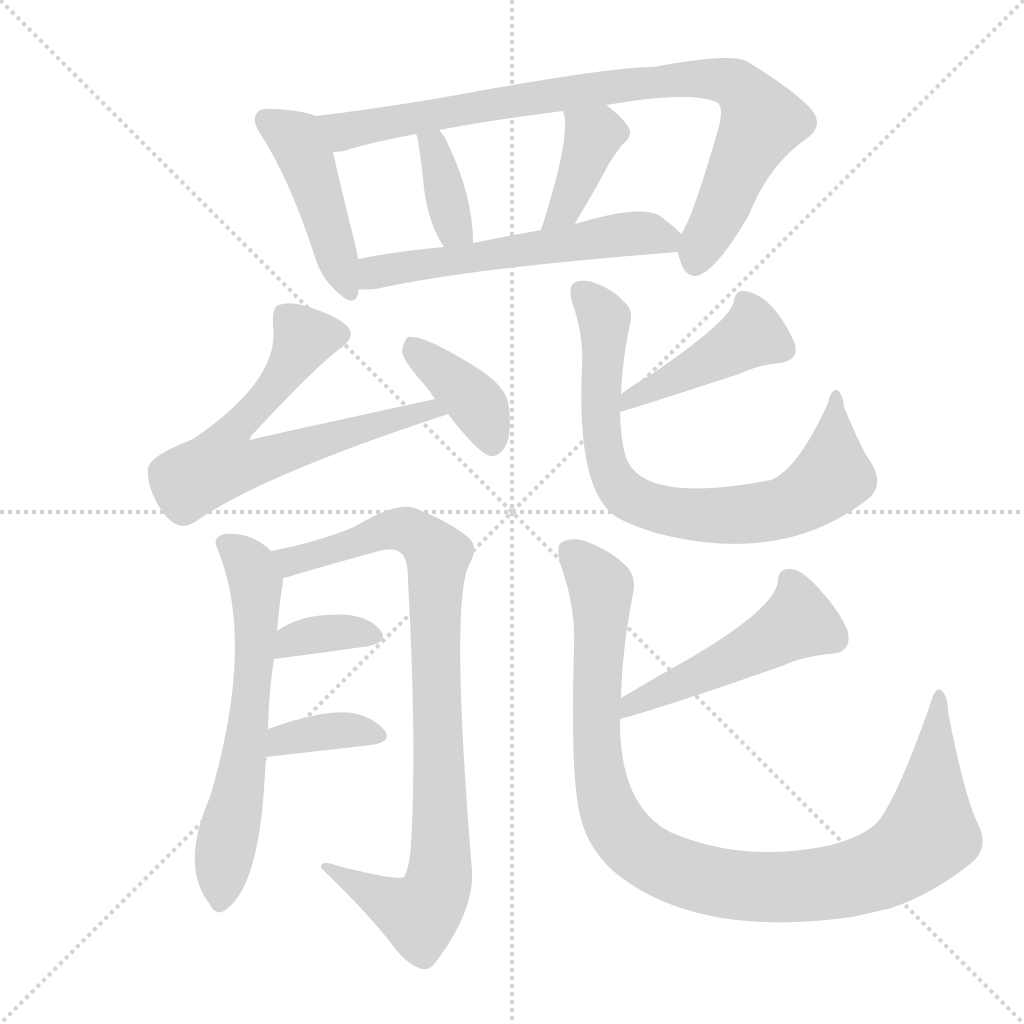
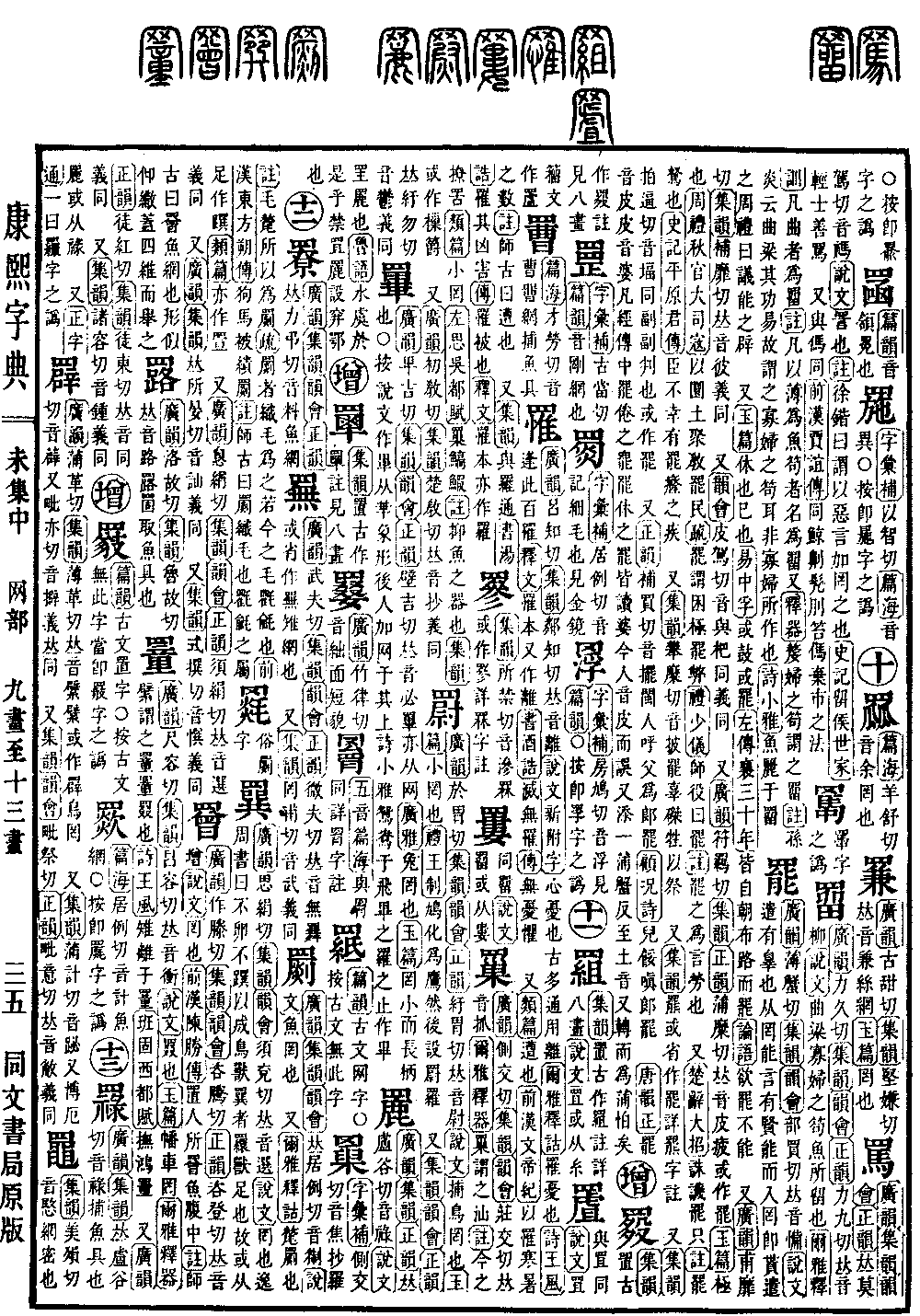
Wei Collection, Middle Volume. Radical: Net (wǎng). Kangxi stroke count: 16. Page 949, Entry 08.
Pronounced xiè. Pronounced mǎi.
According to the Explaining Graphs and Analyzing Characters (Shuowen Jiezi), it refers to the release of those found guilty. Composed of the radical for net and the character for capable. This implies that if a person of capability and virtue is ensnared by the legal net, one should show leniency and release them. The Rites of Zhou (Zhouli) states: deliberate upon the punishments for the capable.
Also, per the Jade Chapters (Yupian), it means to cease or to finish. The Book of Changes (Yijing), section on Inner Truth (Zhongfu), mentions: or beating drums or ceasing. The Zuo Commentary (Zuozhuan), 30th year of Duke Xiang, states: they all spread out their belongings from the court and then dispersed. The Analects (Lunyu) states: wished to stop but could not.
Pronounced bǐ. The meaning is the same.
Pronounced pá. The meaning is the same.
Pronounced pí. Exhausted; sometimes written as this character. Per the Jade Chapters (Yupian), it means to reach the limit. The Rites of Zhou (Zhouli), Office of Autumn, Minister of Justice, states: use the round enclosure to gather and instruct the exhausted people. The commentary states: the exhausted refers to those who are distressed and fatigued. The Book of Rites (Liji), section on Minor Ceremonies (Shaoyi), states: regarding military service, it is called exhaustion. The commentary states: the meaning of exhaustion here is to be weary.
The Songs of Chu (Chuci), Great Summons (Dazhao), states: reproaching the incompetent. The commentary states: this refers to those of low capability. The Records of the Grand Historian (Shiji), Biography of Lord Pingyuan, states: I am unfortunate enough to suffer from a condition of exhaustion and infirmity.
Pronounced pī. This refers to the division of animal carcasses for sacrificial offerings.
Sometimes the character for brown bear is written as this character. See the entry for brown bear for details.
Pronounced bì. Same as the character for secondary. Secondary means to dissect or split. Sometimes written as this character.
Pronounced bǎi. In the Min region, people refer to their father as lang-ba. Gu Kuang's poetry states: the child is hungry and scolds his father.
According to the Tang Dynasty Rhymes Corrected (Tangyun Zheng), this character is pronounced pi, while the character for skin is pronounced po. In all classical texts, where this character denotes fatigue or denotes stopping, it is pronounced po. Modern people pronounce it pi, and erroneously add a pronunciation of xie, while in dialects, it has shifted to the sound of pa.