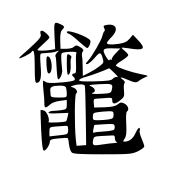
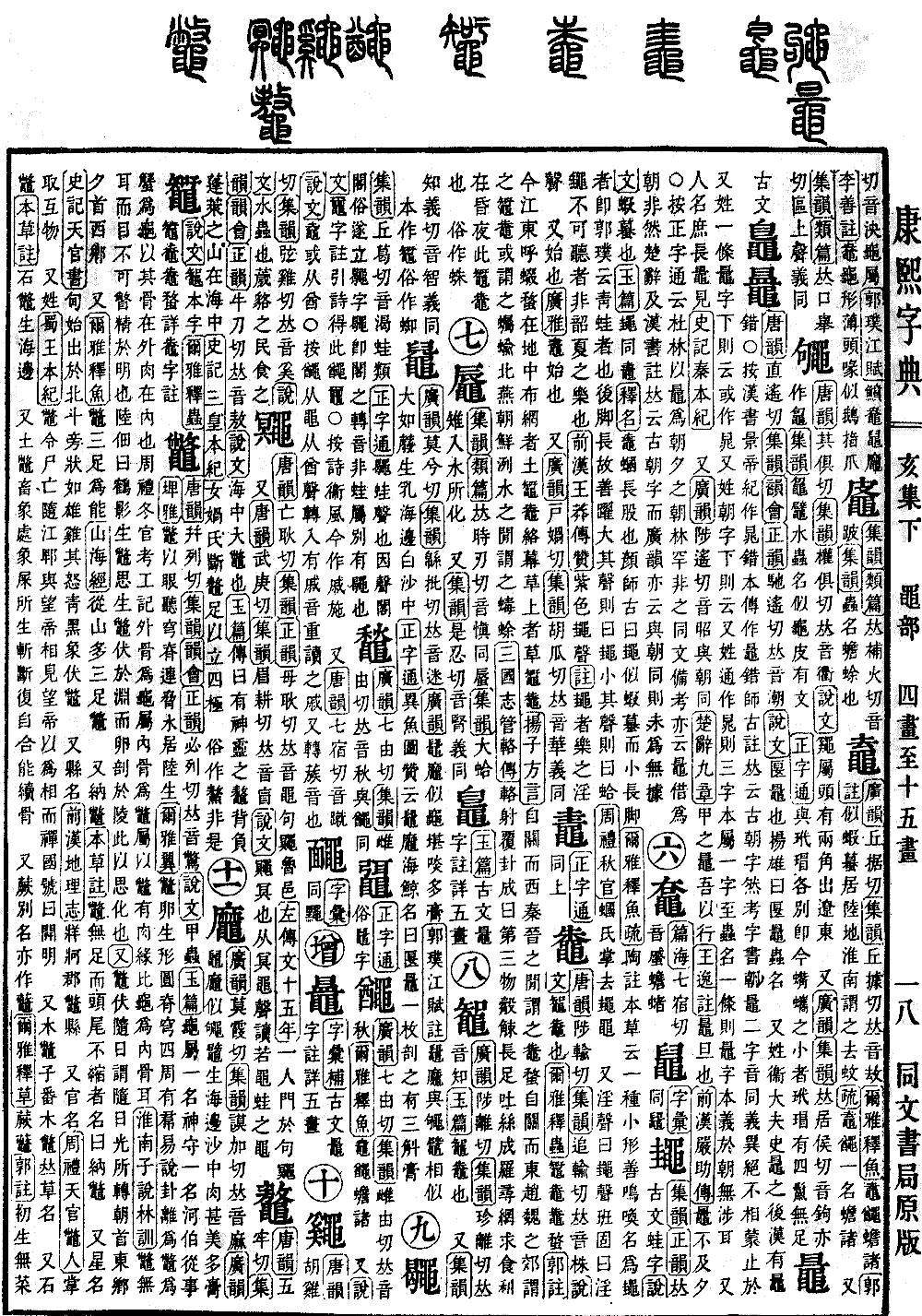
Hai Collection, Lower Volume
Radical: Frog (mǐn)
Page 1524, Entry 27
Pronounced bie.
As defined in the Analytical Dictionary of Chinese Characters (Shuowen Jiezi), it is a crustacean.
As defined in the Jade Chapters (Yupian), it is an animal of the turtle family. It is also known as the Divine Guardian or the Attendant of the River God.
As stated in the Guide to Amplified Meanings (Piya), the turtle hears through its eyes, has a raised spine, connected ribs, and can live both in water and on land.
As stated in the Wings of the Erya (Eryayi), the turtle is oviparous, has a circular body with a raised spine, and possesses a skirt-like edge around its body.
According to the Discussion of Trigrams in the Book of Changes (Yijing), the trigram for fire represents the turtle, the crab, and the tortoise because their skeletons are external and their flesh is internal. The Records of Tradesman in the Winter Officials section of the Rites of Zhou (Zhouli) records that creatures with external skeletons are tortoises, while those with internal skeletons are turtles, because the turtle has fleshy edges, which distinguishes it as having an internal skeleton compared to the tortoise.
As stated in the Forest of Discourses in the Masters of Huainan (Huainanzi), the turtle has no ears and its eyes cannot close, which is why its vision is exceptionally sharp. Lu Dian stated: The shadow of a crane can incubate, and the intention of a turtle can incubate. The turtle hides in deep water but lays its eggs on hills; this is generation through intention. It is also said that the turtle rotates according to the sun; this refers to following the direction of sunlight, with the head facing east in the morning and west in the evening.
Also, as stated in the Explanation of Fish in the Literary Expositor (Erya), a three-legged turtle is called a neng.
As stated in the Classic of Mountains and Seas (Shanhaijing), Mount Cong contains many three-legged turtles.
There is also the na turtle. As stated in the Commentary on the Materia Medica (Bencao Zhu), a turtle without legs that cannot retract its head and tail is called a na turtle.
There is also a name of a constellation. As stated in the Treatise on the Celestial Offices in the Records of the Grand Historian (Shiji), the Xunshi star appears next to the Big Dipper, shaped like a rooster; when it is angry, its color is dark green, resembling a crouching turtle.
There is also a county name. As stated in the Treatise on Geography in the History of the Former Han (Qianhan Shu), the Zangke Commandery has a Bie County.
There is also an official title. The Heaven Officials section of the Rites of Zhou (Zhouli) describes the official in charge of procuring shelled animals.
There is also a surname. As stated in the Annals of the Kings of Shu (Shuwang Benji), the corpse of Bie Ling drifted down the river to the Pi region, where he met Emperor Wang. Emperor Wang appointed him as chancellor and later abdicated the throne to him, with the state name Kaiming.
There are also the plants known as the woody turtle seed and the foreign woody turtle.
There is also the stone turtle. According to the Commentary on the Materia Medica (Bencao Zhu), the stone turtle grows by the sea.
There is also the earth turtle, which is found in places where elephants are kept, generated from elephant dung; if cut, it can rejoin itself and is capable of knitting bones together.
It is also an alternative name for bracken. It is also written in a variant form (bie). As stated in the Explanation of Grass in the Literary Expositor (Erya), the term for bracken is bie. According to the Commentary by Guo Pu, it has no leaves when it first sprouts and is edible; in Jiangxi, it is called bie. In the Odes of Shao in the Book of Odes (Shijing), it says to gather the bracken. The Commentary of Mao states that bracken is the bie. It resembles a turtle's foot when it first sprouts, which is how it got its name.
Also pronounced bei. As stated in the Rhapsody on the Capital of Shu (Shudu Fu) by Zuo Si, the white turtle commands the turtles, and the otters go ashore to perform sacrifices.
The vulgar forms of the character are written as the alternative forms.
Correction: In the Treatise on the Celestial Offices in the Records of the Grand Historian (Shiji), the text originally cited as dian shi appearing next to the Big Dipper has been corrected according to the original source to read xun shi.