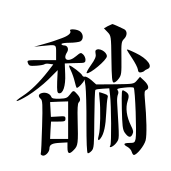
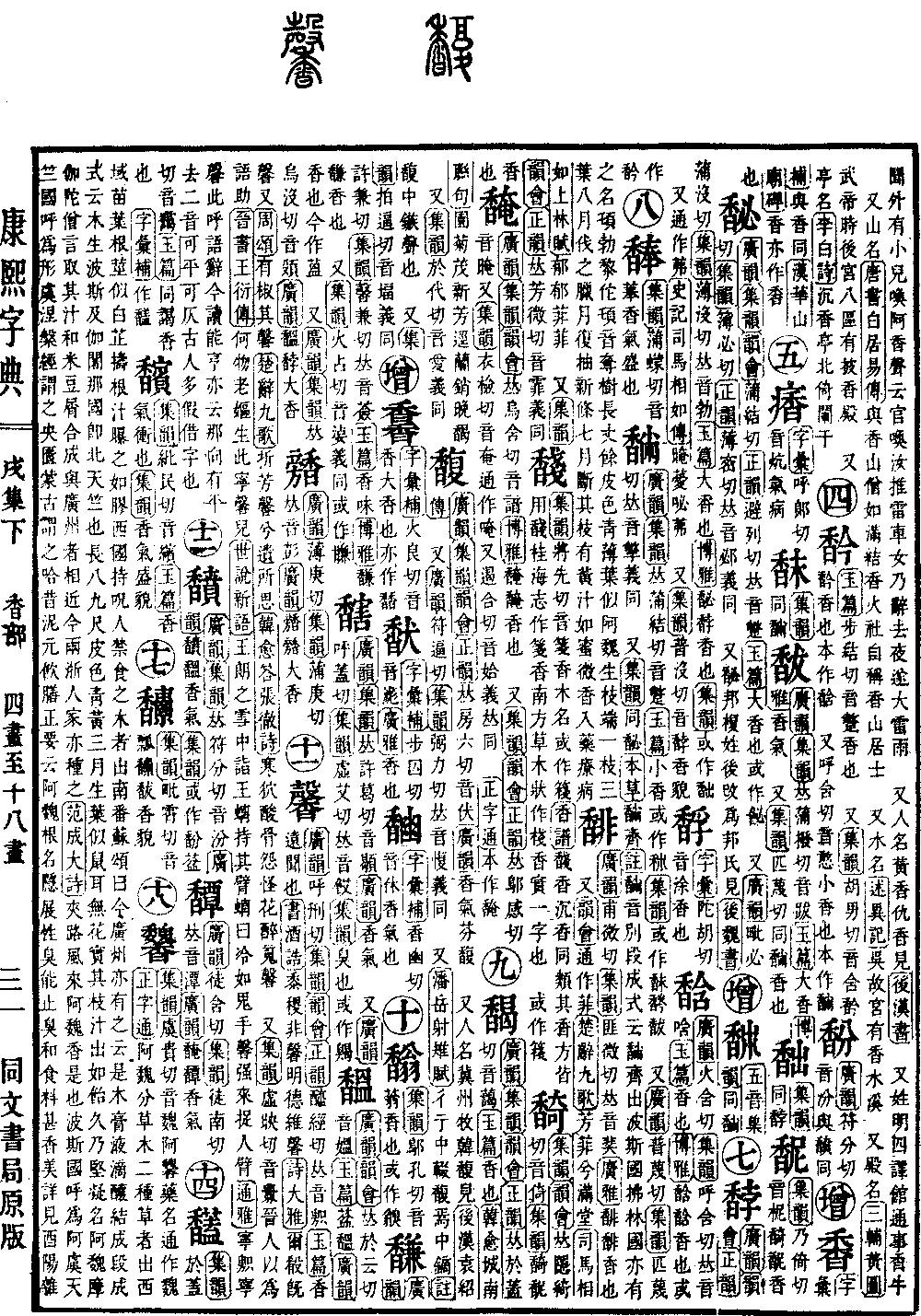
In "Guangyun" and "Jiyun", it is recorded as pronounced pu jie (entering tone), same sound as "bie". "Yupian" explains it as small incense. Sometimes also written as . In "Jiyun", it is also sometimes written as "fe".
Additionally, in "Guangyun", there is also pu mie (entering tone), and in "Jiyun", there is pi mie (entering tone), same sound as "bie". The meaning is the same.
Furthermore, "Jiyun" records it as the same as "li". "Bencao" mentions "qi". The commentary states: "qi", pronounced bie. Duan Chengshi says: "qi" is produced in the country of Persia, and also in the country of Fulin, named Bo Lituo. Pronounced duo. The tree is over a zhang tall, with blue bark and thin leaves, like asafoetida, growing at the tips of branches, with three leaves on each branch. It is cut in August, and new branches sprout in December. If the branches are broken in July, there is a yellow sap, slightly fragrant like honey, which can be used as medicine. The character @ is composed of "xiang" and "cen". Also.