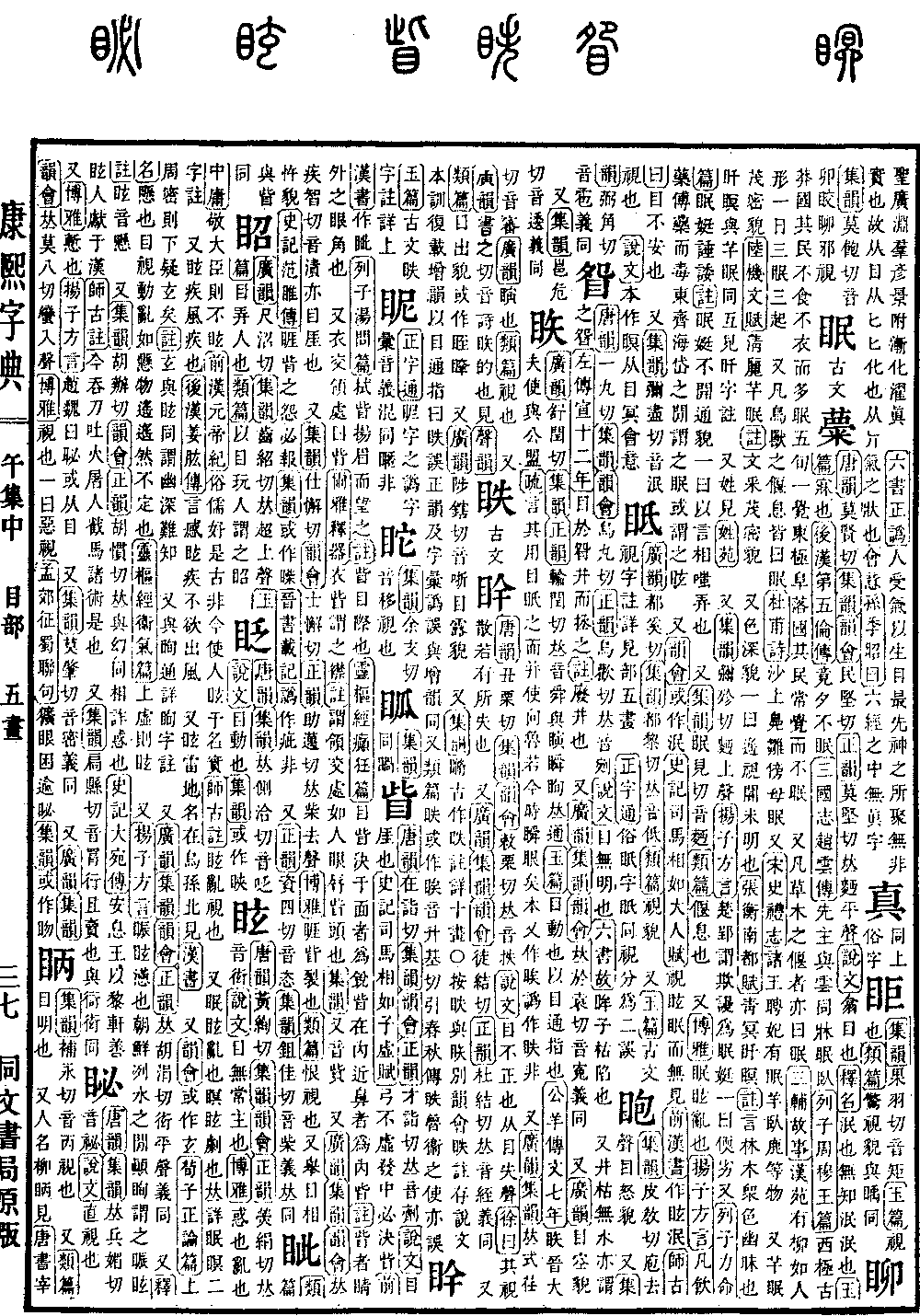
"Tang Yun" and "Ji Yun" record its pronunciation as "bing mei qie," which sounds like "mi." "Shuowen Jiezi" explains it as the appearance of looking directly.
Also, "Boyan" records it as having the meaning of shame. "Yangzi · Fangyan" states that the Zhao and Wei regions call it "chi." Sometimes the character form is from the "Eye" radical.
Furthermore, "Ji Yun" records its pronunciation as "mo bi qie," which sounds like "mi." The meaning is the same as stated above.
Also, "Guangyun," "Ji Yun," and "Yun Hui" record its pronunciation as "mo ba qie," which sounds like the entering tone of the character "man." "Boyan" explains it as looking. Another interpretation is to look fiercely. "Meng Jiao · Zheng Shu Lianju" uses it in the phrase "guang yan kun yu mi." "Ji Yun" records that it is sometimes also written as "mi."
Research: ["Ji Yun" mo zhao qie, pronounced mi.] "Mo zhao qie" has been changed to "mo bi qie" according to the original text.