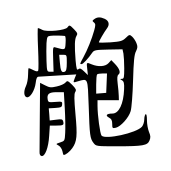
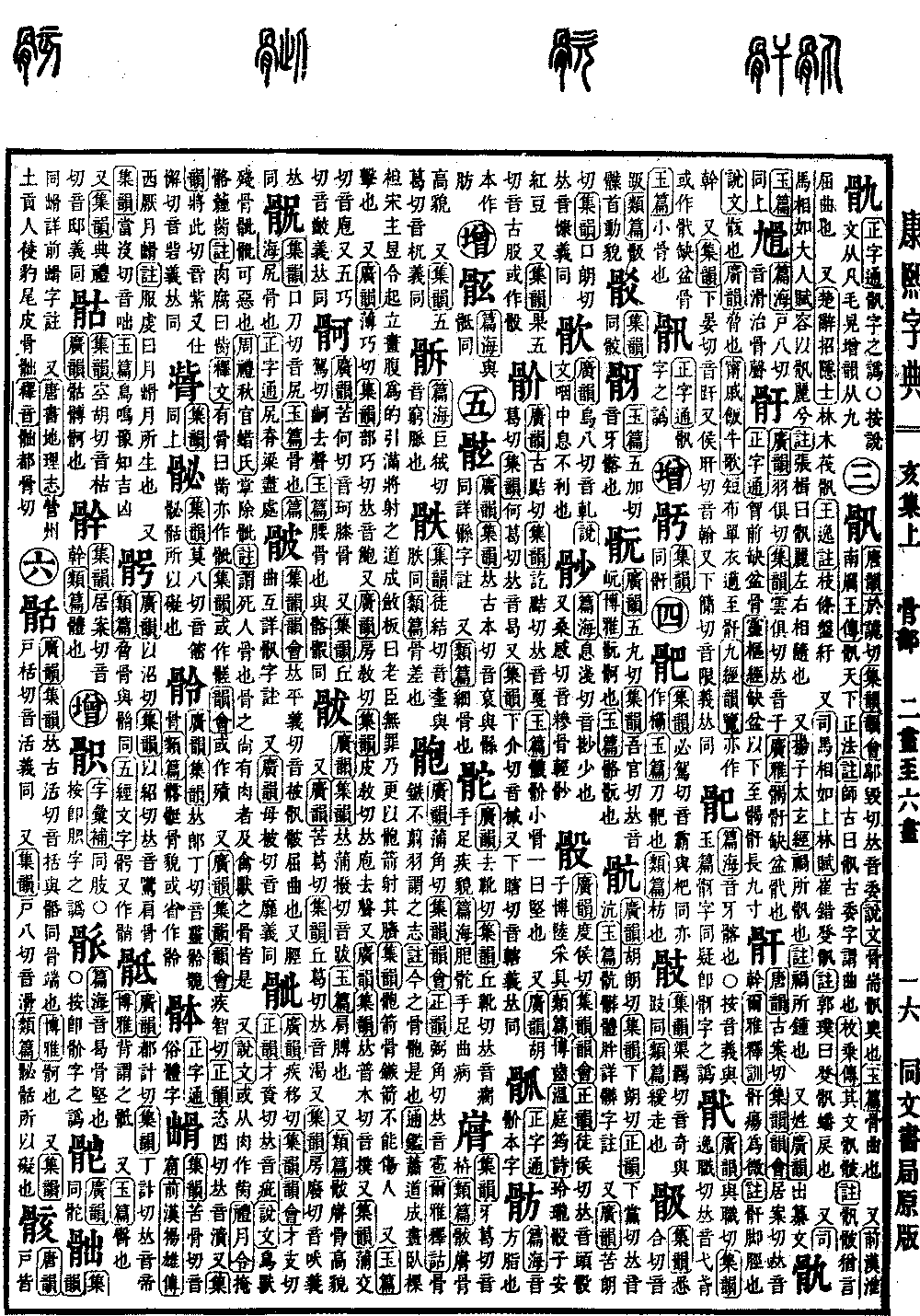
Hai Collection, Upper Volume
Radical: Bone (gǔ)
Kangxi strokes: 15
Page 1448, Entry 30
Broad Rhymes (Guangyun): Pronounced bao. Collected Rhymes (Jiyun), Rhyme Meetings (Yunhui), and Orthodox Rhymes (Zhengyun): Pronounced bao.
Erya: Explanations of Ancient Terms (Erya): A bone arrowhead without clipped feathers is called zhi. Annotation: This refers to what is now known as a bone-tipped blunt arrow (bao).
Comprehensive Mirror (Tongjian): Xiao Daocheng was lying down and naked during the day. Emperor Yu of the Liu Song dynasty ordered him to stand up, drew a target on his abdomen, and fully drew his bow to shoot him. Daocheng clutched his ritual tablet and said: This old subject has committed no crime. The emperor then changed to a bone-tipped blunt arrow to shoot his navel.
Collected Rhymes (Jiyun): A bone-tipped blunt arrow cannot injure a person.
Also, Jade Chapters (Yupian): To strike.
Also, Broad Rhymes (Guangyun): Pronounced bao. Collected Rhymes (Jiyun): Pronounced bao.
Also, Broad Rhymes (Guangyun): Pronounced pao (falling tone). Collected Rhymes (Jiyun): Pronounced pao (falling tone).
Also, Broad Rhymes (Guangyun) and Collected Rhymes (Jiyun): Pronounced pu.
Also, Collected Rhymes (Jiyun): Pronounced pao.
Also, Pronounced yao. The meaning is the same.