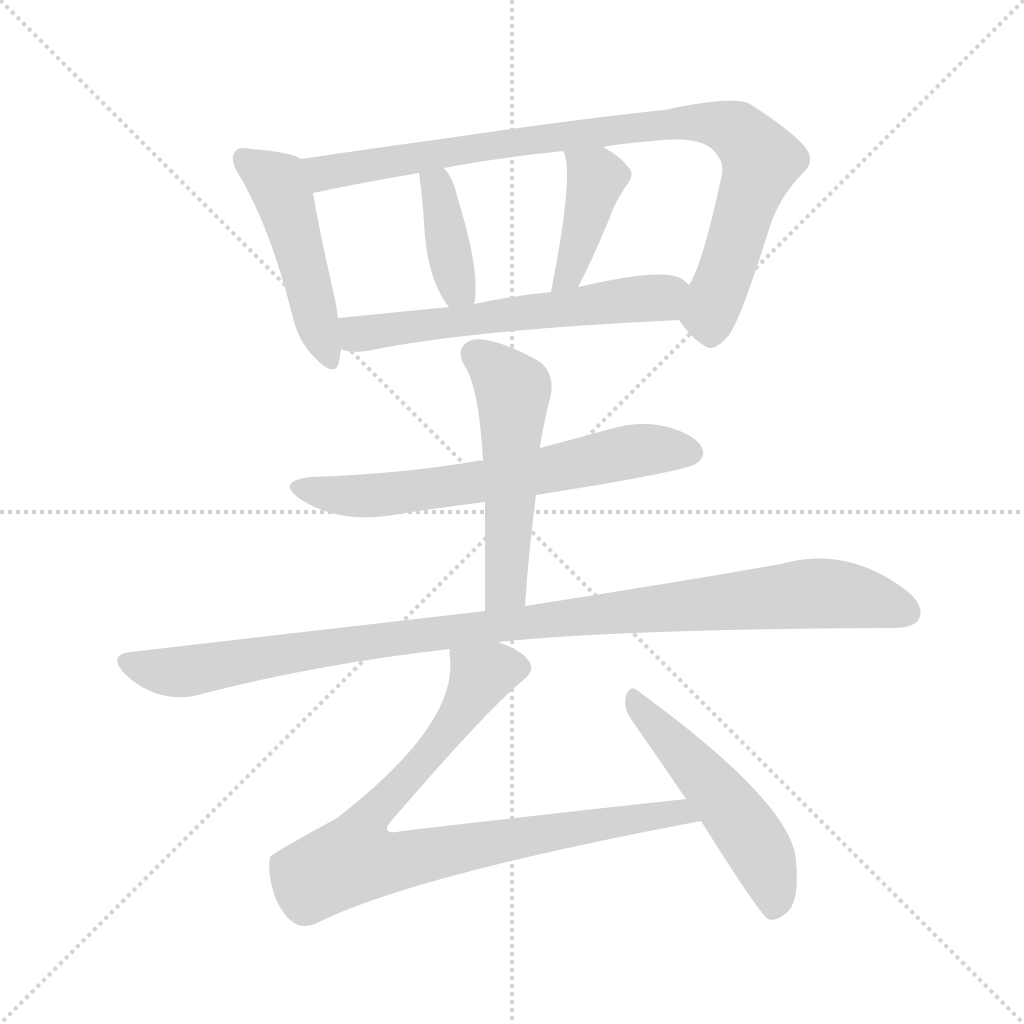
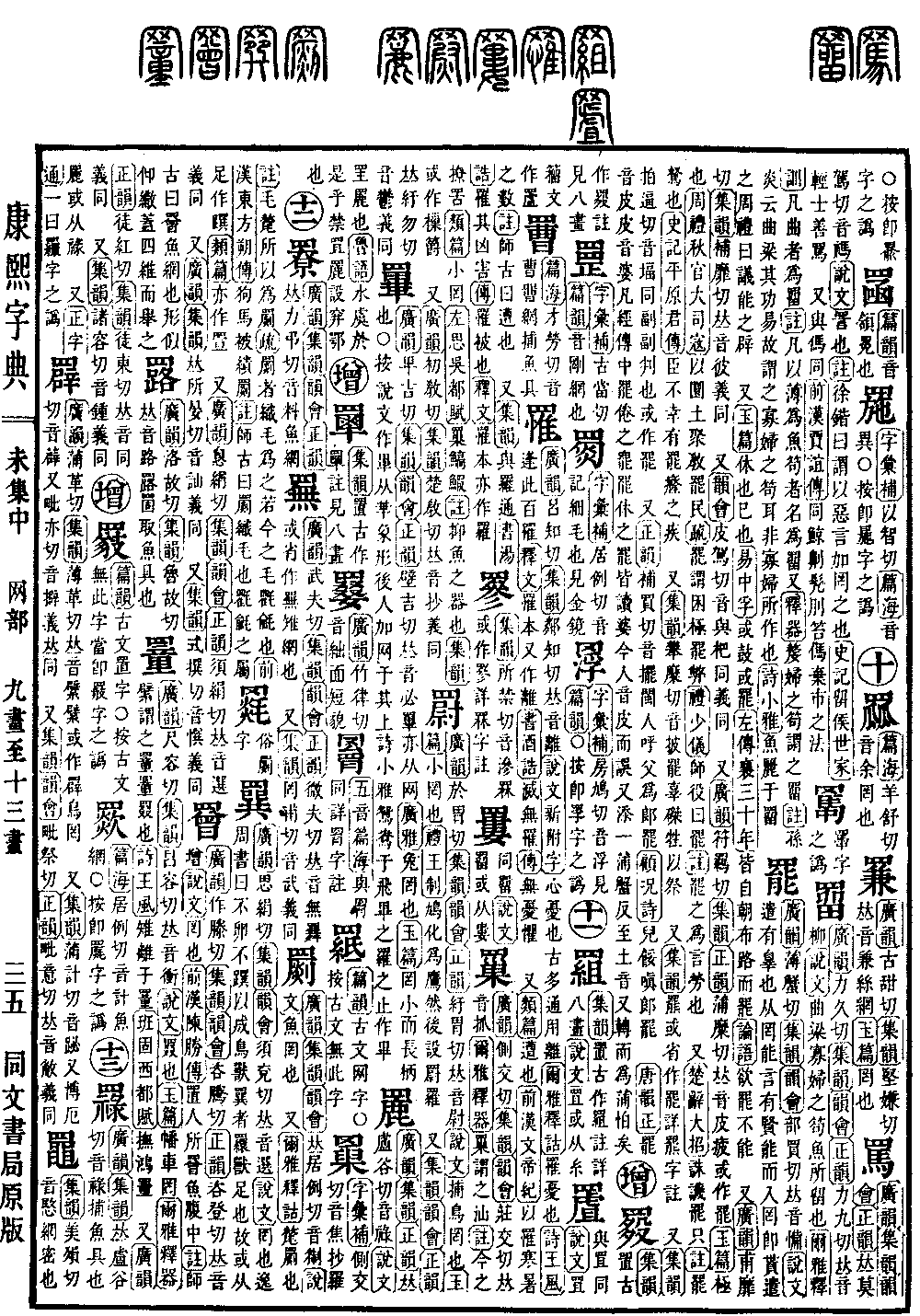
Wei Collection, Middle Volume
Radical: Net (wǎng)
Kangxi Strokes: 16
Page 949, Entry 01
Guangyun: Pronounced bó. Jiyun, Yunhui: Pronounced bù.
Shuowen Jiezi (Shuowen): To dismiss one who has committed a crime. Composed of the radical for net and the character for able. It implies that a person who possesses virtue and ability has been caught in a net, and is therefore forgiven and released. The Rites of Zhou (Zhouli) states: Consider the mitigation of punishments for the able.
Yupian: To rest; to cease.
I Ching (Yijing): Either beating a drum or ceasing.
Zuo Tradition (Zuozhuan): All spread out on the road from the court and dispersed.
Analects (Lunyu): Wishing to cease, but unable to do so.
Guangyun: Pronounced fǔ. Jiyun: Pronounced bǔ. Meaning is the same.
Yunhui: Pronounced pí. Meaning is the same as the character for rake. Meaning is the same.
Guangyun: Pronounced fú. Jiyun, Zhengyun: Pronounced pú. The character for weary is sometimes written as this.
Yupian: Exhausted.
Rites of Zhou (Zhouli): Use a round prison to gather and instruct the weary people.
Commentary: Weary refers to being extremely exhausted and dilapidated.
Book of Rites (Liji): Regarding military service, it is called weary.
Note: Weary is a word referring to exhaustion.
Chu Ci: Criticizing the weary.
Note: Weary means slow or unskilled.
Records of the Grand Historian (Shiji): This subject unfortunately suffers from a weary and chronic illness.
Jiyun: Pronounced pān. A sacrificial rite involving the dismemberment of a sacrificial animal.
Jiyun: The character for brown bear is sometimes abbreviated as this. See the entry for the character for brown bear for details.
Jiyun: Pronounced pāi. Same as the character for secondary. Secondary means to split or divide. Sometimes written as this.
Zhengyun: Pronounced bǎi. People from the Min region address a father as lang-ba.
Gu Kuang poem: The child is hungry and scolds his father.
Tangyun Zheng: This character is pronounced pí. In the classic texts, for the sense of being exhausted or the sense of ceasing, it is always read as pó. Modern people pronounce it as pí, and erroneously added the pronunciation bó, while local dialects have further shifted it to pà.