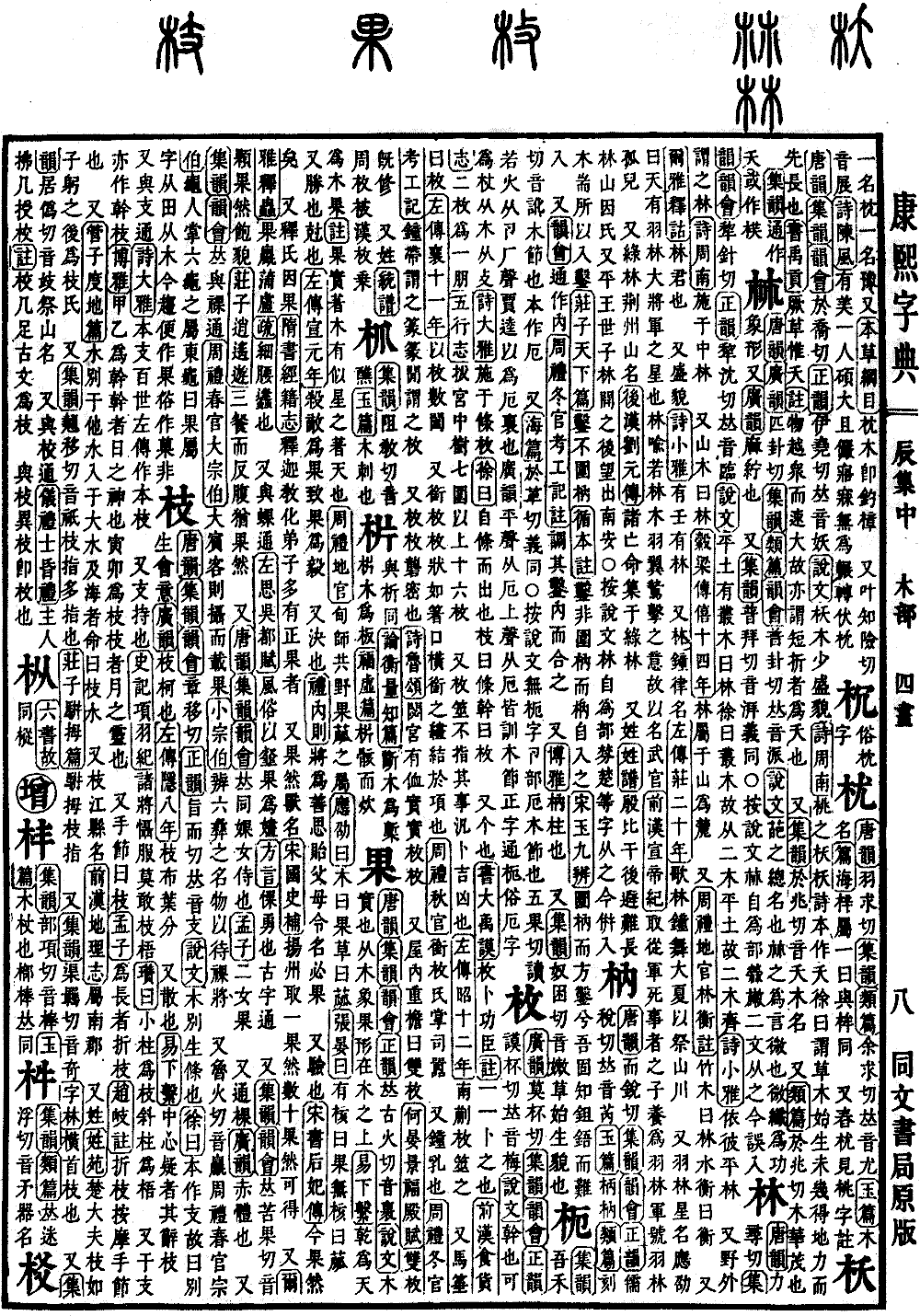
Chen Collection, Middle Volume, Radical: Tree (mù)
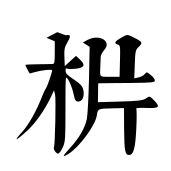
Xi (xī)
Kangxi Stroke Count: 8
Page 515, Entry 08
Classical Chinese:
Pronounced xi (entering tone) according to Tang Yun.
Pronounced xi according to Jiyun and Yunhui.
Pronounced xi according to Zheng Yun.
Meaning: To split wood.
"Book of Odes (Shijing)": "How to split firewood? Without an axe, it cannot be done."
Alternative meaning: To break.
Also means to divide.
"Book of Documents (Shu)" (Yao Dian): "His people are divided."
Kong Anguo's commentary: "Able-bodied men go to work, the old and weak are separated."
Also means to analyze.
Tao Qian's (Jin Dynasty) poem "Moving Residence": "Doubts and meanings are analyzed together."
Also, "Records of the Grand Historian (Shiji)" (Lü Shu): "Yin is called Xi Mu."
Also, a country name.
"Book of Documents (Shu)" (Yu Gong): "Kunlun, Xi Zhi, Qu Sou."
Also, a place name. Xi Cheng, belonging to Ji Province.
Also, a place name.
"Zuo Zhuan" (Duke Xi, 25th year): "Qin has taken Xi."
Also, "Shi Zi": "Rainbows are called Xi Yi."
Also, pronounced si (level tone) according to Leipian.
"Rites of Zhou (Zhou Li)" (Tianguan - Hairen): "Beans offered as food are Xi."
Also, a type of grass. Zhang Yi said: Xi resembles wild oats.
Also, level tone.
Pronounced xi (level tone) according to Tang Yun.
"Records of the Grand Historian (Shiji)" (Wudi Ji): "Xi Zhi Qu Shou."
Suoyin: Written as Xian Zhi Qu Sou. Xian and Xi have similar pronunciations; in ancient times, Xian was read as Si.
Also, pronounced xi (near ci) according to Xi Li Qie.
"Later Han Dynasty" (Western Qiang Biography): "Bordering Ci Zhi."
Note: Ci Zhi is what the "Book of Documents (Shu)" (Yu Gong) refers to as Xi Zhi.
Correction:
"Book of Documents (Shu)" (Yu Gong): "Xi Zhi Qu Sou of the Western Rong." Corrected according to the original text to "Kunlun Xi Zhi Qu Sou."