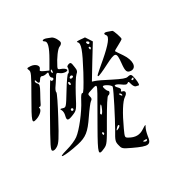
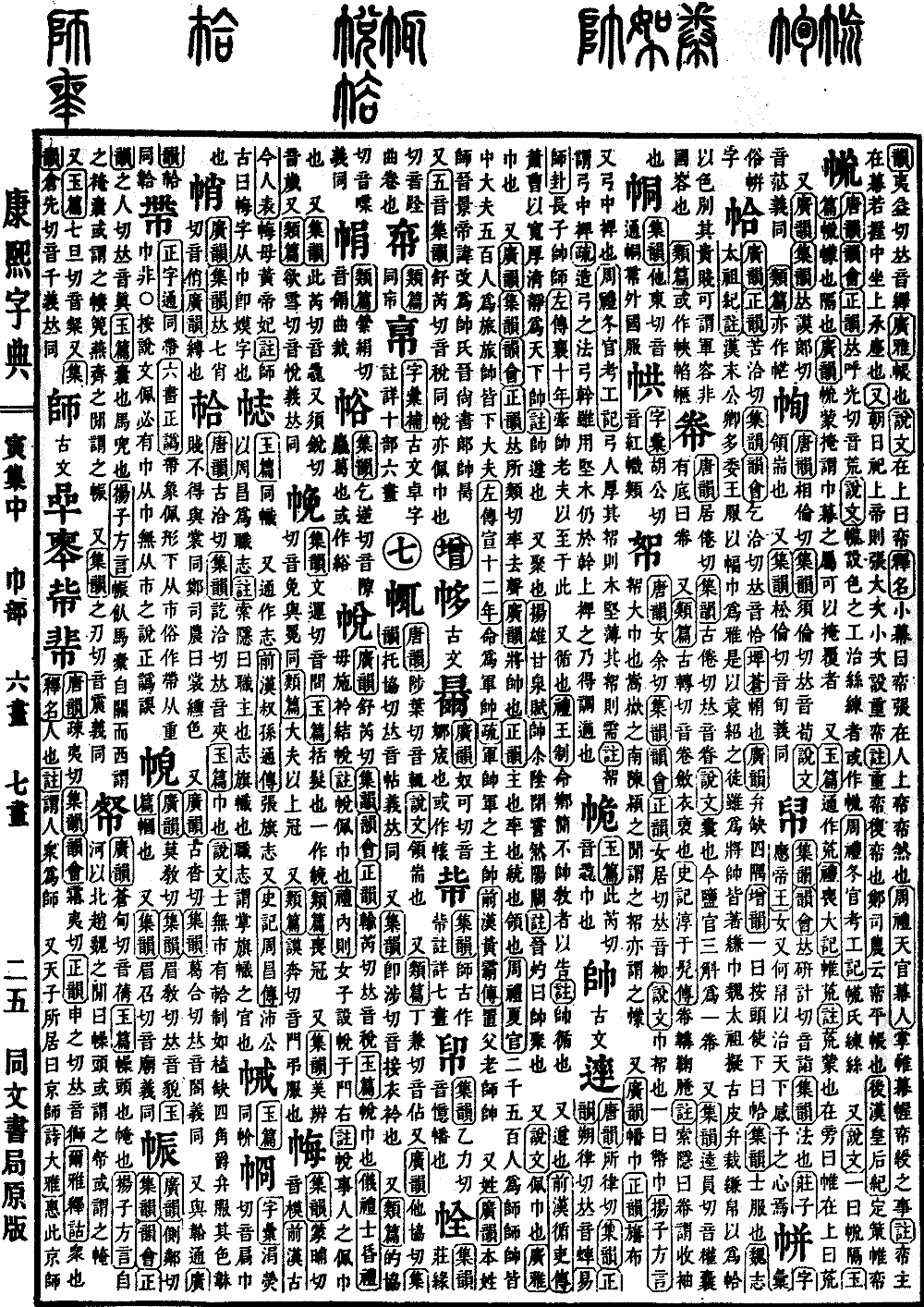
"Tang Yun," "Yun Hui," and "Zheng Yun" (韵书): Pronounced huang (level tone), as in the rhyme group of guang.
"Shuowen Jiezi" (说文解字) explains: 㡛, is a craftsman responsible for dyeing, who processes and boils silk. Sometimes also written as 㡃.
"Zhou Li - Kao Gong Ji" (周礼·冬官考工记) records: The 㡛 clan was responsible for boiling silk.
Also, another explanation in "Shuowen Jiezi": 㡃 has the meaning of obstructing.
"Yupian" (玉篇) explains: 㡃 means to cover and obstruct.
"Guangyun" (广韵) explains: 㡃 refers to covering and concealing, describing things like headscarves and curtains that can be used for covering and concealing.
Also, "Yupian" records: 㡃 is used interchangeably with "huang" (荒).
"Liji - Sang Da Ji" (礼记·丧大记) mentions "wei huang" (帷荒). The commentary states: Huang means to cover. What is beside is called wei (curtain), what is above is called huang.
Also, "Guangyun" and "Jiyun" (集韵) record the pronunciation as mo lang qie (谟郎切), pronounced mang (level tone). The meaning is the same. "Leipian" (类篇) also writes it as .